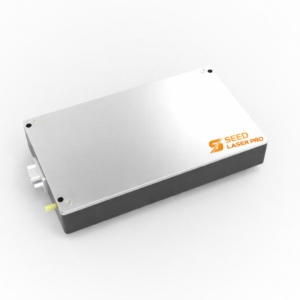
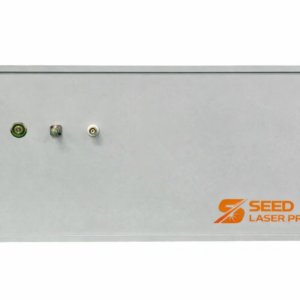
Seed Laser Pro’s 2.0 µm Point Light Source delivers 25 mW of CW output at 1950 nm with M² below 1.05, 0.04 nm spectral bandwidth, and power stability below 0.5% peak-to-peak. The near-diffraction-limited beam quality and eye-safe operating wavelength make it the right choice for spatial positioning, LiDAR calibration, instrument testing, and scientific research where precision spot quality at 2 µm is the primary requirement. Automotive-grade robustness. PM1950 or SM1950 fiber output. Multi-wavelength customization available.
PRODUCT FEATURES
- 25 mW CW at 1950 nm, M² below 1.05, near-diffraction-limited, spectral bandwidth 0.04 nm
- PM1950 or SM1950 fiber output, PER 20 dB, power stability P-P below 0.5%
- Eye-safe 2 µm wavelength, automotive-grade robustness, -10 to 45°C operating range
- Wavelength tuning up to 0.6 nm, SNR 60 dB, 12 VDC, compact 175 x 140 x 25 mm module
TYPICAL APPLICATIONS
- LiDAR system calibration and receiver alignment using eye-safe 2 µm point source
- Scientific research and experimental setups requiring a stable 1950 nm CW reference source
- Device testing and measurement of 2 µm fiber components, detectors, and optical systems
- Industrial processing alignment and spatial positioning at micrometer-level precision
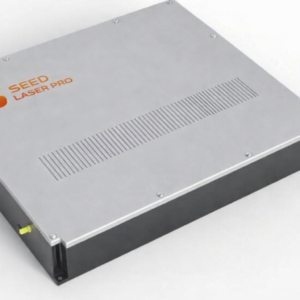
Seed Laser Pro’s 2.0 µm Ultra-Narrow Linewidth Single-Frequency Laser delivers 10 mW of CW output at 1950 nm with sub-10 kHz linewidth and PM1950 or SM1950 fiber output. It bridges the gap between the 2.0 µm Industrial Seed at sub-50 kHz and Hz-level sources; delivering the narrower linewidth that precision spectroscopy, coherent detection, and high-resolution gas sensing require, in the same compact 175 × 140 × 25 mm module format. M² below 1.1, PER above 23 dB, FC/APC connector, -10 to 45°C operating range.
PRODUCT FEATURES
- Sub-10 kHz linewidth, single-mode CW at 1950 nm, optical SNR above 55 dB, M² below 1.1
- PM1950 or SM1950 output, PER above 23 dB, FC/APC connector, 0.6 m fiber customizable
- Power stability P-P below 1%, operating range -10 to 45°C, 5 or 12 VDC
- Compact 175 x 140 x 25 mm module, OEM and custom wavelength configurations available
TYPICAL APPLICATIONS
- High-precision molecular spectroscopy resolving CO2, H2O, and CO absorption features at 2 µm
- Coherent detection and coherent sensing systems requiring narrow-linewidth 2 µm CW illumination
- Medical laser applications at 1950 nm for surgical and therapeutic fiber delivery systems
- Coherent Doppler LiDAR and gas detection at 2 µm requiring sub-10 kHz seed source
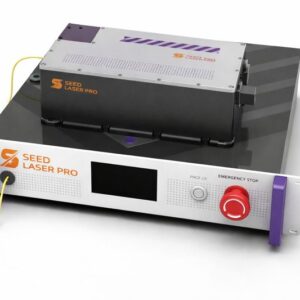
266 nm sits in the UV-C band, four times the wavelength of the 1064 nm fundamental. Reaching it requires fourth-harmonic generation from a near-infrared fiber seed. Doing it with narrow linewidth requires that every conversion stage preserves the spectral quality of the starting source.
Seed Laser Pro’s 266 nm Single-Frequency Laser delivers 5 to 15 mW of CW output at 266 nm. Linewidth is 5 to 25 kHz. Power stability holds at 1% RMS over three hours. Wavelength tuning range covers 50 to 150 pm. Free-space output with M² below 1.3 and 1.0 mm typical beam diameter.
Built for semiconductor material processing, UV fluorescence analysis, photochemistry, and precision UV spectroscopy. Custom wavelength configurations are available.
PRODUCT FEATURES
- Fourth-Harmonic Generation at 266 nm : CW output at 266 nm produced through two sequential second-harmonic generation steps from a 1064 nm single-frequency fiber seed. The conversion chain is designed to preserve narrow linewidth at each stage. The 266 nm output inherits the spectral purity of the fiber source.
- Sub-25 kHz Linewidth : Linewidth between 5 and 25 kHz at 266 nm. Coherence length at this linewidth exceeds several kilometers. Sufficient for high-resolution UV spectroscopy, interferometric measurements, and precision material processing where coherence quality affects the result.
- Active Power Stabilization : Output power stable at 1% RMS over three hours of continuous operation. Adjustable from 10 to 100% of the set output level throughout operation.
- Clean Free-Space Output : M² below 1.3, 0.8 to 1.2 mm beam diameter, beam waist within 1 m of the output port. Fits standard optical tables at 290 × 500 × 130 mm.
TYPICAL APPLICATIONS
- Semiconductor Processing and Inspection : 266 nm photons carry 4.66 eV per photon. That energy level exceeds the bandgap of many semiconductor and dielectric materials, enabling direct photochemical processing without the thermal damage that longer UV wavelengths cause. Narrow linewidth CW output supports both direct processing and interferometric inspection of processed surfaces.
- Material Analysis and UV Fluorescence : Many organic molecules, aromatic compounds, and biological markers have absorption and fluorescence excitation bands in the 260 to 270 nm range. A single-frequency, narrow-linewidth 266 nm source provides selective excitation of specific spectral features that broadband UV lamps cannot resolve.
- Photochemistry Research : Photochemical reactions initiated at 266 nm are used in polymer synthesis, photocatalysis, and photodegradation studies. Narrow linewidth allows wavelength-selective excitation of specific reactant absorption bands for controlled reaction chemistry.
- UV Spectroscopy and Metrology : Sub-25 kHz linewidth at 266 nm supports high-resolution absorption spectroscopy of UV-active species and interferometric metrology of UV optical components. Both applications require coherence far beyond what pulsed or broadband UV sources provide.
Need a custom configuration? Central wavelength is customizable. OEM integration, custom power levels, and engineering support available at the design stage.
Seed Laser Pro’s 509 nm single-frequency laser delivers 0.05 to 3 W of CW output at 509.4 nm with 2 to 10 kHz linewidth. Built for cesium Rydberg atom research, cold atom physics, and solar cell processing. Free-space and fiber output available. Custom wavelength configurations on request.
PRODUCT FEATURES
- Sub-10 kHz linewidth, single longitudinal mode CW output at 509.4 nm
- Output power 0.05 to 3 W, adjustable from 10 to 100%, RMS stability below 0.7%
- Wavelength tuning range 100 to 300 pm, polarization extinction ratio 20 to 25 dB
- Free-space or fiber output, M² below 1.1, 0.7 to 1.1 mm beam diameter
TYPICAL APPLICATIONS
- Cesium Rydberg atom physics and two-step Cs excitation at 509 nm combined with 852 nm
- Cold atom physics, state-selective detection, and photoionization experiments
- Solar cell characterization and photovoltaic laser processing at peak silicon quantum efficiency
- Medical and dermatological applications in the green wavelength band
Green lasers are common. A 532nm low noise laser with single longitudinal mode operation, sub-10 kHz linewidth, and M² below 1.1 is not.
Techwin’s 532 nm frequency-converted laser produces 0.05 to 4 W of continuous-wave green output through second harmonic generation from a single-frequency fiber seed. Linewidth sits between 2 and 10 kHz. Output power stability holds at 0.3% RMS over six hours. Wavelength tuning range reaches 200 pm typically. Both free-space and fiber output options are available. This is a precision green laser source built for applications where intensity noise, beam quality, and spectral purity determine the quality of the result.
PRODUCT FEATURES
- High-Efficiency Nonlinear Frequency Conversion: Second harmonic generation from a single-frequency fiber seed produces 532 nm output with high conversion efficiency. The green output inherits the single longitudinal mode operation and low phase noise of the fiber seed, giving this laser its low noise character at 532 nm.
- M² Below 1.1 Beam Quality: Near-perfect Gaussian beam profile with output beam diameter of 0.7 to 1.2 mm and beam waist position within 1 m of the output port. Directly usable in tight-focus applications without additional spatial filtering.
- Intelligent Power Stabilization: Active output power stabilization holds RMS power stability at 0.3% over six hours of continuous operation. Power adjustable from 10 to 100% of the set output level.
TYPICAL APPLICATIONS
- Precision Processing: Low noise, stable output power, and near-diffraction-limited beam quality make this laser suitable for precision microfabrication, laser scribing, and material processing applications where beam quality and power consistency directly affect process quality.
- Biomedical Applications: 532 nm green light is strongly absorbed by oxyhemoglobin and melanin, making it the standard wavelength for retinal photocoagulation, dermatological treatments, and fluorescence excitation in biological imaging. The low noise and stable output of this system minimize unwanted tissue effects from power fluctuations.
- Scientific Instruments and Quantum Optics: Single-frequency, narrow-linewidth 532 nm output is used in holography, interferometry, Raman spectroscopy, optical tweezers, and as a pump source for optical parametric oscillators targeting visible and near-infrared wavelengths. Low intensity noise is the primary requirement across all of these.
780.24 nm is the rubidium D2 line. Every laser cooling experiment, magneto-optical trap, atom interferometer, and rubidium atomic clock built around rubidium atoms needs a laser locked to this transition. Techwin’s 780 nm frequency-converted laser is purpose-built for that requirement.
The output is generated through second harmonic generation from a 1560 nm single-frequency fiber seed laser. The 780 nm output inherits the narrow linewidth, single longitudinal mode operation, and low phase noise of the fiber seed directly. High-efficiency nonlinear frequency conversion technology and power stabilization produce stable, low-noise output at 780 nm in a compact module format ready for integration into cold atom physics platforms and quantum sensing instruments.
PRODUCT FEATURES
- High-Efficiency SHG Frequency Conversion: Second harmonic generation from a 1560 nm single-frequency fiber seed produces 780 nm output with conversion efficiency optimized through nonlinear crystal design and optical path optimization. The 780 nm output carries the spectral purity of the fiber seed.
- Excellent Beam Quality: Near-diffraction-limited beam quality from the fiber-based source, optimized through beam quality correction in the output stage. Suitable for direct free-space coupling into vacuum chambers and optical setups without additional spatial filtering.
- Power Stabilization: Active power stabilization keeps output power consistent across operating conditions. Stable output power is a direct requirement for controlled optical pumping efficiency in rubidium cooling and trapping experiments.
TYPICAL APPLICATIONS
- Rubidium Laser Cooling and Magneto-Optical Trapping: The 780 nm D2 transition of rubidium-85 and rubidium-87 is the standard wavelength for laser cooling, magneto-optical trapping, and Bose-Einstein condensate experiments. This laser provides the frequency-stable, narrow-linewidth output required to maintain resonance with the D2 line throughout the cooling and trapping sequence.
- Atom Interferometry and Quantum Sensing: Rubidium atom interferometers used in gravimetry, inertial navigation, and fundamental physics require a 780 nm source with tight frequency control and stable output. This frequency-converted laser provides the spectral characteristics atom interferometric systems demand.
- Scientific Instruments and Atomic Physics Research: Rubidium atomic clocks, Rydberg atom experiments, quantum computing platforms using rubidium qubits, and precision spectroscopy all operate at or near the 780 nm D2 line. This laser serves as the primary light source for any rubidium-based experiment requiring single-frequency, stable 780 nm illumination.
Seed Laser Pro’s 795 nm single-frequency laser is built around the rubidium D1 transition. It delivers 0.05 to 4 W of CW output at 795 nm with 2 to 5 kHz linewidth and power stability below 0.8% RMS. Designed for SERF magnetometers, rubidium atomic physics, and precision measurement systems. Free-space and fiber output available. Custom wavelength on request.
Product Features
- Sub-5 kHz linewidth, single longitudinal mode CW output at 795 nm
- Output power 0.05 to 4 W, adjustable 10 to 100%, RMS stability below 0.8%
- Wavelength tuning range 100 to 300 pm, polarization extinction ratio 20 to 26 dB
- Free-space or fiber output, M² below 1.1, 0.7 to 1.1 mm beam diameter
Typical Applications
- SERF magnetometers requiring frequency-stable optical pumping at the rubidium D1 line
- Rubidium atomic physics, optical pumping, and spin-exchange relaxation-free experiments
- Precision magnetic field measurement for medical imaging, navigation, and geophysics
- Quantum optics, polarization squeezing, and rubidium D1 spectroscopy research
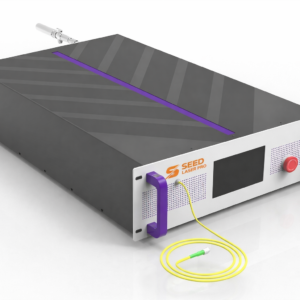
Intensity noise is the hidden limit in most high-precision laser systems. You can have excellent linewidth, stable output power, and perfect polarization. But if your RIN floor is too high, the laser itself becomes the noise source your measurement is fighting against.
Techwin’s Broadband Ultra-Low-Noise Single-Frequency Fiber Laser removes that limit. At 1064 nm, it delivers RIN below -150 dB/Hz across the full 100 Hz to 10 GHz bandwidth and below -160 dB/Hz at 10 MHz. Linewidth holds at 1 kHz typical. Frequency noise sits at below 100 Hz²/Hz at 1 kHz. Output power is adjustable from 0.05 W to 5 W through PM980 fiber with 20 dB polarization extinction ratio.
Built on a DBR resonator architecture with multidimensional active and passive noise suppression. Designed for distributed acoustic sensing, precision interferometry, high-precision coherent detection, and any application where the laser noise floor is the measurement limit.
PRODUCT FEATURES
- RIN Below -160 dB/Hz at 10 MHz: The lowest RIN tier available in Techwin’s 1064 nm product range. RIN below -150 dB/Hz is maintained across the full 100 Hz to 10 GHz measurement bandwidth. This noise floor is comparable to what Thorlabs’ ULN series and Coherent’s Mephisto target in their premium low-noise laser lines, in a fiber-based architecture.
- DBR Architecture with Multidimensional Noise Suppression: The distributed Bragg reflector cavity combines passive structural noise suppression with active feedback loops targeting both intensity and frequency noise simultaneously. The result is 1 kHz typical linewidth and below 100 Hz²/Hz frequency noise at 1 kHz offset.
- Wide Power Range: 0.05 W to 5 W: Output power adjustable from 30 to 100% of set level across the full 0.05 to 5 W range. Single longitudinal mode and RIN performance are maintained across the full adjustment range, not only at one operating point.
TYPICAL APPLICATIONS
- Distributed Acoustic Sensing (DAS): DAS systems use coherent Rayleigh backscattering from a fiber cable to detect vibration, acoustic events, and strain along the sensing fiber. The sensitivity of the measurement is set by the phase noise and RIN of the laser source. A laser with high RIN produces intensity fluctuations in the backscattered signal that mimic real acoustic events. This laser’s RIN floor below -160 dB/Hz keeps the noise contribution of the source well below the signal level in high-sensitivity DAS deployments.
- High-Precision Coherent Detection: Coherent receivers for optical sensing and ranging mix the received signal with a local oscillator copy of the transmitted laser. The shot-noise-limited sensitivity of coherent detection is achievable only when the laser’s RIN is below the shot noise floor. At -160 dB/Hz, this laser reaches that floor, making it suitable for shot-noise-limited coherent detection architectures.
- Precision Interferometric Measurement: Laser interferometers for displacement sensing, surface profiling, and gravitational wave detection research all require both narrow linewidth and low intensity noise. Linewidth determines coherence length. RIN sets the measurement noise floor at DC and low frequencies. This laser provides both with the RIN floor below -150 dB/Hz that precision interferometric systems require.
You cannot publish a linewidth specification without measuring it. And measuring it accurately, especially below 10 kHz, is harder than it looks.
Techwin’s Laser Linewidth Measurement System uses the delayed self-heterodyne interferometry (DSHI) principle to measure laser linewidths down to 2 kHz. An AOM provides the frequency shift. High-sensitivity balanced detectors and a low-noise RF amplifier extract weak beat signals cleanly. A high-resolution spectrum analyzer captures the output. The system covers C-band, 1 µm, and 2 µm wavelength bands, handles narrow linewidth fiber lasers and semiconductor sources, and integrates vibration isolation to keep environmental interference out of the measurement.
Built for laser R&D teams, photonics manufacturers, and research laboratories that need repeatable, traceable linewidth measurements without building a measurement setup from scratch.
PRODUCT FEATURES
- DSHI-Based Measurement Down to 2 kHz — The delayed self-heterodyne method uses a long fiber delay line and an AOM frequency shifter to beat the laser against a decorrelated copy of itself. The beat signal carries the linewidth information directly. No reference laser required. Measurements down to 2 kHz linewidth are achievable.
- High-Sensitivity Balanced Detection — Low-noise balanced detectors and high-linearity amplifiers ensure accurate extraction of weak noise signals near the measurement floor. Balanced detection suppresses common-mode intensity noise, keeping the system noise below the laser noise being measured.
- Vibration Isolation Design — A dedicated vibration isolation structure reduces environmental interference from acoustic and mechanical sources. This is essential for narrow-linewidth measurements where floor vibrations and acoustic noise can artificially broaden the measured beat spectrum and produce false readings.
Measuring laser relative intensity noise accurately is harder than it looks. The laser noise you are trying to measure is often buried under detector noise, amplifier noise, and shot noise. Without the right detection architecture, what you measure is the instrument floor – not the laser.
Seed Laser Pro’s Laser Noise Measurement System uses low-noise balanced photodetection, high-linearity amplifiers, and combined FFT and RF spectrum analysis to measure RIN from near the quantum limit at -160 dB/Hz up to frequencies above 10 MHz. Measurable bands cover C-band, 1 µm, 780 nm, 2 µm, and visible wavelengths. The system characterizes full noise power spectral density from DC to the GHz range in a single integrated setup, with vibration isolation built in. No additional test equipment required.
PRODUCT FEATURES REWRITE
- Near Quantum Limit: -160 dB/Hz RIN Floor: Wide dynamic range measurement from near the shot noise limit at -160 dB/Hz through high-frequency ranges above 10 MHz. Covers the full noise spectrum of CW fiber lasers and semiconductor sources, from low-frequency technical noise through to relaxation oscillation peaks in the GHz range.
- High-Sensitivity Balanced Detection: Low-noise balanced detectors suppress common-mode noise from the detector and amplifier chain, dropping the instrument floor well below the laser noise being measured. High-linearity amplifiers keep measurement accurate across the full dynamic range without compression artefacts.
- Multi-Band FFT and RF Analysis Combined: Integrated baseband FFT analyzer and RF spectrum analyzer cover the full noise PSD from DC to the GHz range from the same detector output. No instrument switching. No calibration gaps at the handover frequency.
- Vibration Isolation Design: A dedicated vibration isolation structure decouples the optical components from floor and acoustic noise. Low-frequency environmental interference is a real source of measurement error in sensitive RIN setups. This design eliminates it.
TYPICAL APPLICATIONS REWRITE
- Fiber Laser Production QC: Every single-frequency fiber laser shipped with a RIN specification needs a system that can verify it. This system covers the wavelength bands and dynamic range required for production testing of Ytterbium, Erbium, and Thulium band fiber lasers at RIN levels down to -160 dB/Hz.
- Semiconductor Laser Characterization: DFB semiconductor lasers, Fabry-Perot diodes, and VCSEL sources all produce RIN spectra with distinct features including relaxation oscillation peaks, low-frequency technical noise, and shot noise floors. The combined FFT and RF analysis covers the full relevant frequency range for semiconductor source characterization in both R&D and production environments.
- Scientific Research and Quantum Optics: Experiments in gravitational wave detection, cold atom physics, optical lattice clocks, and quantum sensing all specify laser RIN as a hard requirement. Researchers verifying that laser sources meet experiment requirements, or optimizing active noise suppression feedback systems, use this system to measure what their laser is actually delivering.