Where This Sits in the 2.0 µm Product Line
Three linewidth tiers cover the 2.0 µm single-frequency seed range at Seed Laser Pro.
| Product | Linewidth | Best For |
| 2.0 µm Industrial Seed Source | Sub-50 kHz | MOPA seeding, mid-IR pumping, general 2 µm use |
| This laser | Sub-10 kHz | Precision spectroscopy, coherent detection, high-res sensing |
| 2.0 µm High-Power MOPA range | Sub-30 kHz at power | High-power applications above 50 mW |
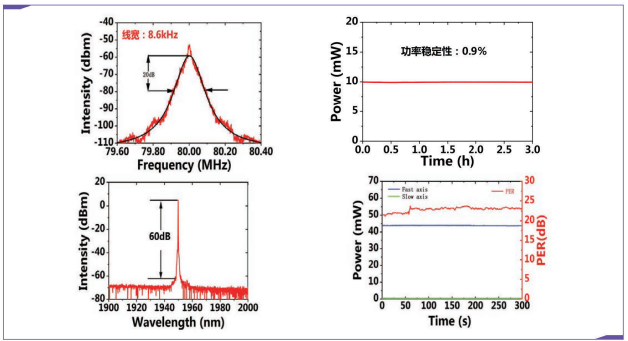
Sub-10 kHz linewidth at 1950 nm gives a coherence length above 9 km. For high-resolution absorption spectroscopy where the laser linewidth must be small relative to the molecular absorption feature being resolved, this is the minimum viable specification. CO2 absorption lines at 2 µm have Doppler-broadened widths on the order of 300 to 500 MHz at room temperature. Sub-10 kHz is four orders of magnitude narrower — more than sufficient spectral resolution for any absorption feature in this band.
For the industrial-grade seed at sub-50 kHz, see the 2.0 µm Industrial Single-Frequency Seed Source. For high-power 2 µm output above 50 mW, see the 2.0 µm high-power single-frequency laser range.
Precision Spectroscopy at 2 µm: Why Linewidth Matters Here
Tunable diode laser absorption spectroscopy (TDLAS) at 2 µm measures gas concentrations by tuning the laser across a molecular absorption feature and detecting the transmitted intensity change. The measurement sensitivity and selectivity depend on how precisely the laser can be positioned on and scanned across the target absorption line.
A sub-50 kHz source covers this well for most gas sensing setups. Sub-10 kHz linewidth improves the situation in two ways. First, it increases the on-resonance extinction ratio when the laser is tuned to the absorption peak — a narrower laser loses a larger fraction of its power at line center compared to a broader source. Second, it reduces the noise floor in frequency-modulation spectroscopy schemes where laser frequency noise directly converts to intensity noise at the detector.
For cavity-enhanced spectroscopy at 2 µm, where the laser is locked to a high-finesse optical cavity and absorption is measured through the cavity, sub-10 kHz linewidth is a practical requirement. Locking a sub-50 kHz source to a cavity with finesse above 10,000 is challenging. Sub-10 kHz linewidth makes the locking bandwidth requirement achievable with standard electro-optic modulator and PZT feedback electronics.
Coherent Detection at 1950 nm
Coherent optical detection at 2 µm uses the interference between a received optical signal and a local oscillator copy of the transmitted laser. Detection sensitivity scales with local oscillator power and coherence. Sub-10 kHz linewidth provides a coherence length above 9 km; far exceeding any practical coherent detection path length requirement in LiDAR or free-space sensing at this wavelength.
The PM1950 fiber output maintains a defined polarization state at the local oscillator input to the coherent receiver. This is required for polarization-sensitive coherent detection architectures where the local oscillator and signal must have matching polarization states to produce maximum fringe visibility on the detector.
OEM and Custom Configuration
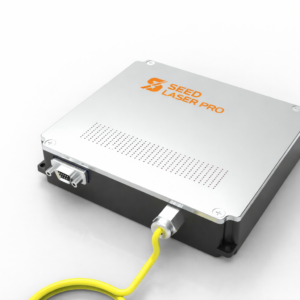
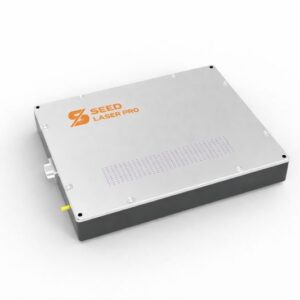
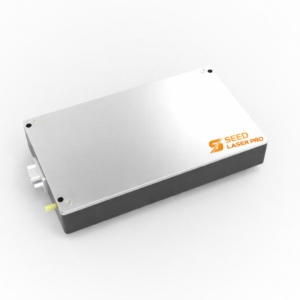
Standard module: 175 × 140 × 25 mm, 5 or 12 VDC, PM1950 or SM1950 output, 0.6 m fiber, FC/APC connector.
Custom options available:
- Wavelength within 1940 to 2000 nm Thulium gain band
- Output fiber length and connector type
- SM1950 or PM1950 output selection
- OEM integration format for instrument enclosure mounting
Contact Seed Laser Pro’s engineering team with your specification and delivery geography.
Frequently Asked Question
What is the difference between this and the 2.0 µm Industrial Seed Source?
Both operate at 1950 nm in the same compact 175 × 140 × 25 mm module. The Industrial Seed specifies sub-50 kHz linewidth and is optimized for MOPA seeding and mid-IR pumping. This ultra-narrow version achieves sub-10 kHz linewidth — five times narrower — for applications requiring higher spectral resolution, such as cavity-enhanced spectroscopy, coherent detection, and high-resolution gas sensing where the broader industrial seed would limit system performance.
Why is sub-10 kHz linewidth important for cavity-enhanced spectroscopy?
Cavity-enhanced spectroscopy locks the laser to a high-finesse optical cavity to extend the effective absorption path length. Locking requires the laser linewidth to be narrower than the cavity linewidth. For a cavity with finesse of 10,000 and a free spectral range of 150 MHz, the cavity linewidth is 15 kHz. Sub-10 kHz linewidth makes this locking requirement achievable with standard feedback electronics. Sub-50 kHz linewidth makes it significantly harder.
Is PM1950 output required for coherent detection?
PM1950 output is required when the coherent receiver uses a polarization-sensitive beam combiner or balanced detector that requires matching polarization between the local oscillator and signal inputs. Most fiber-based coherent receivers at 2 µm use PM fiber throughout and require a PM local oscillator source. SM1950 output is available for setups where polarization is managed with external optics after the laser output.
Can this laser be used in a TDLAS gas sensing system at 2 µm?
Yes. Sub-10 kHz linewidth is well suited for TDLAS targeting CO2 and H2O absorption features at 1950 nm. The laser can be thermally tuned across the target absorption feature within the available tuning range. For faster wavelength scanning required in some TDLAS modulation schemes, contact Seed Laser Pro to discuss modulation bandwidth options.
Is this available for OEM integration in medical devices?
Yes. The all-fiber design, compact form factor, stable CW output, and -10 to 45°C operating range suit integration into 2 µm medical laser platforms. Contact Seed Laser Pro with device specification and delivery geography.