Why 2.0 µm When 1064nm Exists
The 1064nm Ytterbium band is the most mature fiber laser wavelength. Large ecosystem, high efficiency, widely available components. For coherent ranging, interferometry, and 532 nm generation, it is the right choice.
But it cannot reach what Thulium can.
The 2.0 µm band covers strong water vapor absorption for wind LiDAR, tissue absorption for surgical systems, and CO2 molecular features for atmospheric sensing. These are not edge cases. They are applications where 1064nm simply does not produce usable results regardless of power level.
Both architectures follow the same MOPA principle. A short-cavity single-frequency seed sets the spectral quality. A fiber amplifier chain scales the power. PM fiber output throughout. The difference is entirely in what the wavelength unlocks.
For 1064nm seed requirements, see Seed Laser Pro’s 1064nm industrial single-frequency seed laser. For complete 2.0 µm high-power systems, see the high-power single-frequency fiber lasers in the 2.0 µm range.
All-Fiber Industrial Construction
No free-space elements. No alignment-sensitive optical mounts. No periodic recalibration.
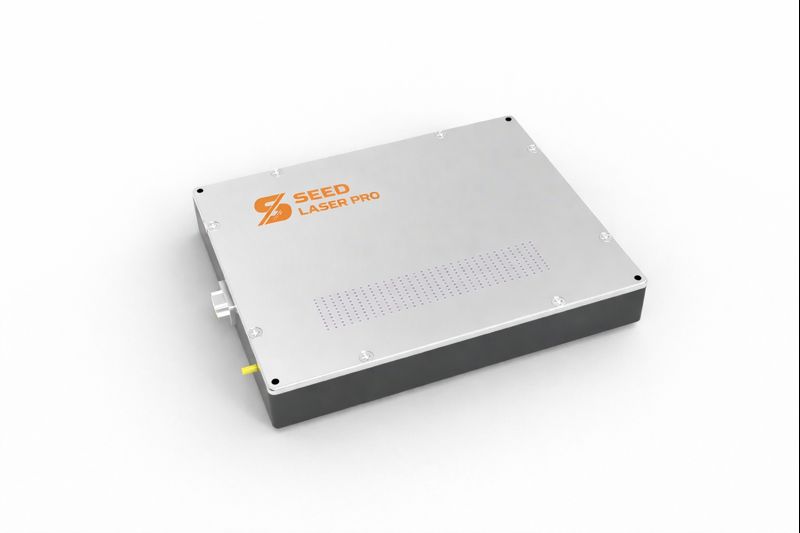
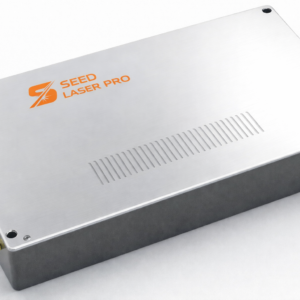
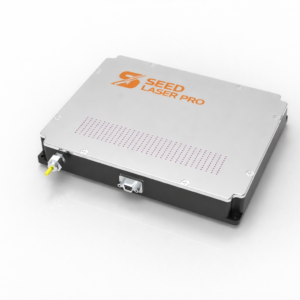
The all-fiber design seals every optical interface inside fiber splices and PM fiber connectors. The laser maintains its specifications across the -10 to 45°C operating range without user intervention. Compact 175 × 140 × 25 mm module fits directly into OEM instrument enclosures.
For field-deployed LiDAR systems and continuously running medical laser platforms, that reliability is a design requirement, not a bonus feature.
Using This as a MOPA Seed
The seed laser defines the spectral ceiling of the entire amplified system. Amplifier stages add power. They cannot add coherence or fix noise that originates at the seed.
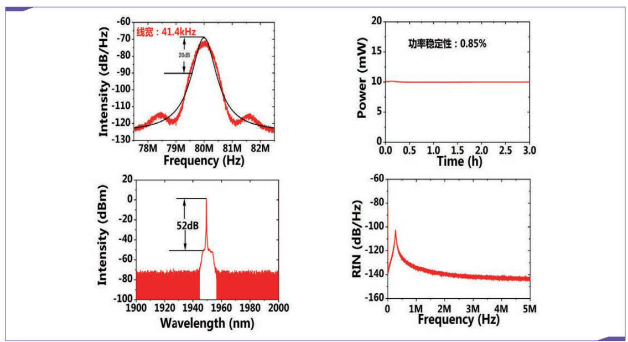
Sub-50 kHz linewidth, mode-hop-free operation, and P-P power stability below 1% are specified to match the input requirements of Thulium fiber amplifier stages. PM1950 output connects directly to PM amplifier input without mode conversion or polarization adjustment.
This source can also be used standalone for low-power spectroscopy, gas sensing, and instrument calibration before a full MOPA chain is integrated.
FAQ SECTION
What is a 2.0 µm Thulium-doped fiber laser?
A single-frequency laser using Thulium-doped silica fiber to produce CW output at 1950 nm. At the seed level, it delivers sub-50 kHz linewidth and single longitudinal mode operation as the master oscillator in MOPA systems.
How does this compare to a 1064nm seed laser?
Same MOPA architecture and PM fiber output standard. Different gain medium and wavelength. 1064nm targets coherent ranging, interferometry, and 532 nm conversion. This 2.0 µm seed targets mid-IR pumping, wind LiDAR, and surgical systems that 1064nm cannot address.
What is mode-hop-free operation?
The laser maintains continuous single-mode output without sudden frequency jumps as conditions vary within the specified range. Mode hops corrupt coherent detection and destabilize downstream amplifiers. Mode-hop-free operation is a baseline requirement for MOPA seeding.
Can this be used without a downstream amplifier?
Yes. 10 mW output is sufficient for spectroscopy, gas sensing, and calibration setups. It is also used as a standalone source during system development before the amplifier chain is added.
Is PM1950 compatible with standard PM components?
PM1950 uses standard FC/APC connectors but requires 2.0 µm-specified components throughout. Standard telecom PM components at 1310 nm or 1550 nm are not compatible. Confirm all downstream components are rated for the 2.0 µm band.