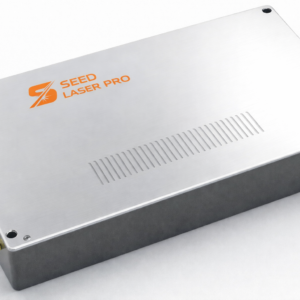
Why Phase Modulation Exists in a Seed Laser
This product requires a different way of thinking about linewidth.
For spectroscopy, coherent detection, and interferometry, narrow linewidth is the goal. The 2 µm single-frequency seeds in Seed Laser Pro’s range achieve sub-10 kHz and sub-50 kHz linewidth for exactly those applications.
For high-power MOPA amplification through single-mode fiber, narrow linewidth becomes a problem. Stimulated Brillouin Scattering is the limiting nonlinear effect. SBS converts forward-propagating signal light into backward-propagating Stokes noise when the optical power density in the single-mode core exceeds the SBS threshold. That threshold is inversely related to the spectral width of the signal — a narrower-linewidth signal has a lower SBS threshold.
A sub-10 kHz seed laser at 2 µm hits the SBS limit in a standard PM1950 fiber amplifier at output powers well below 1W. To reach 10W, 100W, or 500W through single-mode fiber, the linewidth must be broadened beyond the SBS phonon bandwidth, which is approximately 50 to 100 MHz at 2 µm.
Phase modulation accomplishes this. An electro-optic phase modulator in the seed stage applies a controlled frequency modulation that spreads the optical power across a GHz-range linewidth. The 0.1 to 5 GHz adjustable range in this product allows the linewidth to be set precisely for the SBS threshold requirement of each amplifier configuration.
For the kilowatt-class 2 µm systems, see Seed Laser Pro’s 2.0 µm 20 to 500W high-power single-frequency laser which uses this seeding principle at maximum power scale.
Linewidth Selection: How to Choose the Right Setting
The adjustable 0.1 to 5 GHz range is not arbitrary. Each setting corresponds to a different SBS suppression level and therefore a different achievable output power in the downstream amplifier.
| Linewidth Setting |
Approximate SBS Threshold Gain |
Typical Amplifier Output Range |
| 0.1 GHz |
Moderate SBS suppression |
Up to approximately 5 to 10W |
| 0.5 GHz |
Good SBS suppression |
Up to approximately 20 to 50W |
| 1 GHz |
Strong SBS suppression |
Up to approximately 100W |
| 5 GHz |
Maximum SBS suppression |
Up to several hundred watts |
These are approximate figures that depend on fiber length, core size, and amplifier architecture. The exact setting required for your system depends on the specific amplifier chain design. Seed Laser Pro’s engineering team can advise on the correct linewidth setting for your power requirements.
Application Context
High-Power 2 µm LiDAR Transmitters
Coherent Doppler wind LiDAR and atmospheric sensing systems at 2 µm require maximum average transmit power to achieve long detection ranges. Fiber-coupled transmitters use single-mode fiber to deliver power to the transceiver optics. SBS is the primary limitation on achievable CW power through that fiber. A phase-modulated seed with GHz-range linewidth raises the SBS threshold, allowing the amplifier chain to reach its thermal limit rather than its SBS limit — typically 5 to 10 times higher power delivery than a narrow-linewidth seed would permit.
Medical and Material Processing Systems
High-power 2 µm fiber laser systems for soft tissue surgery and material processing at 1950 nm operate at output powers from watts to kilowatts. At these power levels, SBS suppression in the final fiber amplifier stage and the delivery fiber is a fundamental design requirement. This phase-modulated seed source provides the GHz-linewidth input that these systems need, in a compact module that integrates into the seed stage of the amplifier chain.
Gas Sensing with High-Power Sources
Some gas sensing architectures use high-power pulsed or CW 2 µm sources for long-path differential absorption measurements. In these systems, spectral resolution is provided by the measurement architecture rather than laser linewidth, and maximum output power from the amplifier chain determines detection range and sensitivity. The phase-modulated seed optimizes for power delivery in these setups.
What This Laser Is Not Suitable For
Phase modulation broadens linewidth to GHz range. This makes the source unsuitable for:
- High-resolution molecular spectroscopy (requires sub-MHz linewidth)
- Coherent Doppler detection (requires sub-kHz linewidth for Doppler resolution)
- Cavity-enhanced absorption spectroscopy (requires linewidth narrower than cavity linewidth)
- Interferometric sensing (requires long coherence length)
For these applications, see Seed Laser Pro’s 2.0 µm ultra-narrow linewidth laser at sub-10 kHz or the 2.0 µm industrial seed source at sub-50 kHz.
Frequently Asked Question
What does phase modulation do in a seed laser?
An electro-optic phase modulator applies a time-varying phase shift to the CW output of the seed laser. In the frequency domain, this spreads the single optical frequency into a GHz-range spectrum. The spectral width can be controlled by adjusting the modulation amplitude. At 2 µm, this controlled linewidth broadening raises the SBS threshold in downstream fiber amplifiers by a factor proportional to the ratio of the modulated linewidth to the SBS phonon bandwidth, allowing much higher amplifier output power than a narrow-linewidth seed would permit.
Why is adjustable linewidth from 0.1 to 5 GHz useful?
Different amplifier architectures and output power targets require different SBS suppression levels. A system targeting 10W output needs less SBS suppression than one targeting 500W. Setting the linewidth to the minimum required for each system’s SBS threshold avoids unnecessary spectral broadening that is irrelevant to the application. Seed Laser Pro’s engineering team can advise on the linewidth setting appropriate for your specific amplifier design.
Can this seed be used for spectroscopy or interferometry?
No. GHz-range linewidth corresponds to a coherence length of centimeters to tens of centimeters. This is insufficient for interferometry, coherent sensing, or high-resolution spectroscopy. For those applications, see the 2.0 µm ultra-narrow linewidth laser at sub-10 kHz or the industrial seed at sub-50 kHz.
What is the difference between PM1950 and SM1950 output for MOPA seeding?
PM1950 output is required when the downstream Thulium fiber amplifier uses PM gain fiber throughout. PM-to-PM fiber splicing maintains polarization state along the amplifier chain, which is required for polarization-sensitive output stages. SM1950 output is used when the amplifier architecture is not polarization-maintaining or when polarization is managed at a later stage in the chain.
Is custom linewidth within 0.1 to 5 GHz available?
Yes. The phase modulation drive can be set to any linewidth within the 0.1 to 5 GHz range. Contact Seed Laser Pro with your target linewidth, downstream amplifier architecture, and required output power to confirm the appropriate setting and configuration.