Why 1550nm for a Point Light Source
A point light source at 1550nm combines three practical advantages that no other near-infrared wavelength provides together.
First, 1550nm is eye-safe. The cornea absorbs radiation at this wavelength before it reaches the retina. For calibration, alignment, and testing applications where a beam is routinely directed toward optical systems being adjusted, eye-safe operation is a meaningful safety advantage compared to 1064nm sources of equivalent power.
Second, 1550nm has the largest fiber optic component ecosystem of any wavelength. PM1550 fiber couplers, isolators, circulators, patch cables, and detectors are all available off-the-shelf in standard configurations. This makes integration into existing test setups, instrument designs, and calibration fixtures straightforward without custom fiber components.
Third, ±0.2nm wavelength tuning at 1550nm corresponds to approximately ±25 GHz of frequency tuning, which is enough to position the output at specific detector response peaks, etalon resonances, or atmospheric transmission windows relevant to the system being tested or calibrated.
For broadband testing across the full C-band rather than a precision point reference, see Seed Laser Pro’s 1.5 µm ASE Light Source covering 1528 to 1567nm with 39nm bandwidth.
Point Light Source vs Seed Laser: What the Difference Means
Seed Laser Pro’s 1550nm product range includes both seed lasers and point light sources. These are not interchangeable.
| Feature | Seed Lasers | This Point Light Source |
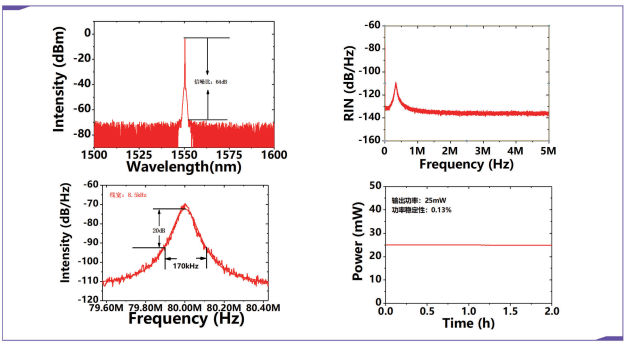
| Linewidth | Sub-kHz to sub-25 kHz explicitly specified | 0.04nm spectral bandwidth (approx 5 GHz) |
| Primary role | Master oscillator for MOPA or frequency locking | Reference source for testing, calibration, imaging |
| Power level | 20 to 50 mW seed stage | 25 mW fixed |
| Beam quality spec | M² specified | Near-diffraction-limited |
| Target buyer | Laser system integrator | Instrument builder, lab researcher, test engineer |
A point light source optimizes for spatial precision, stability, and ease of use as a reference. A seed laser optimizes for spectral purity and downstream amplification compatibility. Both operate at 1550nm but serve fundamentally different positions in a photonic system.
For seed laser requirements at 1550nm, see Seed Laser Pro’s 1.5 µm High-Reliability Single-Frequency Seed Source.
LiDAR Receiver Calibration and Alignment
A 1550nm LiDAR receiver requires a stable, well-characterized illumination source during assembly, alignment, and calibration. The point light source provides a defined spatial reference at the receiver input focal plane, with stable power output and ±0.2nm tuning range for matching the source wavelength to the receiver’s spectral filter passband.
Eye-safe operation at 25mW output allows calibration work to proceed in standard laboratory and production environments without the additional controls required for 1064nm sources at equivalent power. The PM1550 fiber output delivers a well-defined polarization state to receivers using polarization-sensitive detection, which is increasingly common in coherent LiDAR architectures.
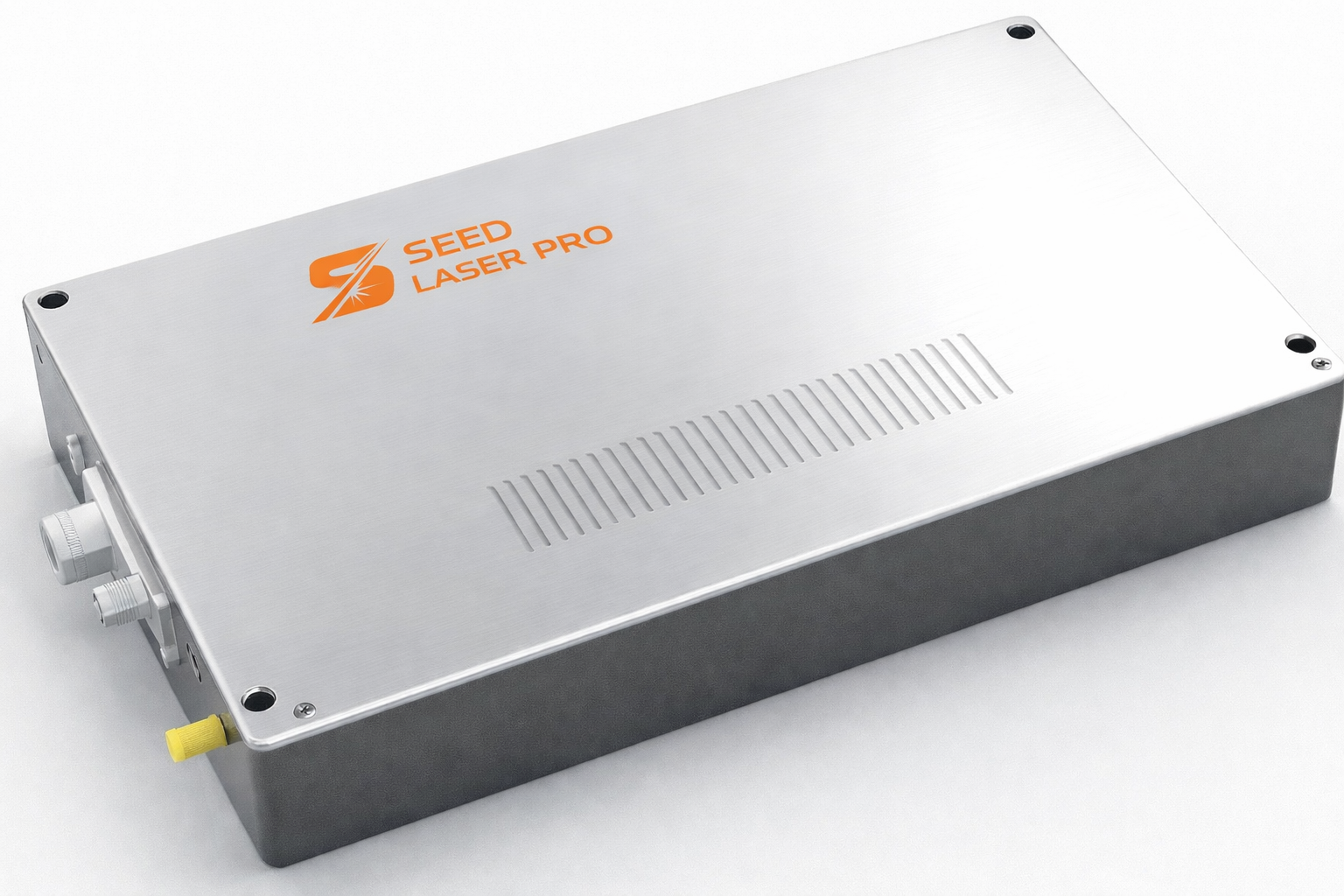
The miniaturized 175 × 140 × 25 mm form factor suits integration into automated test fixtures and production-line calibration stations where space is constrained.
Quantum Technology and Precision Medical Imaging
In quantum technology instrument testing, a stable, tunable 1550nm reference source is used to characterize detector response, verify filter alignments, and calibrate wavelength-dependent components before integration into quantum communication or quantum sensing platforms. The 0.04nm spectral bandwidth provides a sharp enough spectral reference for most component characterization tasks at 1550nm without requiring a fully spectrally-pure single-frequency source.
In precision infrared imaging and medical applications, 1550nm sources are used for illumination in non-invasive sensing, tissue characterization, and optical coherence tomography setups where the eye-safe wavelength and stable output power are practical requirements.
Frequently Asked Questions
What is a 1550nm point light source?
A 1550nm point light source is a compact, stable CW laser at 1550nm designed to serve as a well-characterized reference illumination source for testing, calibration, alignment, and measurement applications. Unlike a seed laser optimized for narrow linewidth and MOPA seeding, this product is optimized for spatial precision, output stability, wavelength tunability, and ease of integration into test setups. The 0.04nm spectral bandwidth and PM1550 fiber output provide a clean, defined reference at 1550nm in a miniaturized module.
Why does eye-safe wavelength matter for a calibration source?
At 1550nm, the cornea absorbs incident radiation before it reaches the retina, providing natural protection at the power levels used in calibration and testing. At 1064nm, equivalent power levels can cause retinal damage. For beam alignment, detector calibration, and instrument testing tasks where a beam is routinely directed toward optical systems being adjusted, eye-safe operation simplifies safety procedures and is often required by workplace laser safety protocols in production and field environments.
What is the difference between this and the 1.5µm ASE Light Source?
The 1.5µm ASE Light Source produces 39nm of broadband output across 1528 to 1567nm for component characterization requiring full C-band coverage. This point light source produces 25mW in a 0.04nm narrow band at a specific wavelength within 1530 to 1560nm, with ±0.2nm tuning. Use the ASE source for broadband insertion loss and spectral transmission measurements. Use this point source for targeted single-wavelength detector calibration, LiDAR receiver alignment, and applications requiring a defined narrow reference wavelength.
Can the fiber length and wavelength be customized?
Yes. Output fiber length above 0.8m is the standard, with customizable lengths available. The ±0.2nm wavelength tuning range allows positioning within the 1530 to 1560nm range, and custom wavelength configurations within the C-band are available on request. Contact Seed Laser Pro with your wavelength, power, and fiber requirements.
Is this product suitable for OEM integration in an instrument?
Yes. The compact 175 × 140 × 25 mm form factor, 5 VDC operation, and PM1550 fiber output with FC/APC connector suit direct OEM integration into instrument enclosures and test fixtures. Custom fiber length, connector type, and operating voltage options are available. Contact Seed Laser Pro’s engineering team with your integration specification.