seed laser pro

Showing all 7 results

Featured Products

  • Hz-Level Ultra-Narrow Linewidth Single-Frequency Fiber Laser

    25 Hz linewidth. That number puts this laser in a category most fiber lasers cannot enter. Techwin’s Hz-level linewidth laser operates at 1550 nm with a measured linewidth below 25 Hz, frequency noise down to 15 Hz²/Hz at 10 kHz offset, and a polarization extinction ratio above 23 dB through PM1550 fiber output. It is a single-frequency, single longitudinal mode, continuous-wave source built for experiments and systems where anything above sub-kHz performance is simply not enough — gravitational wave detection, cold atom physics, optical frequency standards, and high-sensitivity coherent sensing.

    Product Features

    • 25 Hz Linewidth, Hz-Level Phase Noise: Linewidth below 25 Hz with frequency noise of 15 Hz²/Hz at 10 kHz and 100 Hz²/Hz at 1 kHz. This is the performance tier required for gravitational wave interferometers, optical atomic clocks, and cold atom experiments.
    • Ultra-Low Phase Noise Across Decades of Frequency: Frequency noise is characterized from 10 Hz to 10 kHz offset, with a flat noise floor that supports coherence lengths and phase stability well beyond what sub-kHz lasers can achieve.
    • PM1550 Fiber Output with High PER: Linear polarization output through PM1550 fiber with polarization extinction ratio above 23 dB. M² below 1.1. Directly compatible with downstream PM fiber amplifiers, electro-optic modulators, and interferometric systems.

    Typical Applications

    1. Gravitational Wave Detection: LIGO and Virgo-class interferometers require a laser with Hz-level frequency stability sustained over hours of measurement. This laser provides the spectral floor those systems demand.
    2. Cold Atom Physics and Quantum Sensing: Laser cooling and magneto-optical trapping require precise resonance with atomic transitions. Hz-level linewidth ensures the laser stays on resonance with Doppler-broadened features in rubidium, cesium, and strontium cooling experiments.
    3. Coherent Communication and Precision Measurement: Long-haul coherent communication systems and precision interferometers both benefit from the extended coherence length that Hz-level linewidth provides. Coherence length at 25 Hz linewidth exceeds thousands of kilometers.
  • Kilowatt-Class Fiber Laser for Combustion Diagnostics

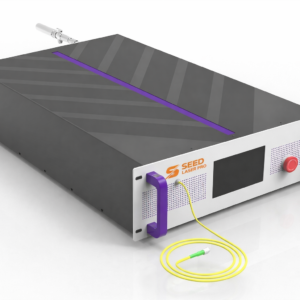
    Combustion diagnostic systems demand a laser that can handle kilowatt-level output while maintaining the spectral control that makes gas species measurements meaningful. This 2 µm fiber laser is built specifically for that requirement. It operates at a central wavelength of 1950 nm, produces 1 to 1.2 kW of continuous-wave output, and holds a linewidth of 3.9 GHz through phase-modulated linewidth broadening in a multi-stage MOPA architecture. Single longitudinal mode operation is maintained throughout the full power range. Designed and manufactured by Techwin with fully independent IP, this system is used in combustion diagnostics, high-temperature industrial processing, and medical laser applications.

    Product Features

    • Phase-Modulated Linewidth Broadening: LiNbO3 phase modulation raises the Stimulated Brillouin Scattering (SBS) threshold, enabling kilowatt-level power delivery through single-mode fiber without nonlinear degradation.
    • Kilowatt-Class Single-Mode Output: 1 to 1.2 kW CW output with M² below 1.5, maintaining beam quality that TDLAS and coherent sensing systems require at high power.
    • Multi-Stage MOPA Architecture: A signal-modulated seed source drives a distributed-pumping, multi-stage amplifier chain. Power scales without linewidth broadening or mode degradation.

    Application

    • Combustion Diagnostics: TDLAS-based temperature and species concentration measurement in gas turbines, scramjets, and industrial combustors. The 2 µm wavelength covers strong absorption features of H2O and CO2 produced in combustion environments.
    • Industrial Processing: High-power 2 µm laser delivery for material processing, cutting, and surface treatment applications where the Thulium band’s strong water absorption improves coupling into polymer and biological materials.
    • Medical Applications: Surgical and therapeutic applications in the 2 µm band, where strong water absorption in tissue enables precise, low-collateral-damage energy delivery.
  • High-Sensitivity Magnetic Detection Laser

    The 1083 nm wavelength is not arbitrary. It corresponds to the 2³S1 to 2³P transition of helium-3, the atomic line used in spin-exchange optical pumping magnetometers, quantum sensing platforms, and geomagnetic field measurement systems. A laser operating at this wavelength must be frequency-stabilized to stay on resonance, narrow in linewidth to interact efficiently with the atomic transition, and stable enough to support long-duration data acquisition without recalibration.

    Techwin’s High-Sensitivity Magnetic Detection Laser is designed around those requirements. It delivers a frequency-stabilized, narrow-linewidth output at 1083 nm in a compact module format, built for integration into quantum magnetometer instruments, geomagnetic survey systems, and scientific research setups where magnetic field sensitivity is the primary measurement objective.

    Product Features

    • High Frequency Stability: Advanced frequency-stabilization technology holds the output on the helium-3 atomic transition line throughout continuous operation, ensuring resonance is maintained without manual intervention.
    • Low Noise Output: Low relative intensity noise and stable output power allow weak magnetic field signals to be resolved without the laser itself contributing to the measurement noise floor.
    • High Environmental Adaptability: Designed to operate reliably across a wide temperature range and in field-deployed environments, not only on a laboratory optical bench.
    • Compact, Integration-Ready Module: The compact mechanical form factor allows direct integration into magnetometer instruments, quantum sensing platforms, and OEM scientific systems.
    • Stable Long-Term Performance: Output power and frequency characteristics remain within specification over extended operating periods, supporting long-duration geomagnetic surveys and continuous sensing deployments.

    Appllications

    • Quantum Magnetometry: Optically pumped helium-3 magnetometers use the 1083 nm transition to achieve sub-femtotesla magnetic field sensitivity. This laser provides the frequency-stabilized, narrow-linewidth source those systems require to pump the helium vapor cell efficiently and maintain resonance during measurement.
    • Geomagnetic Detection and Survey: Ground-based and airborne geomagnetic survey instruments rely on optically pumped magnetometers for high-sensitivity field mapping. The compact form factor and stable frequency output of this laser make it suitable for instrument integration in mobile and field-deployed systems.
    • Scientific Research and Atomic Physics: Research experiments involving helium metastable states, spin-exchange relaxation-free (SERF) magnetometer development, and fundamental studies of atomic magnetic interactions all require a reliable, narrow-linewidth 1083 nm source.
  • High-Power Light Source for Long-Range High-Resolution LiDAR

    Long-range coherent LiDAR systems need a laser that delivers high output power without giving up the spectral purity that makes coherent detection work. This 1550 nm fiber laser does both.

    Built on a three-stage MOPA architecture, it produces 20 to 120 W of continuous-wave output at sub-kHz linewidth, with single longitudinal mode operation maintained across the full power range. Nonlinear effect suppression and noise suppression are integrated into the amplifier chain, keeping phase noise and intensity noise within the limits coherent receivers require. PM and non-PM fiber output options, multiple connector formats including QBH and QCS collimator, and output power adjustable from 5 to 100% make this a coherent LiDAR light source that integrates directly into existing transceiver architectures.

    PRODUCT FEATURES

    • 20 to 120 W Output at Sub-kHz Linewidth: Output power from 20 W to 120 W with a linewidth of 0.5 to 0.8 kHz maintained across the full power range. High power and narrow linewidth are delivered together, not traded off against each other.
    • Integrated Noise Suppression: Nonlinear effect suppression and noise suppression are built into the three-stage MOPA amplifier chain. Phase noise and intensity noise stay within the limits that coherent detection systems require without external filtering.
    • Flexible Output Configurations: PM and non-PM fiber output options. Connector formats include bare fiber, QBH armored, and QCS collimator. Output power continuously adjustable from 5 to 100%.

    APPLICATIONS 

    • Long-Range Coherent LiDAR: Coherent LiDAR systems detect wind velocity, atmospheric turbulence, and hard targets at ranges from kilometers to hundreds of kilometers. The system requires a laser source with high output power, sub-kHz linewidth, and low phase noise to achieve the coherence length and signal-to-noise ratio those ranges demand. This laser is built for that role.
    • Remote Sensing and Environmental Monitoring: Coherent Doppler wind LiDAR, aerosol backscatter systems, and atmospheric profiling instruments operate at 1550 nm where eye-safe power levels and mature fiber component ecosystems reduce system complexity. Sub-kHz linewidth at 80 W typical output provides the coherence and power needed for long measurement paths.
    • Material Inspection and Industrial Sensing: High-power single-mode output at 1550 nm is used in coherent ranging systems for dimensional metrology, structural health monitoring, and industrial surface inspection where measurement range and resolution requirements exceed what lower-power sources can support.
  • Frequency Stabilized Fiber Laser 1550 nm for Precision Sensing

    Sensing systems live or die by the quality of their light source. A laser that drifts in frequency during a measurement run corrupts the data. One that fluctuates in power degrades the signal-to-noise ratio. One that responds to temperature and vibration introduces noise you cannot always trace back to the source.

    Techwin’s frequency stabilized fiber laser at 1550 nm is built to eliminate those variables. It holds wavelength drift within 500 kHz RMS over two hours. Output power stability sits at 0.5% peak-to-peak. A dual closed-loop frequency stabilization system handles both short-term and long-term drift independently, and intelligent environmental compensation keeps performance consistent across real operating conditions. PM1550 output with 20 to 21 dB polarization extinction ratio. Designed for fiber optic sensing, high-resolution spectroscopy, and weak signal detection where the laser itself must not be the limiting factor.

    PRODUCT FEATURES

    • Dual Closed-Loop Frequency Stabilization — Two independent stabilization loops control short-term frequency noise and long-term frequency drift separately. Short-term noise is suppressed through fast feedback. Long-term drift is corrected through slow thermal control. The result is wavelength stability within 500 kHz RMS over two hours of continuous operation without manual intervention.
    • Breakthrough Noise Suppression — Relative intensity noise and phase noise are both actively suppressed. The 55 dB optical signal-to-noise ratio and 0.5% peak-to-peak output power stability give sensing systems a clean signal floor to work from.
    • Intelligent Environmental Compensation — Temperature, humidity, and mechanical perturbations are monitored and compensated in real time. Performance stays within specification across operating conditions, not only in a temperature-controlled laboratory.

    APPLICATIONS 

    • Fiber Optic Sensing — Distributed acoustic sensing (DAS), fiber Bragg grating interrogation, and Brillouin scattering-based sensing systems all require a laser source with stable frequency and low phase noise. Frequency drift during a sensing measurement shifts the interference condition and corrupts the spatial resolution of the system. This laser holds the frequency within 500 kHz over two hours, keeping the sensing baseline stable.
    • High-Resolution Spectroscopy — Resolving fine spectral features in gas absorption spectroscopy, cavity-enhanced spectroscopy, and optical frequency measurement requires a laser whose center frequency is both narrow and stable. 20 kHz linewidth at 1550 nm gives a coherence length above 7,000 km. Frequency stability within 500 kHz over two hours keeps the laser on the spectral feature throughout the measurement window.
    • Precision Measurement and Weak Signal Detection — Interferometric displacement sensing, coherent optical ranging, and weak signal detection in fiber networks all benefit from a laser whose noise floor is well below the signal being measured. The combination of low RIN, stable output power, and dual closed-loop frequency control makes this laser suitable for measurement setups where the noise budget is tight.
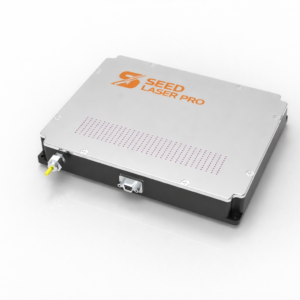
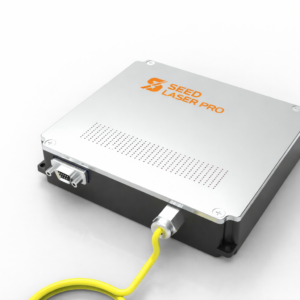
  • Compact Single Frequency Fiber Laser

    Most single frequency fiber lasers are not designed with size or power consumption in mind. They perform well on a bench. They are harder to justify when the system needs to be portable, battery-operated, or integrated into a compact instrument.

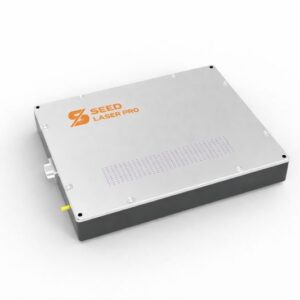
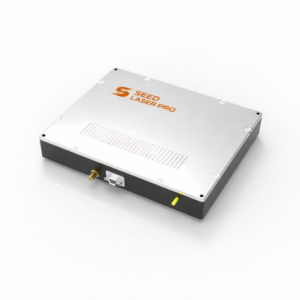
    This laser is different. At 100 × 90 × 25 mm and 6 W power consumption, it is the smallest single frequency fiber laser in Techwin’s range. It operates across the 1030 to 1080 nm Ytterbium band with sub-100 kHz linewidth, M² below 1.05, and PM980 fiber output with 20 dB polarization extinction ratio. Output power is fixed at 40 mW with RMS stability below 0.2%.

    Built for portable sensing instruments, medical and bio-imaging systems, coherent communication modules, and any OEM application where board space, weight, and power draw are real constraints alongside optical performance.

    PRODUCT FEATURES REWRITE

    • Compact OEM Form Factor: 100 × 90 × 25 mm — The smallest single frequency module in the Techwin range. Fits directly into portable instrument enclosures and handheld device designs where a standard 175 × 140 mm laser module would not.
    • 6 W Power Consumption — Low enough for battery-powered portable systems and thermally constrained instrument designs. No active cooling required under normal operating conditions.
    • Sub-100 kHz Linewidth, M² Below 1.05 — Single longitudinal mode CW output at sub-100 kHz linewidth with near-perfect beam quality. RIN below -130 dBc/Hz at 5 MHz and RMS power stability below 0.2% support sensing and imaging applications where noise performance matters.

    TYPICAL APPLICATIONS REWRITE

    • Precision Measurement and Portable Sensing — Field-deployed sensing instruments, handheld interferometers, and compact fiber sensing interrogators all have size and power constraints that full-size laser modules cannot meet. This laser fits those form factor requirements without trading away the linewidth and noise performance precision sensing demands.
    • Medical and Bio-Imaging — Optical coherence tomography probes, confocal microscopy systems, and biomedical imaging instruments require compact, low-power laser sources that can be integrated into clinical instruments without adding bulk or heat. The 1030 to 1080 nm Ytterbium band provides good tissue penetration for near-infrared imaging applications.
    • Coherent Communication — Short-reach coherent optical links, lab-on-chip coherent systems, and research setups evaluating coherent modulation formats at 1 µm require a compact, stable single-frequency source. This laser provides single longitudinal mode CW output in PM980 fiber at a power level suited to direct modulator input.

  • Broadband Ultra-Low-Noise Single-Frequency Fiber Laser

    Intensity noise is the hidden limit in most high-precision laser systems. You can have excellent linewidth, stable output power, and perfect polarization. But if your RIN floor is too high, the laser itself becomes the noise source your measurement is fighting against.

    Techwin’s Broadband Ultra-Low-Noise Single-Frequency Fiber Laser removes that limit. At 1064 nm, it delivers RIN below -150 dB/Hz across the full 100 Hz to 10 GHz bandwidth and below -160 dB/Hz at 10 MHz. Linewidth holds at 1 kHz typical. Frequency noise sits at below 100 Hz²/Hz at 1 kHz. Output power is adjustable from 0.05 W to 5 W through PM980 fiber with 20 dB polarization extinction ratio.

    Built on a DBR resonator architecture with multidimensional active and passive noise suppression. Designed for distributed acoustic sensing, precision interferometry, high-precision coherent detection, and any application where the laser noise floor is the measurement limit.

    PRODUCT FEATURES 

    • RIN Below -160 dB/Hz at 10 MHz: The lowest RIN tier available in Techwin’s 1064 nm product range. RIN below -150 dB/Hz is maintained across the full 100 Hz to 10 GHz measurement bandwidth. This noise floor is comparable to what Thorlabs’ ULN series and Coherent’s Mephisto target in their premium low-noise laser lines, in a fiber-based architecture.
    • DBR Architecture with Multidimensional Noise Suppression: The distributed Bragg reflector cavity combines passive structural noise suppression with active feedback loops targeting both intensity and frequency noise simultaneously. The result is 1 kHz typical linewidth and below 100 Hz²/Hz frequency noise at 1 kHz offset.
    • Wide Power Range: 0.05 W to 5 W: Output power adjustable from 30 to 100% of set level across the full 0.05 to 5 W range. Single longitudinal mode and RIN performance are maintained across the full adjustment range, not only at one operating point.

    TYPICAL APPLICATIONS

    • Distributed Acoustic Sensing (DAS): DAS systems use coherent Rayleigh backscattering from a fiber cable to detect vibration, acoustic events, and strain along the sensing fiber. The sensitivity of the measurement is set by the phase noise and RIN of the laser source. A laser with high RIN produces intensity fluctuations in the backscattered signal that mimic real acoustic events. This laser’s RIN floor below -160 dB/Hz keeps the noise contribution of the source well below the signal level in high-sensitivity DAS deployments.
    • High-Precision Coherent Detection: Coherent receivers for optical sensing and ranging mix the received signal with a local oscillator copy of the transmitted laser. The shot-noise-limited sensitivity of coherent detection is achievable only when the laser’s RIN is below the shot noise floor. At -160 dB/Hz, this laser reaches that floor, making it suitable for shot-noise-limited coherent detection architectures.
    • Precision Interferometric Measurement: Laser interferometers for displacement sensing, surface profiling, and gravitational wave detection research all require both narrow linewidth and low intensity noise. Linewidth determines coherence length. RIN sets the measurement noise floor at DC and low frequencies. This laser provides both with the RIN floor below -150 dB/Hz that precision interferometric systems require.
Translate »