Why Size and Power Consumption Matter in Laser System Design
Performance specifications get most of the attention when evaluating single frequency laser modules. Linewidth, phase noise, polarization extinction ratio, power stability. All of those matter.
But for a growing class of applications, two other numbers matter just as much: physical dimensions and power draw.
A portable sensing instrument running on battery power has a strict energy budget. Every watt of laser power consumption reduces operating time between charges. A compact medical probe or endoscopic imaging system has a housing with fixed internal volume. A laser module that does not fit that volume cannot be used, regardless of how good its optical specs are.
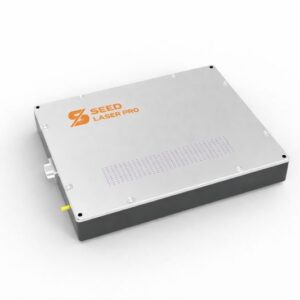
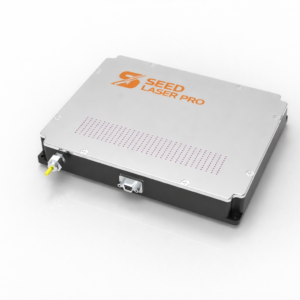
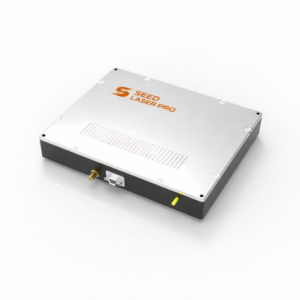
This is the gap the Compact Single Frequency Fiber Laser is designed to fill. It brings the spectral performance of a single frequency fiber laser into a 100 × 90 × 25 mm package consuming 6 W. That combination does not exist in most competitors’ catalogs. Premium OEM single frequency lasers like the Koheras MIKRO are designed for industrial robustness in harsh environments but occupy larger footprints and carry premium pricing. General-purpose compact laser modules at 1064nm typically sacrifice linewidth and polarization performance to hit size targets. This product hits both. nktphotonics
Optical Performance in a Small Package
Sub-100 kHz linewidth at 1030 to 1080 nm gives a coherence length above 950 m. For most portable sensing and imaging applications, this is more than sufficient. The coherence length requirement for OCT depth imaging is in the millimeter range. For interferometric displacement sensing over short paths, meters of coherence length is the ceiling. This laser exceeds both requirements with substantial margin.
M² below 1.05 is near-diffraction-limited beam quality. For a compact module, this matters because spatial mode quality affects how efficiently the output couples into downstream fiber components, modulators, and optical systems. A laser with poor beam quality forces additional spatial filtering stages that add size, cost, and loss to the downstream system.
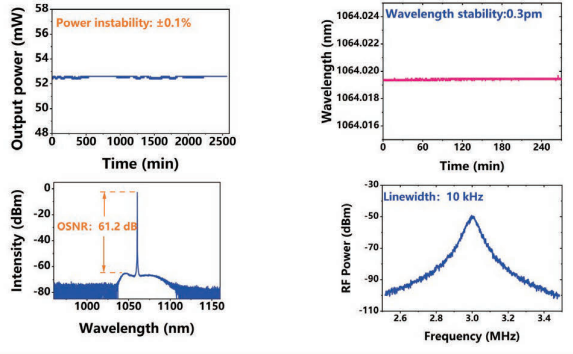
RIN below -130 dBc/Hz at 5 MHz and RMS power stability below 0.2% keep the intensity noise floor low enough for sensitive photodetection in bio-imaging and coherent sensing receivers.
PM980 fiber output with 20 dB polarization extinction ratio ensures a defined, stable polarization state at the output connector. This is the correct fiber type for 1 µm wavelength PM components. Output fiber length is 0.6 m standard, with customizable length available.
The 1030 to 1080 nm Band
The Ytterbium gain band centered around 1064 nm is the most efficient fiber laser wavelength in the near-infrared. Ytterbium-doped fiber offers the highest gain efficiency of any rare-earth dopant, which is why compact, low-power designs are more practical at this wavelength than at 1550 nm where Erbium-doped fiber requires more pump power to reach comparable output levels.
The 1030 to 1080 nm range covers the standard 1064 nm wavelength used as the seed for Nd:YAG amplifiers, as the pump for second harmonic generation to 532 nm, and as the operating wavelength for OCT systems targeting tissue depths where 1 µm penetration is better than 1.5 µm.
For applications requiring other wavelengths in the same compact form factor, Techwin’s single frequency fiber seed laser range covers 1.0 µm, 1.5 µm, and 2.0 µm in standard module configurations. For higher output power at 1 µm from the same seed architecture, see the high power single frequency fiber lasers in the 1.0 µm range.
FAQ SECTION
What makes this a compact single frequency fiber laser?
At 100 × 90 × 25 mm, this is the smallest single frequency fiber laser module in Techwin’s range and one of the most compact available at the 1 µm wavelength band with PM fiber output. Standard single frequency fiber laser modules typically measure 175 × 140 × 25 mm or larger. This module reduces the footprint by more than 60% while maintaining sub-100 kHz linewidth, single longitudinal mode operation, and PM980 output.
Is 6 W power consumption low enough for battery-operated systems?
Yes. 6 W is a realistic budget for portable instruments powered by rechargeable batteries. For context, a typical laptop draws 15 to 45 W under light load. A portable sensing instrument with this laser as the light source, a compact photodetector, and signal processing electronics can realistically operate for several hours on a standard lithium-ion battery pack. Power consumption depends on output power setting. Operating at reduced output power reduces consumption further.
What is PM980 fiber and why is it used instead of PM1550?
PM980 is polarization-maintaining fiber with a zero-dispersion wavelength and cutoff frequency optimized for operation at wavelengths around 980 to 1080 nm. It is the correct PM fiber type for Ytterbium-band lasers and amplifiers. PM1550 is optimized for the 1550 nm Erbium band. Using PM1550 at 1 µm wavelengths increases propagation loss and reduces polarization extinction ratio. For 1 µm systems, PM980 is the standard fiber throughout.
Can this laser be used to seed a fiber amplifier?
Yes. The 40 mW output power and PM980 fiber output are compatible with Ytterbium-doped fiber amplifier input stages. The sub-100 kHz linewidth of this seed will be preserved through the amplification process. For high-power 1 µm MOPA systems where this compact module serves as the seed, Techwin’s high power single frequency fiber laser range at 1.0 µm covers the amplifier configurations.
What is the wavelength tuning range and how is it used?
The wavelength tuning range of up to 0.4 nm allows the laser to be positioned across absorption features or tuned to match a specific spectral target within the 1030 to 1080 nm band. Tuning is achieved through thermal control of the fiber cavity. This is used in spectroscopy setups that need the laser positioned at a specific molecular absorption line, and in sensing systems that require wavelength dithering for signal extraction.