Why 2 µm for Combustion Diagnostics?
Combustion measurement is not simple. Inside a gas turbine or scramjet combustor, temperatures exceed 2000K, pressures reach tens of atmospheres, and the environment is optically harsh. Non-intrusive laser diagnostics are the only practical way to get accurate, time-resolved data from these environments.
Tunable diode laser absorption spectroscopy (TDLAS) is the standard technique. It works by tuning a narrow-linewidth laser across a molecular absorption feature and detecting the transmitted intensity. The measurement yields temperature, species concentration, pressure, and flow velocity simultaneously, without inserting any probe into the combustion zone. Where milliwatt-level single frequency fiber seed lasers are the starting point for most TDLAS systems, some combustion environments demand far more power at the measurement point.
The 2 µm wavelength band is particularly well suited for combustion TDLAS. Water vapor, one of the primary combustion products of hydrocarbon and hydrogen fuels, has strong, well-characterized absorption lines in this spectral region. CO2 absorption features are also accessible at 2 µm. This makes a 2 µm laser the right source for measuring combustion completeness, equivalence ratio, and flame temperature in real combustion environments.
The Challenge: Power vs Spectral Control
Standard TDLAS uses milliwatt-level sources. But long-path measurements through high-optical-density combustion zones, tomographic imaging systems that split the beam across multiple paths, and coherent detection architectures that must overcome background noise from hot luminous gases all push power requirements well above what seed-level sources can deliver.
This is where high power single frequency fiber lasers become necessary. But at kilowatt levels, single-mode fiber delivery runs into a fundamental problem: Stimulated Brillouin Scattering (SBS). SBS converts forward-propagating laser light into backward-propagating Stokes light, capping practical power delivery through single-mode fiber well below kilowatt levels. Solving SBS while keeping the laser in single longitudinal mode is the core engineering challenge in kilowatt-class narrow-linewidth fiber laser design.
How This System Solves It
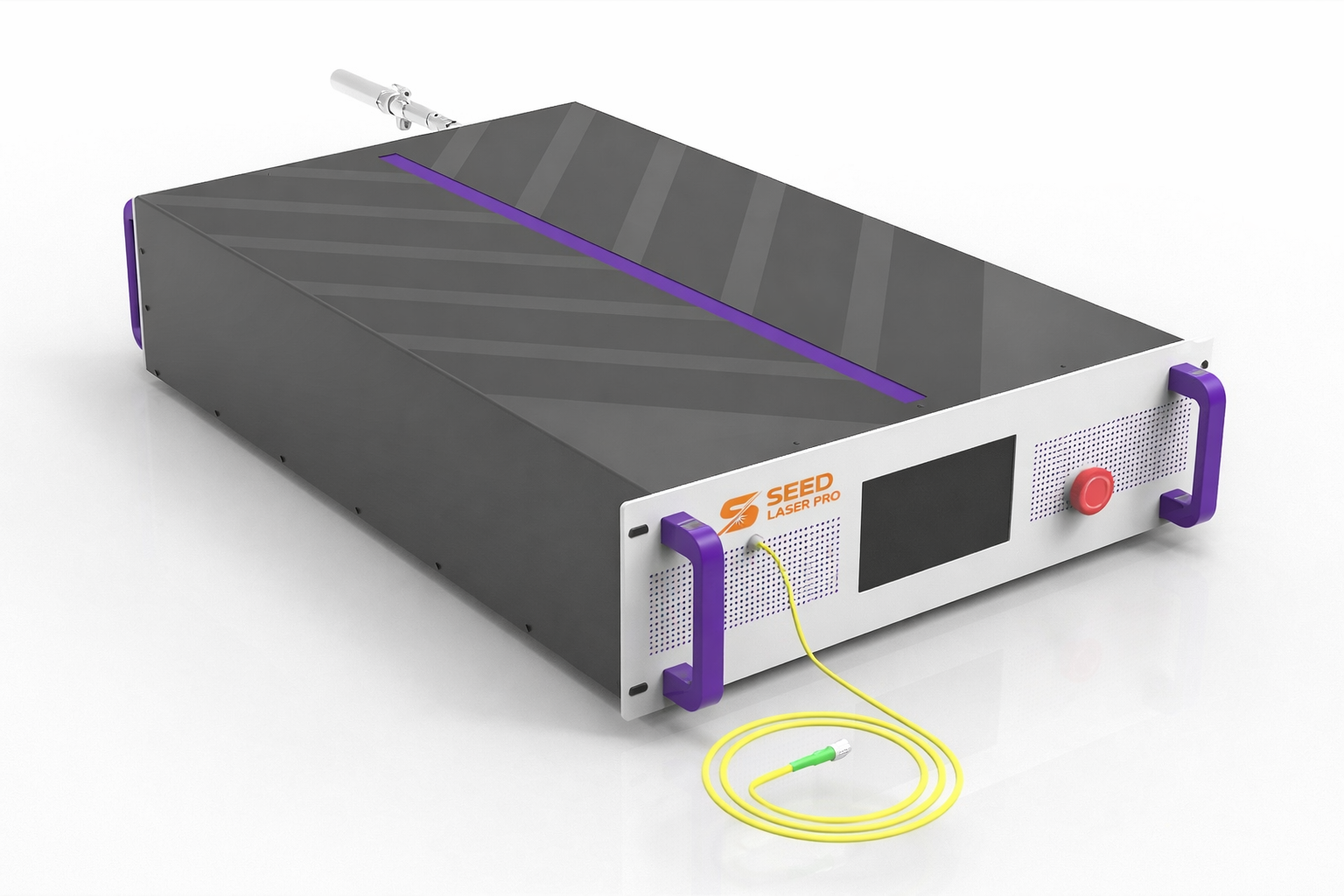
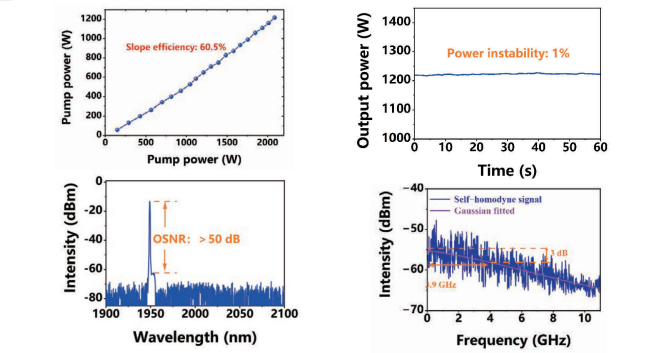
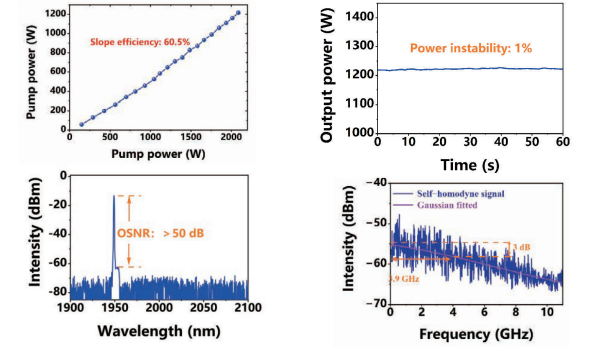
Techwin’s kilowatt-class combustion diagnostics laser uses phase-modulated linewidth broadening to address SBS directly. A LiNbO3 electro-optic phase modulator in the seed stage spectrally broadens the linewidth to 3.9 GHz. This raises the SBS threshold by distributing optical power across a wider spectral range, allowing kilowatt-level power to propagate through the single-mode delivery fiber without triggering Brillouin backscattering.
The multi-stage MOPA amplifier chain and distributed pumping architecture bring the output to 1 to 1.2 kW while maintaining single longitudinal mode operation and M² below 1.5 beam quality. Output power is continuously adjustable from 5% to 100%.
The QBH fiber connector delivers this output to the application. For combustion diagnostic setups requiring specific beam delivery configurations or custom fiber lengths, Techwin offers customizable output fiber length on request. Performance verification of the laser output is supported by Techwin’s Laser Testing and Measurement Systems, including the Laser Linewidth Measurement System and Laser Noise Measurement System.
FAQ SECTION
What makes a 2 µm wavelength suitable for combustion diagnostics?
The 2 µm spectral region contains strong absorption lines of water vapor (H2O) and carbon dioxide (CO2), both primary combustion products of hydrocarbon and hydrogen fuels. TDLAS systems operating at 2 µm can measure flame temperature, water vapor concentration, and combustion efficiency non-intrusively in real combustion environments, including gas turbines, scramjets, and industrial burners.
What is phase-modulated linewidth broadening and why is it used?
Phase-modulated linewidth broadening uses an electro-optic phase modulator in the seed laser stage to spectrally broaden the laser linewidth. This raises the Stimulated Brillouin Scattering (SBS) threshold, which is the primary barrier to delivering high optical power through single-mode fiber. Without linewidth broadening, SBS limits single-mode fiber delivery to well below kilowatt levels. With 3.9 GHz broadening, this system delivers 1 to 1.2 kW through a QBH single-mode fiber output.
What is a MOPA architecture and how does it work in this laser?
MOPA stands for Master Oscillator Power Amplifier. A seed laser (the master oscillator) sets the wavelength, linewidth, and spectral characteristics of the output. One or more fiber amplifier stages (the power amplifier) boost the power while preserving the spectral quality set by the seed. This system uses a signal-modulated seed source and a multi-stage amplifier with distributed pumping to reach 1 to 1.2 kW output while maintaining single longitudinal mode operation.
Can this laser be used for applications other than combustion diagnostics?
Yes. The 2 µm wavelength and kilowatt-class output make this system applicable to high-power industrial material processing, where the Thulium band’s strong absorption in polymers and biological materials offers processing advantages over 1 µm systems. Medical applications using high-power 2 µm delivery are also supported. Contact Techwin to discuss suitability for specific use cases.
Is the output fiber length customizable?
Yes. Output fiber length is listed as under 1 meter as standard, with customizable length available on request. The output connector is QBH. Contact Techwin’s engineering team at the inquiry stage to specify your beam delivery requirements.