What Hz-Level Linewidth Actually Means
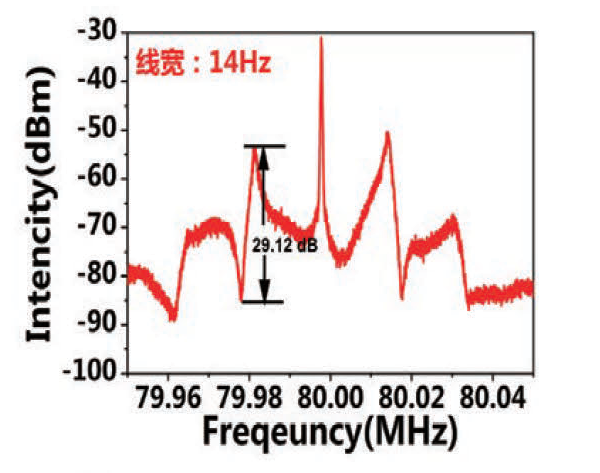
Most single-frequency fiber lasers operate in the sub-kHz range. A 1 kHz linewidth laser is already excellent for fiber sensing, interferometry, and most spectroscopy applications. A 25 Hz linewidth laser is a different instrument entirely. At 25 Hz linewidth, the coherence length of the 1550 nm output exceeds 7,500 km. The frequency noise floor at 10 kHz offset sits at 15 Hz²/Hz. At 10 Hz offset, it holds at 5000 Hz²/Hz. These are measured frequency noise power spectral density values that characterize the laser’s noise behavior across four decades of frequency offset.
For most applications, this level of performance is more than sufficient. For a small set of applications, it is the minimum viable specification.
Applications That Require Hz-Level Performance
Gravitational Wave Detection
Gravitational wave observatories like LIGO and Virgo use kilometer-scale Michelson interferometers to detect spacetime distortions smaller than a proton’s diameter. The laser source feeding these interferometers must hold Hz-level frequency stability across the measurement window. Any frequency noise above the shot noise floor corrupts the signal. This laser’s 25 Hz linewidth and characterized noise profile from 10 Hz to 10 kHz maps directly to the frequency band where gravitational wave signals are detected.
For researchers building tabletop interferometric experiments or prototype sensing systems ahead of full observatory deployment, this laser provides the spectral performance of observatory-grade sources in a compact, PM fiber-coupled module.
Cold Atom Physics and Optical Clocks
In laser cooling experiments, the laser must stay resonant with a specific atomic transition throughout the cooling and trapping cycle. For strontium optical lattice clocks, which represent the current state of the art in timekeeping accuracy, the laser linewidth must be comparable to or narrower than the atomic transition linewidth itself. That can reach the millihertz range for clock transitions.
At 25 Hz linewidth, this laser sits in the performance range required for pre-stabilization stages in optical clock systems. It also provides direct utility for rubidium and cesium cooling experiments where cavity-enhanced interaction requires a highly coherent source.
High-Sensitivity Coherent Sensing
Distributed fiber sensing systems using coherent detection, Brillouin or Rayleigh backscattering techniques, and coherent optical time-domain reflectometry all benefit from the extended coherence length that Hz-level linewidth provides. Longer coherence length means longer sensing range and better spatial resolution in distributed measurements.
For coherent sensing deployments that have already extracted the maximum performance from sub-kHz fiber lasers, this laser is the natural upgrade path.
Why PM1550 Output Matters at This Performance Level
At Hz-level linewidth, polarization stability is not optional. Any polarization instability at the fiber output introduces effective phase noise that degrades the measurement performance the laser’s spectral purity is designed to provide.
PM1550 fiber with a polarization extinction ratio above 23 dB ensures that the linear polarization state at the output connector is stable and well-defined. This is the fiber type expected by downstream PM fiber amplifiers, Mach-Zehnder modulators, and interferometric systems. An M² below 1.1 confirms near-perfect Gaussian beam quality from the fiber tip.
Output power of 50 mW is suitable for direct use in sensing and measurement systems, or as a seed for high power single frequency fiber lasers in MOPA architectures where the Hz-level spectral quality of this seed determines the coherence quality of the amplified output.
Frequently Asked Questions
What does Hz-level linewidth mean in practical terms?
Linewidth is the spectral width of the laser’s optical output. A 25 Hz linewidth means the laser emits across a frequency range of just 25 Hz, centered on 1550 nm. A standard single-frequency DFB fiber laser has a linewidth of a few kilohertz. A sub-kHz fiber laser reaches hundreds of Hz. At 25 Hz, this laser operates at the performance level used in gravitational wave observatories and optical atomic clock research. The corresponding coherence length at this linewidth exceeds 7,500 km.
What is the difference between linewidth and frequency noise?
Linewidth is a single number that summarizes the spectral width of the laser output, typically measured as the full width at half maximum of the optical spectrum. Frequency noise is a more complete description. It gives the noise power at each frequency offset from the carrier, expressed as Hz²/Hz. A laser with the same linewidth can have very different frequency noise profiles depending on how the noise is distributed across frequency offsets. The frequency noise specification in this product’s datasheet gives four data points across the 10 Hz to 10 kHz range, which is the band most relevant for sensing and interferometric applications.
What is a sub-kHz fiber laser and how does this product relate to that category?
A sub-kHz fiber laser is any single-frequency fiber laser with a linewidth below 1000 Hz. This product at 25 Hz sits within that category at the upper-performance end. Buyers evaluating sub-kHz fiber lasers for applications that demand the narrowest available linewidth in a PM fiber-coupled module will find this product covers that requirement with margin.
Can this laser be used as a seed in a MOPA system?
Yes. The PM1550 output and stable single longitudinal mode operation make this laser directly compatible with PM fiber amplifier stages. The 25 Hz linewidth of the seed is preserved through the amplification process, so the amplified output inherits the Hz-level coherence of this seed. This is the correct approach when a high-power Hz-level linewidth laser is required: seed at this performance level, then amplify.
How does this laser compare to a standard 1550 nm single frequency seed laser?
A standard 1550 nm single frequency fiber seed laser operates at sub-10 kHz linewidth, which is sufficient for fiber sensing, coherent ranging, and general spectroscopy. This Hz-level linewidth laser is two to three orders of magnitude narrower in linewidth and correspondingly better in frequency noise. It is the right choice when sub-kHz performance is a hard specification, not just a preference.