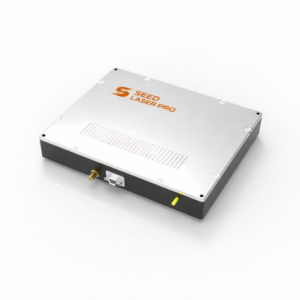
The Problem with Unstabilized Lasers in Sensing
A standard narrow-linewidth single-frequency laser has good linewidth. But linewidth alone does not guarantee stable frequency. A laser with 10 kHz linewidth can still drift by hundreds of megahertz over an hour of operation due to temperature changes in the gain medium, pump current fluctuations, and mechanical stress in the fiber cavity.
For most applications that drift is acceptable. For high-sensitivity sensing systems, it is not. Distributed fiber sensing systems use the interference pattern between transmitted and locally referenced light to detect vibration, strain, or temperature changes along a fiber cable. When the laser frequency drifts, the reference shifts. The interference pattern changes. The sensing system sees a signal that looks like a physical event but is actually the laser drifting.
Cavity-enhanced spectroscopy systems lock the laser to a high-finesse optical cavity. When the laser frequency drifts outside the cavity linewidth, the lock breaks. The measurement stops. Setup time is wasted relocking to the cavity. These are not edge cases. They are the practical daily reality of working with unstabilized narrow-linewidth sources in demanding sensing environments.
How Dual Closed-Loop Stabilization Works
This laser uses two separate feedback loops to control frequency, each operating on a different timescale. The fast loop suppresses short-term frequency noise. It responds to fluctuations happening on the millisecond to microsecond timescale, where acoustic noise, vibration, and current noise in the pump drive are the dominant sources. It uses a high-bandwidth actuator, typically a piezoelectric element on the fiber cavity, to correct frequency in real time.
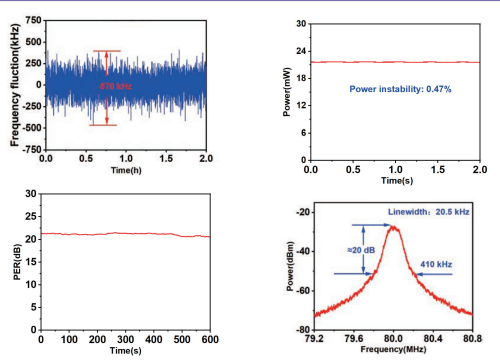
The slow loop controls long-term frequency drift. It responds to changes happening over seconds to hours, where thermal drift in the cavity and mechanical creep in the fiber are the dominant sources. It uses a thermal actuator with high range but lower bandwidth to keep the center frequency within the specified 500 kHz drift window over two hours. Running both loops simultaneously covers the full frequency offset range from fast noise to slow drift. A single-loop system that handles one timescale will leave the other uncorrected. The dual closed-loop architecture in this laser covers both.
Why 1550 nm for High-Sensitivity Sensing
The 1550 nm band is the standard wavelength for fiber optic sensing for the same reasons it is standard for fiber optic communications. Transmission loss in standard single-mode fiber reaches its minimum around 1550 nm, which means sensing signals travel farther before they fall below the detection threshold. The component ecosystem at 1550 nm is the most mature of any fiber wavelength, with wide availability of PM couplers, circulators, isolators, and photodetectors designed for this band.
For distributed sensing over long fiber cables, the low transmission loss at 1550 nm directly determines the maximum sensing range achievable. For spectroscopy applications, the 1550 nm band covers the overtone absorption features of methane, CO2, and water vapor used in near-infrared gas detection. Techwin’s single frequency fiber seed lasers cover the full range of 1550 nm performance grades from standard sub-10 kHz through to Hz-level ultra-narrow linewidth. This frequency stabilized laser sits in the practical mid-range, optimized for real-world sensing deployment rather than laboratory research.
FAQ SECTION
What is a frequency stabilized fiber laser?
A frequency stabilized fiber laser is a single-frequency laser with active feedback control that keeps the output frequency within a defined stability window over time. Without stabilization, a narrow-linewidth laser drifts in center frequency due to temperature changes, mechanical stress, and pump current variations. Stabilization corrects for these effects in real time, keeping the output frequency consistent throughout continuous operation. This laser holds wavelength drift within 500 kHz RMS over two hours using a dual closed-loop system.
What is the difference between linewidth and frequency stability?
Linewidth describes the spectral width of the laser output at any given instant. Frequency stability describes how much the center of that linewidth moves over time. A laser with 20 kHz linewidth and poor stability might drift by 100 MHz over an hour, meaning the center frequency changes by 5,000 times the linewidth. For sensing and spectroscopy applications, both parameters matter. Linewidth sets the resolution of the measurement. Frequency stability determines whether the measurement stays on target throughout the data acquisition window.
What sensing applications need a frequency stabilized source?
Distributed acoustic sensing and distributed temperature sensing systems using coherent detection need frequency stability to maintain the interference reference throughout a measurement. Cavity-enhanced spectroscopy needs frequency stability to maintain lock to a high-finesse cavity. Fiber optic gyroscopes need frequency stability to prevent center-frequency drift from appearing as a rotation signal. Any application where the measurement window is longer than a few seconds and frequency drift would change the measurement baseline is a candidate for a frequency stabilized source.
Why does this laser use dual closed-loop stabilization rather than single-loop?
A single feedback loop can only be optimized for one frequency offset range. A fast loop with high bandwidth corrects short-term noise but has limited range for slow drift. A slow loop with high range corrects long-term drift but cannot respond quickly enough to suppress fast noise. Running both simultaneously gives full correction across all timescales. The dual closed-loop architecture in this laser covers fast noise from acoustic and electronic sources and slow drift from thermal and mechanical effects independently.
Is PM1550 output required for sensing applications?
PM output is required when downstream components in the sensing system are polarization-sensitive, such as PM fiber circulators, fiber Bragg grating interrogators, and coherent receivers that use polarization diversity detection. For systems that manage polarization externally or use polarization-insensitive components throughout, non-PM output is also available. Contact Techwin with your system architecture to confirm the right output configuration.