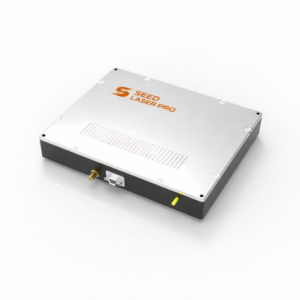
What Coherent LiDAR Requires from Its Laser Source
Coherent LiDAR is fundamentally different from direct-detection LiDAR. Direct-detection systems measure the intensity of returned light. Coherent systems mix the returned signal with a local oscillator copy of the transmitted beam and detect the interference. This heterodyne or homodyne detection process extracts Doppler frequency shifts, which translate directly into radial velocity measurements. It also provides much higher sensitivity than direct detection, allowing coherent systems to detect signals far weaker than the direct-detection noise floor.
That sensitivity comes with a strict requirement on the laser source. The local oscillator and transmit beam must be coherent with each other over the round-trip propagation time. For a target at 10 km range, the round-trip propagation time is about 67 microseconds. Over that time, the laser must hold its phase relationship well enough to produce clean interference fringes. A laser with 1 kHz linewidth has a coherence time of around 160 microseconds, which is just sufficient. Sub-kHz linewidth gives comfortable margin.
At the same time, long-range targets return extremely weak signals. More transmit power means more signal at the receiver, which directly improves detection range and measurement signal-to-noise ratio. This is why a coherent LiDAR light source for long-range applications needs both high output power and narrow linewidth simultaneously.
Why This System Achieves Both
Most fiber laser amplifiers face a fundamental tension between output power and spectral purity. Nonlinear effects in optical fiber, particularly stimulated Brillouin scattering (SBS) and stimulated Raman scattering (SRS), grow with increasing power and can generate broadband noise that degrades the linewidth. Managing these effects while scaling power is the core engineering challenge in high-power narrow-linewidth fiber laser design.
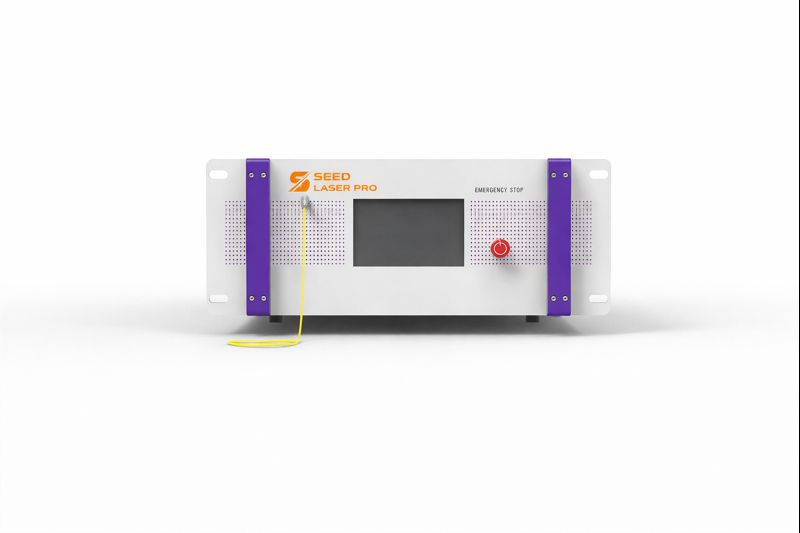
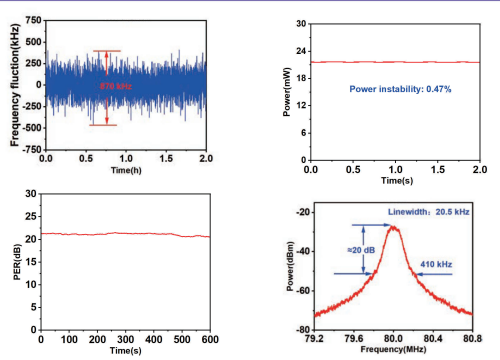
This system addresses that challenge through a three-stage MOPA architecture with integrated nonlinear effect suppression at each amplifier stage. The seed laser establishes the spectral quality. Each amplifier stage adds power with suppression measures in place to prevent nonlinear effects from degrading the linewidth. The result is 0.5 to 0.8 kHz linewidth maintained from 20 W through 120 W output.
For buyers evaluating single frequency fiber seed lasers for lower-power coherent sensing applications, this system represents the high-power extension of that product line. The spectral architecture is the same. The power level is an order of magnitude higher.
1550 nm for Long-Range LiDAR Seed Source Applications
The 1550 nm wavelength is the standard for coherent LiDAR and long-range sensing for three reasons.
First, it is eye-safe at the power levels used in outdoor LiDAR systems. The 1550 nm band falls within the spectral range where the cornea and lens absorb incident light before it reaches the retina, enabling regulatory approval for higher outdoor transmit powers than are permitted at 1064 nm.
Second, it benefits from decades of telecom-driven component development. Erbium-doped fiber amplifiers, PM fiber couplers, isolators, circulators, electro-optic modulators, and photodetectors optimized for 1550 nm are mature, widely available, and cost-effective compared to equivalent components at other wavelengths.
Third, atmospheric transmission at 1550 nm is favorable for long-range propagation. The window between water vapor and CO2 absorption bands at this wavelength gives acceptable transmission through maritime and humid atmospheric conditions where shorter-wavelength systems can suffer significant propagation loss.
For long-range LiDAR seed source applications where the output of this system feeds into a larger transmitter chain or is used directly as the transmit beam, the combination of these factors makes 1550 nm the practical engineering choice.
Output Configuration Options
Three connector formats are available to match different integration architectures.
Bare fiber output suits laboratory setups and custom integration where the connector type will be determined by the downstream system.
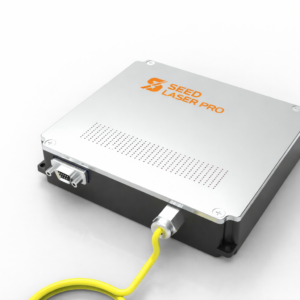
QBH armored connector is the standard format for high-power fiber delivery in industrial and outdoor systems. The armored cable provides mechanical protection for field-deployed installations.
QCS collimator provides a collimated free-space output beam from the fiber, which suits LiDAR transceiver designs that require free-space beam expansion or telescope coupling after the laser.
PM and non-PM fiber options are both available. PM output is required when the downstream transceiver architecture uses polarization-sensitive components such as electro-optic modulators, fiber-based circulators operating in PM configuration, or coherent receivers that expect a defined polarization state. For systems managing polarization externally, non-PM output reduces component cost.
If your system requires a configuration outside the standard options, contact Techwin to discuss custom output specifications. Performance verification of the output is supported by the Laser Testing and Measurement Systems available from Techwin, including the Laser Linewidth Measurement System for sub-kHz linewidth verification.
FAQ SECTION
What is a coherent LiDAR light source?
A coherent LiDAR light source is a laser that provides both the transmit beam and the local oscillator reference in a coherent LiDAR system. The key requirement is that the transmit and reference copies remain phase-coherent over the round-trip propagation time to the target and back. This requires narrow linewidth, which sets the coherence time, and high output power, which sets the achievable detection range. This system provides both at 1550 nm.
Why is sub-kHz linewidth important for long-range LiDAR?
Coherence length is inversely proportional to linewidth. A 1 kHz linewidth laser has a coherence length of approximately 95 km. At 0.5 kHz linewidth, coherence length doubles to around 190 km. For a LiDAR system detecting targets at 10 to 50 km range, this gives substantial margin for clean interference fringes at the receiver. Going wider than 1 kHz linewidth at these ranges would degrade the coherent detection signal quality and reduce effective detection range.
What is a three-stage MOPA and why does it matter for high-power LiDAR?
MOPA stands for Master Oscillator Power Amplifier. A three-stage MOPA uses three sequential amplifier stages to scale power from the seed level to the final output power. Each stage is individually optimized for gain and nonlinear effect suppression. This staged approach allows the linewidth and spectral quality set by the seed to be preserved through each amplification step, which is not achievable by trying to produce high power in a single amplifier stage.
What is the difference between PM and non-PM output for LiDAR applications?
PM (polarization-maintaining) fiber output delivers the laser light in a defined, stable linear polarization state. This is required when downstream components in the LiDAR transceiver are polarization-sensitive, such as electro-optic modulators, polarization-based beam splitters, or coherent receivers that use polarization diversity. Non-PM output suits systems where polarization is managed externally or not a constraint. Both options are available on this product.
Can this system be used as a long-range LiDAR seed source feeding a larger amplifier?
Yes. The 20 W minimum output power and sub-kHz linewidth make this system suitable as a high-power seed for further amplification stages in larger LiDAR transmitter architectures. The single longitudinal mode CW output and PM fiber option are both compatible with downstream PM fiber amplifier stages. Contact Techwin to discuss integration requirements if your system uses this as an intermediate stage rather than a final transmitter.