Sub-1 kHz at 1550nm: Why This Number Is Significant
Most commercial single-frequency seed lasers at 1550nm specify linewidth in the multi-kHz to tens-of-kHz range. A standard industrial-grade seed at this wavelength typically lands around 3 to 10 kHz, which is more than sufficient for coherent LiDAR, fiber sensing, and MOPA seeding.
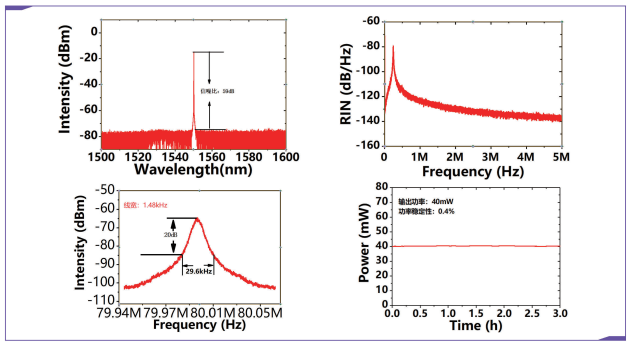
Sub-1 kHz pushes into a different performance tier. The coherence length at 1 kHz linewidth is approximately 95 km. At sub-1 kHz, that coherence length extends further still. This level of spectral purity is the entry requirement for a narrower set of applications where coherence over very long timescales or very high-fidelity quantum states is the determining factor in system performance, not just a margin of safety.
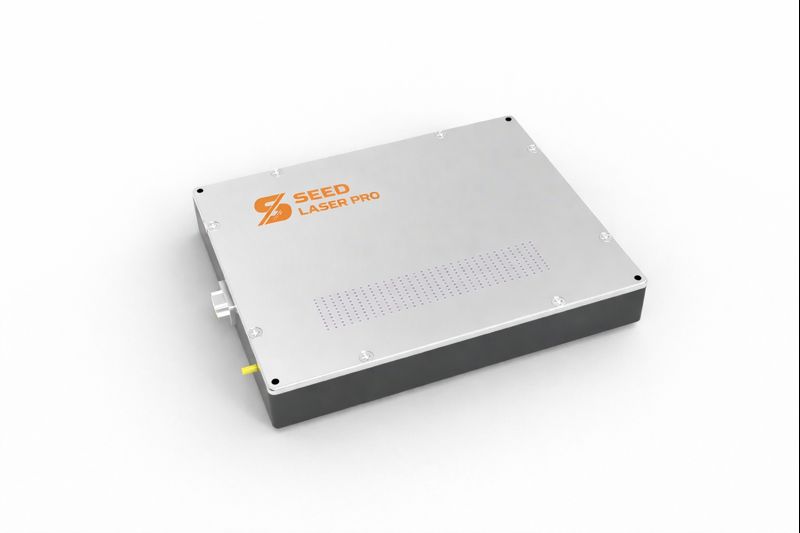
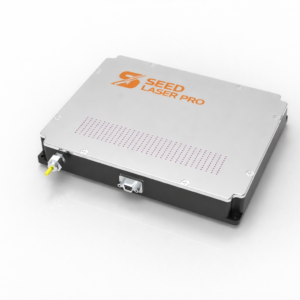
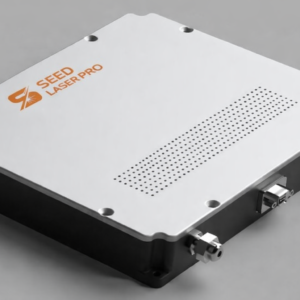
The DBR architecture is what makes this achievable in a compact, mode-hop-free package. Distributed Bragg Reflector gratings at each end of a short gain section give the cavity wide longitudinal mode spacing, which is the physical reason mode-hop-free operation and sub-kHz linewidth can coexist in the same compact 175 × 140 × 25 mm module rather than requiring a much larger, externally stabilized laboratory setup.
Why 1550nm Specifically for Quantum Computing
The telecommunications C-band at 1550nm is increasingly relevant to quantum computing architectures, particularly those using photonic qubits or requiring compatibility with existing fiber telecom infrastructure for quantum networking and distributed quantum computing links. A laser operating natively in this band integrates directly with standard PM1550 fiber components, telecom-grade modulators, and detectors already deployed at scale, rather than requiring specialized hardware built around a non-standard wavelength.
Sub-kHz linewidth at 1550nm is relevant to quantum computing approaches where the coherence of a classical reference laser sets a bound on achievable gate fidelity or measurement precision in hybrid classical-quantum control loops. Mode-hop-free operation removes a failure mode that would otherwise introduce unpredictable phase discontinuities into a quantum control sequence.
For quantum communication links and quantum key distribution research specifically operating at other wavelengths within the converted laser range, see Seed Laser Pro’s wavelength converted fiber laser products.
Quantum Precision Measurement and Sensing
Atomic clock local oscillators, precision frequency metrology references, and high-sensitivity interferometric sensing setups operating at or near 1550nm all benefit from the same underlying property: a laser whose phase remains coherent over the longest practical measurement window. Sub-kHz linewidth combined with ±0.2 nm thermal tuning allows the operator to position the laser precisely on a target reference feature, such as an atomic transition accessed through frequency conversion, or a reference cavity resonance, and then rely on the laser’s narrow linewidth to maintain that lock with minimal residual phase noise.
For high-sensitivity sensing deployments outside the laboratory, mode-hop-free operation matters as much as the linewidth number itself. A laser that occasionally jumps modes under thermal or mechanical perturbation introduces sudden, large phase discontinuities that corrupt long-duration sensing measurements regardless of how narrow its linewidth is between hops. The DBR architecture in this seed laser is specifically engineered against that failure mode.
How This Compares to Seed Laser Pro’s Other 1550nm Products
| Product | Linewidth | Primary Differentiator |
| This Seed Source | Sub-1 kHz | DBR architecture, mode-hop-free, quantum-grade coherence |
| 1.5 µm 0.2-2W High Power Laser | 3 kHz | MOPA architecture for higher output power |
| 1.5 µm 2-20W High Power Laser | 0.1-2 kHz | Two-stage MOPA, gravitational wave and wind LiDAR power scale |
This seed source occupies the narrowest-linewidth, lowest-power position in Seed Laser Pro’s 1550nm range, purpose-built for applications where spectral purity is the priority over output power. For applications requiring higher power at the same wavelength, see the 1.5 µm 0.2 to 2W High-Power Single-Frequency Laser.
FAQ
What is a 1550nm DBR single frequency seed laser?
A DBR single frequency seed laser uses Distributed Bragg Reflector gratings at each end of a short gain section to form the laser cavity, rather than the integrated grating used in DFB designs. This architecture gives wide longitudinal mode spacing, which supports mode-hop-free operation and very narrow linewidth in a compact package. At 1550nm, this product achieves sub-1 kHz linewidth, placing it among the narrowest-linewidth seed lasers commercially available at this wavelength.
Why is sub-1 kHz linewidth relevant to quantum computing?
In photonic and hybrid quantum computing architectures, classical reference lasers are often used to control, read out, or stabilize quantum states. The phase coherence of that reference laser places a practical bound on the precision of those control and measurement operations. Sub-kHz linewidth provides coherence over a long enough timescale that the laser’s own phase noise is unlikely to be the limiting factor in most current quantum hardware control loops operating at 1550nm.
What does mode-hop-free mean and why does it matter for sensing applications?
Mode-hop-free operation means the laser maintains continuous single-mode output without discontinuous jumps to an adjacent longitudinal mode as temperature or current vary within the specified range. A mode hop introduces a sudden, large frequency and phase discontinuity. In long-duration sensing or quantum measurement applications, even one mode hop during a measurement run can corrupt the entire dataset, making mode-hop-free operation a reliability requirement rather than a convenience feature.
How does this compare to the 1.5 µm high-power single-frequency lasers in your range?
This seed source prioritizes spectral purity at low power. Sub-1 kHz linewidth is significantly narrower than the 3 kHz specification on Seed Laser Pro’s 0.2 to 2W high-power MOPA laser, but maximum output power is limited to 40 mW. For applications needing both narrow linewidth and higher power, this seed laser can be used as the master oscillator feeding a downstream PM1550 fiber amplifier stage from Seed Laser Pro’s high-power range.
Is the wavelength tuning range sufficient for locking to a reference cavity?
The ±0.2 nm thermal tuning range corresponds to approximately ±25 GHz at 1550nm, which covers the typical capture range needed to locate and lock onto a reference cavity resonance or atomic reference feature during initial setup. Fine control within the locked state is then maintained by the laser’s inherent sub-kHz linewidth and any external feedback loop applied by the user’s control system.