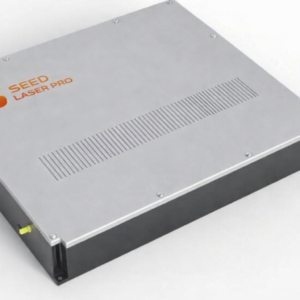
Why 1083 nm and How It Differs From 1064 nm
1083.2 nm sits within the Ytterbium gain band but is a distinct operating point from the 1064nm wavelength used in Seed Laser Pro’s standard high-power MOPA seed range. The 1083 nm line corresponds to the 2³S1 to 2³P transition of metastable helium, used in helium optical pumping, magnetometry, and helium spectroscopy. Systems built around this specific atomic transition require a laser precisely at 1083 nm, not at any nearby Ytterbium wavelength.
Outside helium-specific applications, 1083 nm also serves general single-frequency requirements within the broader Ytterbium gain band where 1064 nm component availability or system design constraints make a slightly different operating wavelength preferable.
For helium magnetometry and quantum sensing applications specifically, see Seed Laser Pro’s High-Sensitivity Magnetic Detection Laser, which addresses the same 1083 nm transition with a frequency-stabilized configuration optimized for that use case.
Centimeter-Scale DBR Cavity: The Reliability Architecture
The defining technical feature of this laser is its resonator construction. A DBR (Distributed Bragg Reflector) design places Bragg grating reflectors at each end of a short gain fiber section, rather than writing the grating directly into the gain medium as a DFB design does. Combined with highly doped specialty fiber, this allows the entire resonator to be built at centimeter scale.
A short cavity has two direct consequences for reliability. First, the longitudinal mode spacing is inversely proportional to cavity length — a shorter cavity has wider mode spacing, which makes single-mode selection more robust and mode hops less likely to occur as temperature or current vary. Second, a shorter mechanical structure has fewer degrees of freedom for vibration-induced perturbation, making the cavity inherently more resistant to mechanical shock than longer-cavity designs.
This is why mode-hop-free operation, no burst noise, and high side-mode suppression ratio all appear together in this product’s specification. They are not independent achievements — they are the direct consequence of the centimeter-scale DBR architecture combined with specialty fiber doping
What “High-Reliability” Means in Practice
Special temperature-control protection and shock-resistant design are built into the resonator structure itself, not added as external isolation. The operating temperature range of -20 to 50°C and storage range of -40 to 80°C reflect genuine field-deployment conditions rather than laboratory-only specifications.
For applications where this laser is integrated into:
- Field-deployed fiber sensing instruments subject to temperature cycling and vibration over months of continuous operation
- Prototype gravitational wave detection setups where measurement runs extend over hours and any mode hop corrupts the interferometric baseline
- Coherent LiDAR transceivers mounted in vehicles or aircraft subject to mechanical shock during operation
- Research-grade coherent communication testbeds requiring consistent reference laser performance across extended test campaigns
the difference between a laser that performs in these conditions and one that does not is precisely this resonator-level reliability engineering.
FAQ
What is the difference between this 1083nm seed laser and a standard 1064nm seed laser?
Both operate within the Ytterbium gain band using a similar DBR resonator architecture and PM980 fiber output. The difference is the precise operating wavelength. 1083.2 nm corresponds to the helium optical pumping transition and is required for applications targeting metastable helium spectroscopy or magnetometry. For general MOPA seeding, coherent ranging, and 532 nm frequency doubling, the 1064nm industrial seed laser is the more commonly specified product.
What makes this laser mode-hop-free?
The centimeter-scale DBR resonator built on highly doped specialty fiber produces wide longitudinal mode spacing, which makes single-mode operation robust against the small perturbations from temperature drift and current variation that cause mode hops in longer-cavity designs. Combined with active temperature-control protection in the resonator structure, this maintains stable single-mode output across the full -20 to 50°C operating range.
Is this laser suitable for prototype gravitational wave detection setups?
Yes. Sub-50 kHz linewidth, mode-hop-free operation, low RIN, and high side-mode suppression ratio are the specifications required for tabletop and prototype interferometric gravitational wave detection research. The shock-resistant resonator design also supports stable operation during extended measurement campaigns without performance degradation from environmental vibration.
Can this laser be customized for a different wavelength within the Ytterbium band?
Contact Seed Laser Pro’s engineering team to discuss custom wavelength requirements within the Ytterbium gain band. Wavelength thermal tuning of 0.2 nm is available as standard around the 1083.2 nm center wavelength for fine adjustment within that range.
What is the shock and vibration tolerance of this laser?
The resonator incorporates dedicated anti-shock and vibration-resistant design at the cavity level, integrated into the mechanical structure rather than relying solely on external housing isolation. For specific shock and vibration test certification requirements relevant to your application, contact Seed Laser Pro’s engineering team with your qualification standard.