Seed Laser Pro offers two seed lasers at this wavelength and power range that are easy to confuse on a quick spec scan. Both operate at 980 to 1120 nm with 10 to 50 mW output and 10 kHz linewidth. The difference is in what each one stabilizes and by how much.
The practical distinction: the Ultra-Low Noise Seed Source is optimized primarily for intensity noise suppression as a standalone goal. This product adds frequency stabilization and tunability on top of an even tighter power stability specification, making it the choice when the application needs both a stable amplitude reference and the ability to actively position or track the output wavelength.
See Seed Laser Pro’s 1.0 µm Ultra-Low Noise Seed Source if frequency tuning is not required and the application calls only for intensity stability.
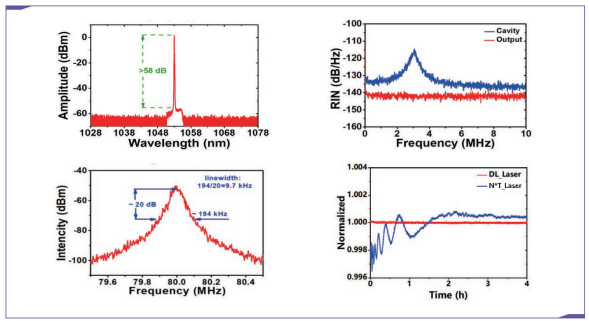
Why -140 dB/Hz Peak RIN and 0.02% Power Instability Matter Together
A RIN specification on its own describes noise in the frequency domain — how much power fluctuates at a given Fourier frequency. Power instability over one hour describes the time-domain integral of that noise across the full measurement window. Specifying both gives a complete picture: -140 dB/Hz confirms the noise floor is exceptionally low across the measured spectrum, and 0.02% P-P over 1 hour confirms that low noise floor translates into genuinely stable output power over realistic experiment durations.
This combination matters specifically for coherent LiDAR systems performing long integration-time measurements, and for quantum optics experiments running multi-minute data acquisition sequences where any slow power drift would corrupt the measurement baseline independent of the laser’s instantaneous noise floor.
Frequency Stabilization and 600 pm Tuning
The intelligent control system actively stabilizes the operating frequency against thermal and mechanical drift, while the 600 pm tuning range allows the output wavelength to be deliberately positioned within the 980 to 1120 nm Ytterbium gain band. This combination — stability plus controlled tunability — is what coherent LiDAR systems need when matching the transmit wavelength to a specific detector response or atmospheric transmission window, and what interferometric setups need when actively locking to a reference cavity or fringe-tracking during a measurement.
Application Context
New Energy Laser Driving
Laser-driven energy delivery systems require predictable, repeatable power output over extended operating periods. The combination of low RIN and tight power stability ensures the driven system receives a consistent input, free from the slow drift or fast noise spikes that would otherwise propagate into output variability.
Coherent LiDAR
Detection sensitivity in coherent LiDAR depends on the local oscillator’s noise floor relative to the returned signal. -140 dB/Hz RIN keeps the local oscillator noise well below typical signal levels at practical detection ranges, while wavelength tuning allows the system to be matched precisely to detector or atmospheric requirements.
Precision Interferometric Measurement
Long-duration interferometric measurements accumulate phase and amplitude errors from any source instability over the acquisition window. 0.02% power instability over one hour keeps that accumulated error well below typical measurement noise floors in displacement sensing, surface metrology, and reference cavity locking applications.
Quantum Optics
Quantum optics experiments measuring squeezed states, entanglement, or quantum-limited sensing protocols require a reference laser whose classical noise does not mask the quantum signal being studied. The combination of low RIN and frequency stability supports these noise-sensitive measurement architectures.
FAQ
What is the difference between this and the Ultra-Low Noise Seed Source?
Both share the same wavelength range, power range, and 10 kHz linewidth. This product adds high-precision frequency stabilization, 600 pm wavelength tuning, an explicitly specified peak RIN below -140 dB/Hz, and a tighter 0.02% power instability specification over one hour, compared to the 0.5% peak-to-peak specification on the Ultra-Low Noise Seed Source. Choose this version when the application needs active frequency control and tuning in addition to low noise.
What does 0.02% power instability over 1 hour actually mean?
It means that over a continuous one-hour measurement, the output power varies by no more than 0.02% peak-to-peak from its set level. This is a long-term time-domain stability specification, distinct from RIN, which describes noise in the frequency domain. Together, the two specifications confirm the laser is stable both instantaneously and over realistic experiment durations.
Why is wavelength tuning included on a noise-optimized seed laser?
Frequency stabilization and wavelength tuning are complementary, not contradictory. Stabilization holds the output steady against unwanted drift. Tuning allows the operator or control system to deliberately move the output wavelength to a target value, then have it held stably at that new point. Coherent LiDAR and interferometric locking applications frequently need both: precise positioning and stable holding.
Can this laser be used as a seed for a high-power MOPA system?
Yes. PM980 output and single longitudinal mode CW operation make this compatible with Ytterbium fiber amplifier input stages. The frequency stability and wavelength tuning carry through amplification, useful for high-power systems requiring precise output wavelength control. See Seed Laser Pro’s high-power 1.0 µm laser range for downstream amplification options.
Is HI-1060 output available instead of PM980?
Yes. Both PM980 and HI-1060 are available. PM980 is required when downstream components are polarization-sensitive. HI-1060 suits setups where polarization is managed externally or is not a system constraint.