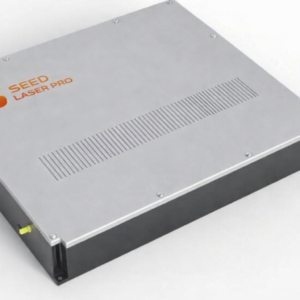
The 1064nm single frequency seed laser is the most widely used master oscillator wavelength in fiber laser systems. Nearly every high-power Ytterbium MOPA, coherent LiDAR transmitter, and 532 nm frequency-doubled green laser system starts here.
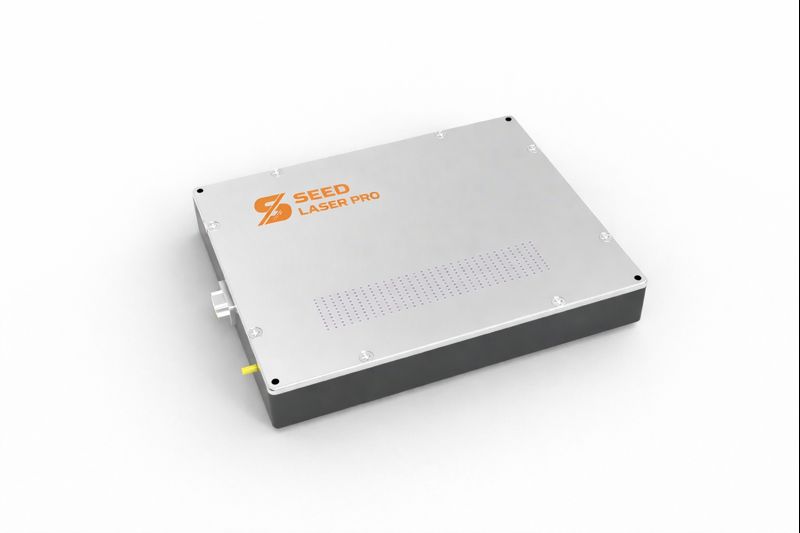
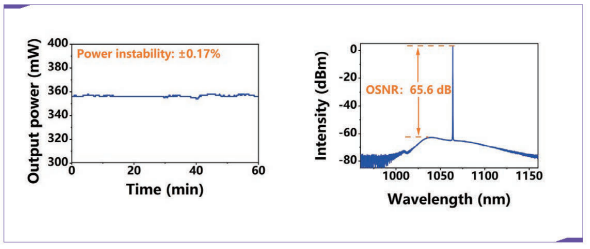
Seed Laser’s PRo 1.0 µm Industrial Single-Frequency Seed Laser is built on highly doped specialty fiber in a centimeter-scale resonator. That compact cavity design produces sub-30 kHz linewidth, single longitudinal mode output with no mode hopping, no burst noise, and RIN below -130 dBc/Hz at 5 MHz. Temperature-control protection and vibration-resistant construction are integrated into the resonator itself, keeping performance stable across operating temperatures from -10 to 45°C and under real industrial vibration and shock conditions. PM980 fiber output, 50 mW, FC/APC connector standard.
PRODUCT FEATURES
- Sub-30 kHz Linewidth, Mode-Hop-Free: Centimeter-scale specialty fiber cavity with kilohertz-level linewidth and no mode hopping across the wavelength tuning range. Mode-hop-free operation means no sudden frequency jumps during tuning or thermal variation: essential for coherent sensing and MOPA seeding applications where a mode hop would disrupt the downstream system.
- No Burst Noise, High SMSR: Burst noise, the occasional large intensity spike found in some single-frequency lasers during mode competition, is eliminated by the compact resonator design. Side-mode suppression ratio above 60 dB confirms clean single-mode operation with no competing longitudinal modes.
- Low RIN, Excellent Vibration Resistance: RIN below -130 dBc/Hz at 5 MHz. Special temperature-control and vibration-resistant resonator construction allows stable operation in environments where standard lab-grade seed lasers would lose lock or produce unstable output.
TYPICAL APPLICATIONS
- Coherent LiDAR and Laser Radar: 1064 nm is one of the two standard wavelengths for coherent LiDAR systems alongside 1550 nm. It offers stronger Rayleigh backscatter in fiber and better receiver sensitivity in some detection architectures. This seed laser’s mode-hop-free operation, sub-30 kHz linewidth, and low RIN meet the coherence and noise requirements of coherent Doppler LiDAR and range-finding systems.
- Fiber Optic Sensing: Distributed acoustic sensing (DAS), Brillouin sensing, and fiber interferometry systems at 1 µm require a seed source with stable frequency, low intensity noise, and vibration-resistant construction for field deployment. The industrial-grade design of this seed laser makes it suitable for both laboratory sensor development and deployed field instruments.
- Gravitational Wave Detection: Research-scale interferometric experiments and prototype gravitational wave detection setups use 1064 nm seed lasers as the master oscillator. Sub-30 kHz linewidth with mode-hop-free operation and low burst noise keep the interferometric baseline stable throughout long measurement runs.
- Coherent Communication: Single-frequency 1064 nm sources are used in coherent optical communication research, short-range free-space optical links, and as local oscillator references in coherent detection experiments. Low RIN and high SMSR are the primary requirements in these applications.