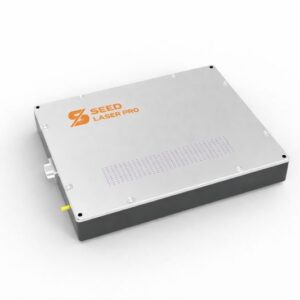
What a Point Light Source Is and Why M² Matters
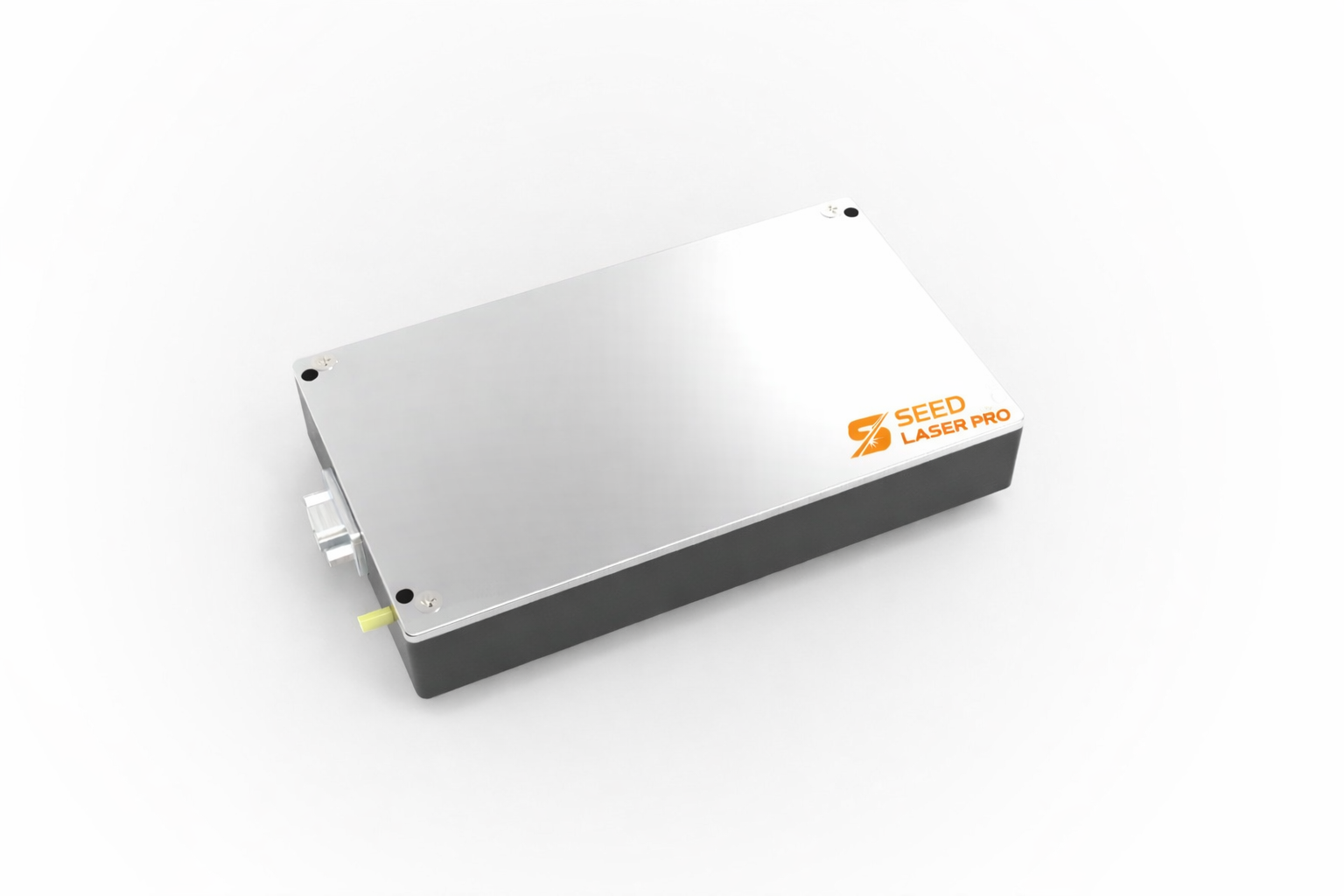
A point light source is a laser designed to approximate an ideal single spatial point emitter. In practice this means near-perfect Gaussian beam quality with M² as close to 1.0 as achievable. M² below 1.05 means this laser focuses to within 5% of the theoretical diffraction limit. At 1950 nm, the diffraction-limited spot diameter in a tight-focus setup is determined entirely by the beam quality and the focusing optic, not by aberrations or higher-order modes in the source.
This property matters for any application where the position of a focused spot must be precisely defined. In LiDAR receiver calibration, the point source is focused onto a known target or reference plane and the receiver system is aligned and characterized against that reference. In detector testing, the focused spot defines the illuminated area precisely, allowing spatial response measurements with micrometer-level positioning accuracy.
For comparison, standard 2 µm fiber laser sources have M² values ranging from 1.1 to 1.5 depending on power level and architecture. At M² below 1.05, this source produces a spot that is approximately 10 to 50% smaller in area than those alternatives at the same focusing conditions. A meaningful difference in applications where spot size determines measurement accuracy.
Eye Safety at 2 µm: Practical Advantages
The 2 µm wavelength is inherently eye-safe under international laser safety standards. The cornea absorbs 2 µm radiation before it reaches the retina. This property has direct practical consequences for applications in field-deployed instruments, automotive LiDAR systems, and industrial environments where beam access cannot always be fully controlled.
At 25 mW output power, this source operates at a power level where the eye-safe wavelength provides meaningful protection advantages compared to 1064 nm sources of equivalent power. For automotive-grade LiDAR calibration, test bench setups in non-laboratory environments, and industrial processing alignment tasks, eye-safe operation simplifies safety procedures and reduces the regulatory burden associated with beam management.
Automotive-Grade Robustness
The description of automotive-grade robustness refers to the environmental qualification standard, not just the application. Automotive-grade components are tested against temperature cycling, mechanical shock, vibration, humidity, and EMC requirements that exceed standard laboratory equipment specifications.
For a 2 µm point light source deployed in a LiDAR test fixture in a vehicle production environment, or used in a field calibration system subjected to road vibration and temperature cycling, this qualification level means the source maintains its beam quality and power stability under conditions that would degrade laboratory-grade equivalents. The -10 to 45°C operating range and stable PM1950 fiber output are consistent with this design intent.
Device Testing and 2 µm Component Characterization
Testing photodetectors, fiber components, and optical coatings at 2 µm requires a stable, well-characterized 2 µm source. The point light source provides:
- Known beam quality : M² below 1.05 makes it a predictable reference for testing the spatial response of detectors and imaging systems
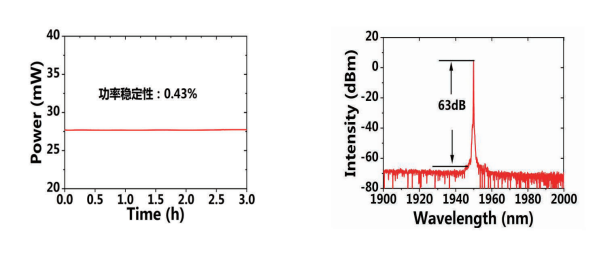
- Stable output power : P-P below 0.5% ensures measurement repeatability across test sequences
- 60 dB SNR : clean signal for sensitive detector characterization setups
- PM fiber output : defined polarization state for testing polarization-sensitive components
For testing the full 2 µm fiber component range, this source covers the characterization requirements for PM1950 couplers, circulators, and isolators at 1950 nm. See Seed Laser Pro’s 2.0 µm ASE Light Source for broadband component testing across the full Thulium gain band, and the 2.0 µm single-frequency seed and high-power range for higher-power 2 µm requirements.
Multi-Wavelength Customization
The standard configuration operates at 1950 nm. Custom wavelengths within the Thulium gain band (1940 to 2000 nm) are available. This is relevant for applications where the test wavelength must match a specific absorption feature, detector response peak, or coating specification at a wavelength other than 1950 nm.
For multi-wavelength customization, contact Seed Laser Pro with the required output wavelength, output power, fiber type, and application context.
Frequently Asked Question
What is a 2 µm point light source?
A 2 µm point light source is a compact CW laser at 1950 nm designed to produce a near-diffraction-limited beam with M² below 1.05. It approximates an ideal spatial point emitter, giving a precisely defined focused spot for alignment, calibration, positioning, and testing applications at 2 µm. Unlike seed lasers optimized for linewidth or high-power MOPA sources, this product is optimized for beam quality and spatial precision.
How does M² below 1.05 compare to standard 2 µm sources?
Most 2 µm fiber laser sources have M² values between 1.1 and 1.5 depending on power level. M² below 1.05 means the beam focuses to within 5% of the theoretical diffraction limit. In focused-spot applications, this translates to a spot area approximately 10 to 50% smaller than that of equivalent-wavelength sources with higher M² values. For micrometer-level spot positioning and detector characterization, this difference is significant.
What makes this laser suitable for automotive LiDAR calibration?
Three properties make it well suited: the eye-safe 1950 nm wavelength, the near-diffraction-limited M² below 1.05 for precise reference spot definition, and the automotive-grade robustness qualification. In vehicle production LiDAR testing environments, a stable eye-safe reference source that maintains beam quality and power stability under mechanical and thermal stress is a practical requirement that laboratory-grade sources do not always meet.
Is PM1950 or SM1950 output better for device testing?
PM1950 is required for testing polarization-sensitive components such as PM fiber circulators, polarization beam splitters, and PM-based sensors. SM1950 is sufficient for polarization-insensitive component testing including standard couplers, isolators, and photodetectors. If your test setup uses any PM fiber components between the source and the device under test, PM1950 output eliminates polarization uncertainty in the measurement.
Can the output wavelength be customized?
Yes. Custom wavelengths within the 1940 to 2000 nm Thulium gain band are available. Contact Seed Laser Pro with your target wavelength and application requirements.