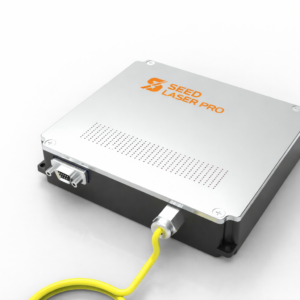
How This Differs From the 1.0 µm Phase-Modulated Seed Source
Seed Laser Pro makes phase-modulated seed sources at both 1.0 µm and 1.5 µm. They share a common principle but serve distinctly different applications with different engineering priorities.
| Feature | 1.0 µm Phase-Modulated Seed | This 1.5 µm Version |
| Wavelength | 980 to 1120 nm | 1530 to 1560 nm |
| Bandwidth range | Up to 100 GHz | 0.1 to 40 GHz |
| Output power | 20 mW | 50 mW |
| Primary goal | Maximum SBS suppression for kW-class MOPA | Low phase noise + controlled bandwidth for quantum, DAS, LiDAR |
| PM optical path | Standard | All-polarization-maintaining throughout |
| Phase noise spec | Not the primary emphasis | Ultra-low phase noise explicitly specified |
The 1.0 µm version is optimized for one thing: raising the SBS threshold of downstream high-power Ytterbium amplifiers as high as possible. Maximum bandwidth means maximum SBS suppression means maximum power delivery.
This 1.5 µm version is optimized for precision. The 0.1 to 40 GHz bandwidth range is not about maximizing SBS suppression. it is about precisely controlling the spectral characteristics of the output for applications where phase noise, polarization purity, and spectral shape all directly affect system performance. The all-PM optical path ensures that the polarization state of every photon in the modulation chain is maintained, eliminating polarization-related noise sources that compromise quantum communication and coherent sensing applications.
For the 1.0µm version targeting high-power MOPA seeding, see Seed Laser Pro’s 1.0 µm Phase-Modulated Fiber Seed Source.
Why Low Phase Noise and All-PM Construction Matter Together
Phase noise and polarization purity are related in quantum and coherent sensing applications in a way that makes it necessary to address both simultaneously.
Phase noise in the seed laser manifests as random frequency jitter. In a coherent detection architecture, this jitter appears as noise in the Doppler frequency measurement or in the quadrature components of the detected signal. Ultra-low phase noise minimizes this contribution, keeping the seed laser below the signal noise floor of the downstream detection system.
Polarization instability generates a different but equally harmful noise mechanism. When the polarization state of the modulated seed drifts or fluctuates, the interference visibility in coherent detection drops and becomes time-varying. In DAS systems, this produces fading; signal dropouts at points along the sensing fiber where the local polarization state produces near-zero interference visibility. In quantum communication, polarization noise introduces errors in the quantum state being encoded or detected.
An all-polarization-maintaining optical path eliminates polarization-induced noise at the source level, before it can propagate into the amplifier chain or detection system. Combined with ultra-low phase noise, the result is a seed source that contributes minimally to every noise budget in the downstream system.
Application
Optical Quantum Communication
Quantum key distribution and continuous-variable quantum communication systems operating at 1550nm use phase-encoded or amplitude-quadrature-encoded signals. The security and fidelity of these protocols depend on the classical laser source having phase noise below a threshold set by the quantum signal level being detected. Ultra-low phase noise at the seed stage carries through amplification, keeping the classical reference below the quantum signal floor.
All-PM construction ensures the polarization state of the local oscillator in homodyne or heterodyne detection matches the signal polarization throughout the system, maximizing detection efficiency and minimizing basis mismatch errors in polarization-encoded protocols.
Distributed Acoustic Sensing
DAS systems launch coherent light into a sensing fiber and analyze Rayleigh backscatter signals along the fiber length to detect vibration, acoustic events, and strain. Phase-modulated CW seeds are used in specific DAS architectures where the controlled bandwidth of the modulated source determines the spatial resolution and fading immunity of the measurement.
Polarization fading, signal dropout caused by random local birefringence in the sensing fiber. It is one of the primary noise sources in DAS. An all-PM seed source combined with polarization diversity in the receiver architecture suppresses fading and improves signal continuity along the full sensing fiber length.
Coherent LiDAR
Coherent LiDAR systems using frequency-modulated continuous wave (FMCW) or other coherent ranging techniques require a seed with controllable spectral characteristics and low phase noise to achieve the velocity resolution and ranging accuracy the system is designed for. The 0.1 to 40 GHz adjustable bandwidth range allows the spectral width to be matched to the coherent receiver’s IF bandwidth, optimizing the signal-to-noise ratio for the target detection scenario.
Femtosecond Micromachining
Ultrashort pulse micromachining systems based on 1550nm fiber lasers use phase-modulated seeds in specific pulse synthesis architectures where the spectral coherence and phase properties of the seed determine the achievable pulse duration and quality after compression. Ultra-low phase noise at the seed stage reduces temporal jitter in the output pulse train, which is critical for precision ablation and surface structuring applications.
Bandwidth Selection: 0.1 to 40 GHz Range
The continuously adjustable bandwidth from 0.1 to 40 GHz gives system designers precise control over the spectral properties of the seed output.
At 0.1 GHz (100 MHz), the output is only slightly broadened from a single-frequency source. Coherence length remains in the kilometer range. This setting suits applications requiring low phase noise with minimal spectral broadening, such as quantum communication local oscillator generation.
At intermediate settings of 1 to 10 GHz, the spectral width covers typical DAS and coherent LiDAR intermediate frequency ranges, matching the seed bandwidth to the coherent receiver’s processing window.
At 40 GHz, significant spectral broadening provides SBS suppression for high-power Erbium amplifier seeding while maintaining the low phase noise and all-PM polarization purity that are absent in the 1.0 µm phase-modulated product optimized purely for SBS management.
FAQ
What is the difference between this 1.5µm phase-modulated seed and the 1.0µm version?
The 1.0µm version targets maximum SBS suppression for kilowatt-class Ytterbium MOPA systems, with bandwidth up to 100GHz and 20mW output. This 1.5µm version targets ultra-low phase noise and all-PM optical path construction for quantum communication, DAS, and coherent LiDAR at 1550nm, with 0.1 to 40GHz bandwidth and 50mW output. The two products share the phase modulation principle but serve fundamentally different applications and optimize for different performance properties.
Why is an all-polarization-maintaining optical path important for DAS applications?
Polarization fading caused by random birefringence in the sensing fiber. It is one of the primary noise sources in DAS systems. An all-PM seed source provides a well-defined, stable polarization state at the laser output, which, combined with polarization diversity in the receiver, suppresses fading and improves measurement continuity along the sensing fiber. A seed with an unstabilized polarization state injects polarization noise at the source that cannot be fully corrected in the receiver.
What bandwidth setting should I use for DAS applications?
DAS architectures vary in their bandwidth requirements depending on the pulse or modulation scheme used. Typical coherent DAS systems use seeds with bandwidths in the 1 to 10 GHz range matching the coherent receiver IF bandwidth. Contact Seed Laser Pro with your specific DAS architecture — pulse duration, sensing range, and spatial resolution requirements — for a recommended bandwidth setting.
Can this seed be used to drive a high-power Erbium fiber amplifier?
Yes. PM1550 fiber output and 0.1 to 40GHz bandwidth range make this suitable for seeding Erbium-band PM fiber amplifiers. At 40GHz bandwidth, SBS suppression is sufficient for multi-watt amplifier output. For the highest power 1550nm amplification requirements, see Seed Laser Pro’s 1.5µm high-power single-frequency laser range.
Is the bandwidth continuously adjustable or stepped?
Bandwidth is set by controlling the RF drive power to the phase modulator. Adjustment is continuous within the 0.1 to 40GHz range. Contact Seed Laser Pro for specific bandwidth control interface options relevant to your system architecture.