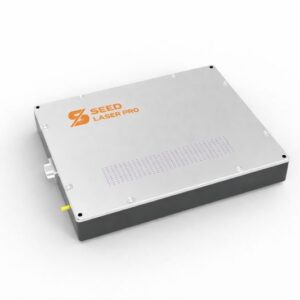
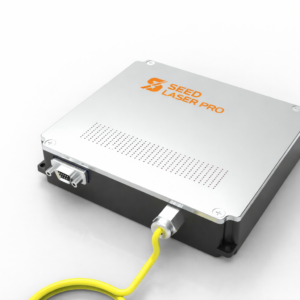
Adjustable Linewidth: A Different Engineering Tool
Every other seed laser in Seed Laser Pro’s 1.0 µm range targets the narrowest possible linewidth — sub-30 kHz for industrial seeding, even narrower for frequency-stabilized configurations. This product targets the opposite specification deliberately, and the reason is the same SBS problem that limits all high-power single-mode fiber delivery.
Stimulated Brillouin Scattering converts forward-propagating signal power into backward-propagating Stokes noise once the power density in a single-mode fiber core exceeds a threshold set by the spectral width of the input. A sub-30 kHz seed reaches that threshold at relatively low power. Broadening the linewidth into the GHz range raises the threshold by orders of magnitude, because the optical power is now distributed across a much wider spectral band rather than concentrated at one frequency.
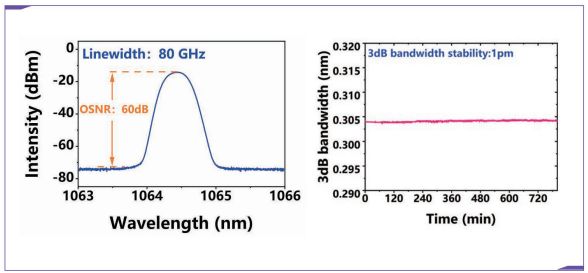
The distinguishing feature of this product compared to a fixed-broadening solution is that the spectral width is adjustable by controlling RF drive power to the phase modulator. This allows the same seed module to be configured for different amplifier architectures and different target output powers, rather than requiring a separate fixed-linewidth seed for each system design.
For high-power 1064nm systems built around this seeding approach, see Seed Laser Pro’s 1.0 µm high-power single-frequency laser range spanning 0.2W through 500W.
Spectral Width Selection Guide
| Spectral Width Setting | SBS Suppression Level | Typical MOPA Output Range |
| Several GHz | Moderate | Tens of watts |
| 20 to 50 GHz | Strong | Hundreds of watts |
| Up to 100 GHz | Maximum available on this product | Highest power MOPA configurations |
These figures are approximate and depend on fiber type, gain stage design, and total amplifier length. Seed Laser Pro’s engineering team can recommend the appropriate setting for a specific amplifier architecture and target output power.
Application Context
High-Power Narrow-Linewidth Laser Seeding
The term is not contradictory. The seed itself is broadened, but the goal is to maximize the achievable output power of the downstream amplifier system while keeping the final delivered linewidth within an acceptable range for the application. This seed source is the input stage for high-power MOPA systems where SBS would otherwise cap achievable power well below the thermal and gain limits of the amplifier hardware.
Spectral Synthesis
Spectral synthesis combines multiple distinct optical frequencies or wavelength channels into a single coherent or quasi-coherent output, used in applications such as multi-wavelength laser radar, hyperspectral illumination, and certain photonic signal processing architectures. Controlled, adjustable spectral width at each channel allows the synthesis system to manage coherence properties and channel spacing precisely across the combined output.
Coherent Beam Combining
Coherent beam combining architectures seed multiple parallel amplifier chains from a common master oscillator and recombine the outputs with active phase control. Matching the spectral characteristics across all seeded channels, including a controlled, adjustable linewidth, supports more predictable combining efficiency and simplifies the phase-locking control loop design compared to mismatched or uncontrolled seed spectral properties.
Why Wavelength Tuning Across the Full Band Matters Here
The 980 to 1120 nm tuning range covers the full Ytterbium gain bandwidth. For high-power MOPA seeding specifically, the ability to set the exact center wavelength within this range allows the seed to be matched to the peak gain wavelength of a specific amplifier fiber batch, or to be offset slightly to manage gain competition in multi-stage amplifier chains. Combined with the adjustable spectral width, this gives system integrators two independent controls — center wavelength and linewidth — for optimizing a specific high-power amplifier design.
FAQ
What does phase modulation do to a single-frequency seed laser?
An electro-optic phase modulator applies a controlled, time-varying phase shift driven by an RF signal. In the frequency domain, this spreads the laser’s spectral output from a narrow single-frequency line into a broader band whose width depends on the RF drive power. This product allows that spectral width to be adjusted up to 100 GHz, giving direct control over the SBS threshold of downstream fiber amplifier stages.
Why would I want to broaden linewidth instead of keeping it narrow?
For high-power amplification through single-mode fiber, narrow linewidth lowers the threshold at which Stimulated Brillouin Scattering begins limiting achievable output power. Broadening the seed linewidth into the GHz range raises that threshold, allowing the amplifier chain to reach much higher output power before SBS becomes limiting. This is a deliberate trade-off: a wider seed linewidth in exchange for substantially higher achievable system output power.
How is the spectral width adjusted on this product?
Spectral width is controlled by adjusting the RF drive signal power applied to the phase modulator. Higher RF power produces wider spectral broadening, up to the 100 GHz maximum specified for this product. This can be configured for a specific target spectral width matched to a downstream amplifier’s SBS threshold requirement.
Is this seed compatible with coherent beam combining systems?
Yes. The single longitudinal mode CW output, PM980 fiber, and adjustable controlled linewidth make this suitable as a common master oscillator seeding multiple parallel amplifier branches in a coherent beam combining architecture. Matched spectral properties across seeded channels support predictable combining performance.
Can the center wavelength be set anywhere within 980 to 1120nm?
Yes. The wavelength tuning range covers the full 980 to 1120 nm Ytterbium gain band. Contact Seed Laser Pro to specify the exact center wavelength required for your application, which can be matched to a specific amplifier fiber’s peak gain wavelength or set for other system design reasons.