The Difference Between This and the Frequency-Stabilized Sensing Laser
Seed Laser Pro makes two frequency-stabilized 1550 nm products. Understanding the difference between them is the first step to selecting the right one.
The Frequency-Stabilized Laser for High-Sensitivity Sensing is a standalone source. Its dual closed-loop stabilization system works internally, a fast piezoelectric loop suppresses short-term noise, a slow thermal loop corrects long-term drift. No external reference is required. The laser stabilizes itself and delivers a clean output for direct use in fiber sensing, spectroscopy, and standalone interferometric setups.
This Frequency-Stabilized Laser Seed Source is built for a different architecture. It incorporates error signal extraction technology, which means the laser outputs not just the optical signal but also the error signal needed for an external control loop to actively lock the laser frequency to a reference. That reference could be an external optical cavity, an atomic transition, an optical frequency comb, or another frequency standard relevant to the quantum technology or precision measurement system the laser is being integrated into.
This is a seed source in the specific sense that it is designed for integration as the master oscillator in a larger system with its own control architecture, not as a self-contained instrument.
| Feature | Freq-Stabilized Sensing Laser | This Seed Source |
|---|
| Stabilization type | Internal dual closed-loop | Error signal extraction for external locking |
| Reference required | None, self-contained | External optical or atomic reference |
| Primary role | Standalone source | Master oscillator in larger system |
| Environmental compensation | Intelligent on-board | System-level (handled externally) |
| Target buyer | Sensing instrument builder | Quantum tech / precision measurement integrator |
Error Signal Extraction: What It Enables
Error signal extraction is the technique at the core of most high-performance frequency locking schemes. In a Pound-Drever-Hall (PDH) lock, the laser frequency is modulated at a radio frequency, and the reflected signal from a reference cavity is demodulated to produce an error signal. That error signal is fed back to the laser’s frequency actuator to lock the laser to the cavity resonance.
For this to work, the laser must produce an output that can be modulated and whose frequency response is fast enough to follow the feedback correction signal. The error signal extraction technology specified for this seed source is designed around exactly this requirement — providing an accessible signal path for the external control loop to use.
The practical consequence for quantum technology applications is significant. Quantum sensing platforms, optical atomic clocks, and quantum computing control loops that require a 1550 nm reference laser typically lock it to an ultra-stable optical cavity or an optical frequency comb output. Having a seed laser with built-in error signal extraction architecture eliminates custom engineering of the locking interface, shortening integration time substantially.
Why ±500 kHz RMS Over 2 Hours Matters as a Seed Specification
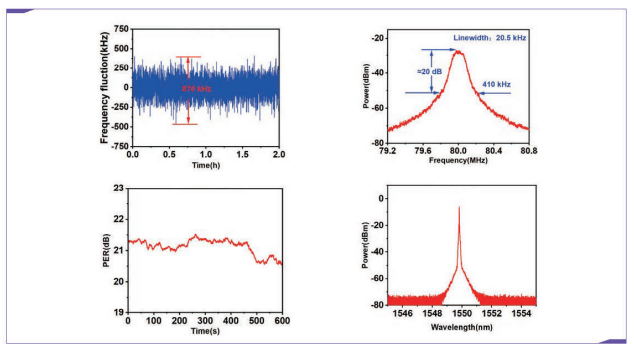
±500 kHz RMS frequency drift over two hours is the specification that applies to this laser operating without external locking. that is, with only the on-board noise suppression scheme active.
When this laser is locked to an external reference using the error signal extraction output, the achieved frequency stability is determined by the external loop, the reference cavity or atomic standard, and the laser’s frequency actuator response; not by the ±500 kHz free-running specification. The free-running spec defines how stable the laser is as a starting point before the external loop is closed.
For a seed laser going into a quantum technology system where it will always be externally locked, ±500 kHz free-running stability means the external control loop’s capture range and lock acquisition are straightforward, even without advanced pre-search routines.
Seeding High-Power 1550 nm MOPA Systems
This seed source connects directly to Erbium-doped PM1550 fiber amplifier input stages. PM1550 output with PER above 20 dB ensures the amplifier receives a well-defined polarization state, which is required for PM amplifier chains used in coherent beam combining and precision interferometry applications where the amplified output must maintain a defined polarization relationship with other system elements.
The frequency stability and error signal architecture carry through amplification. A seed locked to an external reference via the error signal output produces an amplified output at the same locked frequency, with the frequency control provided by the master oscillator inheriting into the amplified output.
For the downstream high-power 1550 nm amplifier options, see Seed Laser Pro’s 1.5 µm 0.2 to 2W High-Power Single-Frequency Laser and 1.5 µm 2 to 20W configuration.
Frequently asked questions
What is the difference between this and the Frequency-Stabilized Laser for High-Sensitivity Sensing?
The Frequency-Stabilized Laser for High-Sensitivity Sensing is a self-contained instrument with internal dual closed-loop stabilization requiring no external reference. This Frequency-Stabilized Laser Seed Source incorporates error signal extraction technology for integration into systems that actively lock the laser frequency to an external reference such as an optical cavity or atomic transition. This product is a master oscillator component for a larger system, not a standalone instrument.
What is error signal extraction and why does it matter?
Error signal extraction provides the control signal needed for an external feedback loop to lock the laser frequency to a reference. In a PDH locking scheme, the error signal is derived from the interaction between the modulated laser output and a reference cavity. The error signal extraction technology built into this laser provides an accessible interface for that external control loop, enabling tight frequency locking to cavity resonances, atomic references, or optical frequency comb outputs used in quantum technology platforms.
What does ±500 kHz RMS drift over 2 hours represent for this seed laser?
This is the free-running frequency stability of the laser with only its on-board noise suppression active and no external locking applied. When integrated into a system with an active external frequency lock, the achieved stability is determined by the external loop and reference. The ±500 kHz free-running specification defines the starting point that the external loop works from and sets the capture range requirement for initial lock acquisition.
Is this laser suitable as a master oscillator in a coherent beam combining system?
Yes. PM1550 output, single longitudinal mode CW operation, and error signal extraction make this suitable as the master oscillator in coherent beam combining architectures using 1550 nm Erbium-band amplifiers. The frequency control provided by the external lock applied via the error signal output maintains the phase relationship across all seeded amplifier branches.
What downstream amplifiers are compatible with this seed source?
PM1550 fiber amplifiers in the Erbium gain band are directly compatible. Seed Laser Pro’s 1.5 µm high-power single-frequency laser range covers 0.2 W to 120 W in the same PM1550 fiber architecture. Contact Seed Laser Pro with your target output power and system architecture for configuration recommendations.