The Gap This Laser Fills
The commercial 1550nm single-frequency fiber laser market has a clear power gap. Compact seed modules top out at 100 to 500 mW. Broad-spectrum multimode sources reach 10W but without single-frequency operation. CW single-frequency PM output at 2W is available from several suppliers. Above 2W in CW single-frequency at 1550nm with sub-kHz linewidth, the options drop sharply.
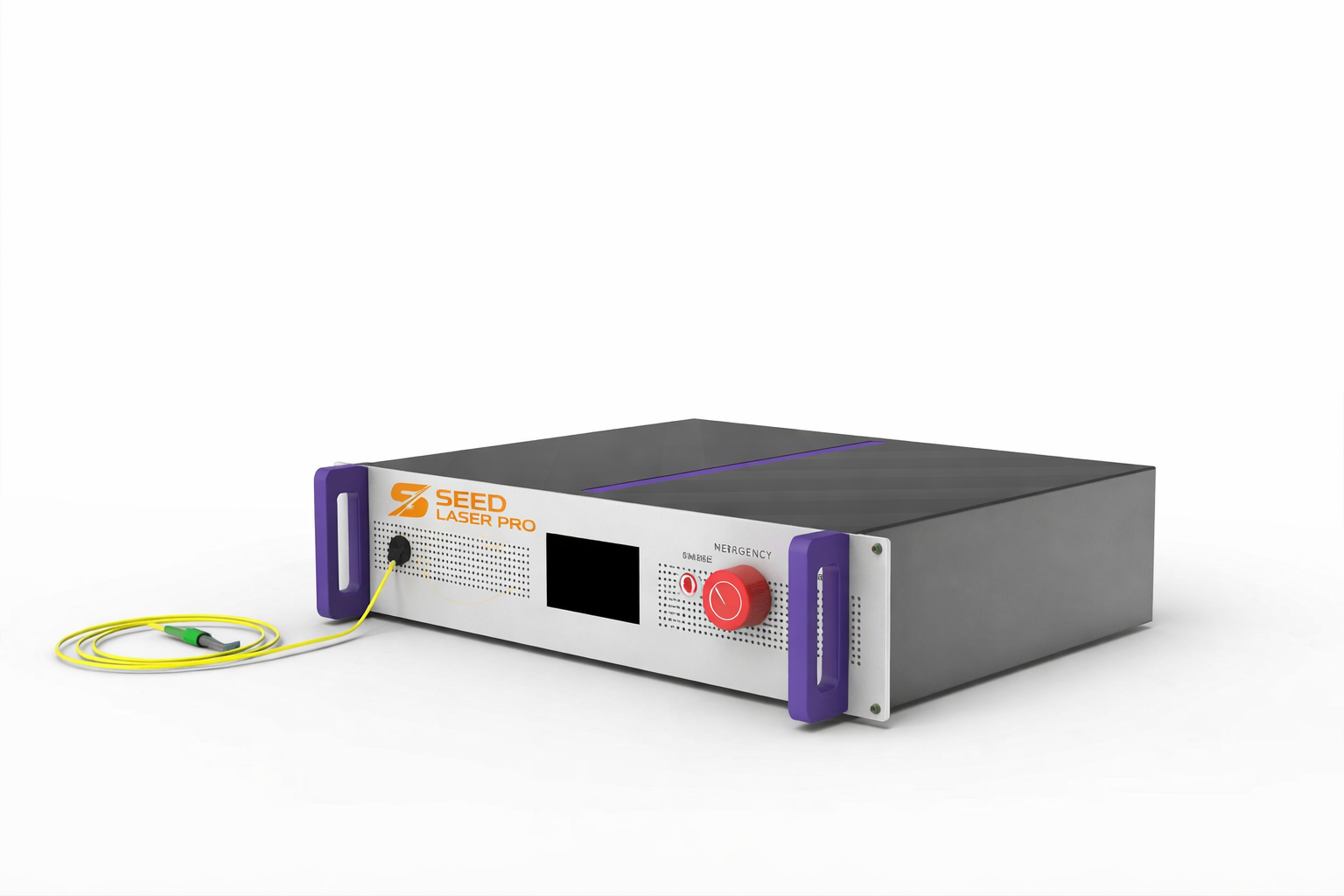
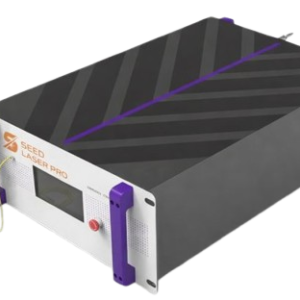
Seed Laser Pro’s 2 to 20W configuration fills that gap directly. It is not a repackaged seed module with extra gain. It is a dedicated two-stage MOPA architecture engineered to maintain 100 Hz to 2 kHz linewidth at 10W typical output, with the SBS suppression and noise management that this power level demands.
For the 0.2 to 2W entry tier, see the 1.5 µm 0.2 to 2W configuration. For requirements above 20W, see the 1.5 µm 20 to 120W configuration.
Hundred-Hertz Linewidth at Watt-Level Power
100 Hz linewidth at 10W output is not a spec that appears often. Here is why it matters and what it requires.
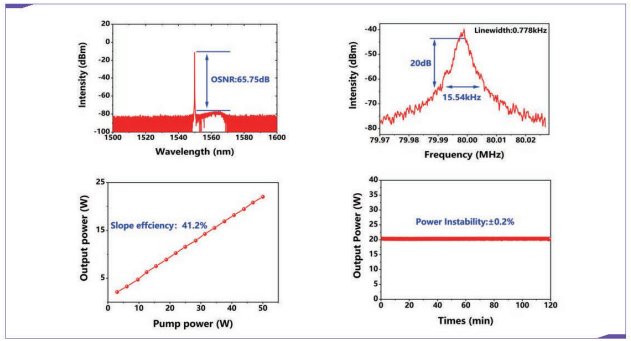
Linewidth at the output of a MOPA system is not the same as linewidth at the seed. SBS in the amplifier fiber generates a backward-propagating Stokes wave that can broaden the effective output linewidth and reduce output coherence. Managing SBS while scaling power requires a combination of fiber selection, power distribution across gain stages, and active suppression measures.
This laser integrates all of these. The 0.1 kHz minimum linewidth specification reflects performance at reduced power settings. The 0.8 kHz typical value at 10W output represents the real-world operating point for most applications. At 100 Hz linewidth, the coherence length exceeds 950 km, which is the performance tier used in gravitational wave interferometer input stages and advanced atom interferometry platforms.
For comparison, most competitors offering 1550nm fiber lasers at this power level are multimode sources with no linewidth specification. Those that do specify linewidth typically quote the seed stage value, not the verified output value. Seed Laser Pro specifies and verifies linewidth at the output.
Why Each Use Case Needs This Power Level
Coherent Doppler Wind LiDAR
Coherent Doppler wind LiDAR measures wind velocity by detecting the Doppler frequency shift of backscattered 1550nm light from atmospheric aerosols. Detection range scales with transmit power. Systems measuring at ranges beyond 5 km require sustained average power in the multi-watt range to maintain adequate signal-to-noise ratio against atmospheric attenuation.
Single-frequency operation is essential. A multimode source produces incoherent backscatter that cannot be processed for Doppler velocity extraction. The 2 to 20W range covers both short-range high-resolution systems at the lower power end and long-range monitoring systems at higher power. QBH connector output suits the fiber-to-telescope coupling architectures used in most deployed wind LiDAR transceivers.
Gravitational Wave Detection Research
Advanced interferometric gravitational wave detectors use high-power 1550nm input lasers to achieve shot-noise-limited sensitivity. Research programs developing next-generation detectors, testing new optical configurations, and characterizing noise sources all require high-power single-frequency sources with sub-kHz linewidth that can be integrated into precision optical setups.
The 2 to 20W range covers tabletop research interferometers and prototype detector input stages where the full power of observatory-scale systems is not needed but single-frequency performance is mandatory. The 2U rack format and PM output option suit both laboratory optical tables and instrument rack integration.
Distributed Acoustic Sensing and Distributed Fiber Sensing
DAS systems launch high-power coherent pulses into sensing fiber and detect Rayleigh backscatter along the fiber length. Longer sensing range requires higher launch power. CW single-frequency operation at high power allows continuous coherent interrogation of the sensing fiber for applications requiring real-time acoustic event detection over pipeline, perimeter, or infrastructure monitoring deployments.
Nonlinear Frequency Conversion
High average power at 1550nm seeds optical parametric oscillators and difference frequency generation systems targeting mid-infrared wavelengths in the 3 to 5 µm range. Single-frequency input maximizes conversion efficiency in the nonlinear crystal. 10 to 20W average CW power provides sufficient pump intensity for efficient OPO threshold operation without requiring pulsed architectures.
Output Connector Guide
Three output formats are available. The right choice depends on the downstream system.
Bare fiber: For laboratory setups, splice integration, or custom connector termination. The fiber end is cleaved and unconnectorized. Suitable when the installation environment dictates a specific connector type not listed as standard.
QBH (end cap): The standard high-power fiber connector for multi-watt delivery. The end cap expands the beam at the fiber exit to reduce power density at the connection point. Required for reliable operation above 5W in most system configurations. Standard for wind LiDAR and sensing system integration.
QCS collimator: Delivers a free-space collimated beam from the fiber output. Used when the downstream optical system requires free-space beam shaping, telescope input coupling, or spatial filtering before the target.
PM and non-PM output are both available. PM output preserves linear polarization state and is required for polarization-sensitive downstream components. Non-PM output is available when polarization is managed externally or is not a system constraint.
Why Seed Laser Pro vs Other 1550nm Suppliers
| Feature | Most Competitors | Seed Laser Pro |
|---|
| Max CW single-frequency 1550nm | 2W | 20W |
| Linewidth at output | Often unstated or seed-stage only | Verified at output, 0.1 to 2 kHz |
| PM output | Sometimes | Standard, always available |
| QBH connector | Rarely available | Standard option |
| OEM custom configs | Limited | Full custom engineering support |
| Global supply | Variable | Yes, USA / Europe / Asia |
Seed Laser Pro manufactures all products in-house with 20 years of single-frequency fiber laser experience. Every unit is tested against linewidth, output power, power stability, and PER before shipment.
Frequently Asked Questions
What is the difference between the 0.2 to 2W and 2 to 20W 1550nm configurations?
The 0.2 to 2W version is a single-stage MOPA in a compact 200 × 175 mm module with PM1550 FC/APC output, suited for coherent sensing seeds, interferometry, and OPO pump stages at moderate power. The 2 to 20W version uses a two-stage MOPA with integrated SBS suppression in a 2U rack format, reaching 10x higher power with QBH or bare fiber output for systems requiring multi-watt delivery. The two-stage design also achieves narrower linewidth — 100 Hz minimum versus 3 kHz in the lower power tier.
Why does hundred-hertz linewidth matter at 1550nm?
At 100 Hz linewidth, the coherence length of the 1550nm output exceeds 950 km. For gravitational wave research interferometers, this coherence length far exceeds the optical path difference in any laboratory-scale system. For advanced DAS systems where phase coherence over long sensing fiber lengths determines spatial resolution, sub-kHz linewidth eliminates coherence-related noise that would otherwise limit the sensing range.
What is QBH and when do I need it?
QBH is a standardized high-power fiber connector with an end cap that expands the beam diameter at the output face, reducing power density and preventing connector damage at multi-watt power levels. For systems running above 5W in regular operation, QBH is the standard choice. FC/APC connectors are not rated for reliable continuous operation at these power levels and should not be used as the primary output connector above approximately 2W.
Is this laser eye-safe at 1550nm?
1550nm falls within the eye-safe wavelength range as defined by international laser safety standards (IEC 60825-1). At this wavelength, the cornea and lens absorb incident light before it reaches the retina. This allows higher outdoor power levels for LiDAR and atmospheric sensing deployments than are permitted at 1064nm under equivalent regulatory frameworks. Specific power limits depend on application, beam diameter, and exposure conditions. Always verify compliance with applicable safety standards for your specific deployment.
Can this laser be supplied for OEM integration outside China?
Yes. Seed Laser Pro supplies this product to research institutions, defense contractors, and instrument manufacturers in North America, Europe, Japan, and South Korea. Custom configurations including wavelength, fiber type, connector, control interface, and form factor are available. Contact Seed Laser Pro with your specification and delivery location for lead time and pricing.