seed laser pro

1.0 μm High-Power Single-Frequency Laser (2–20 W)

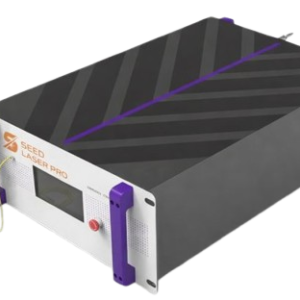
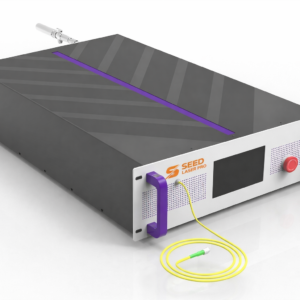
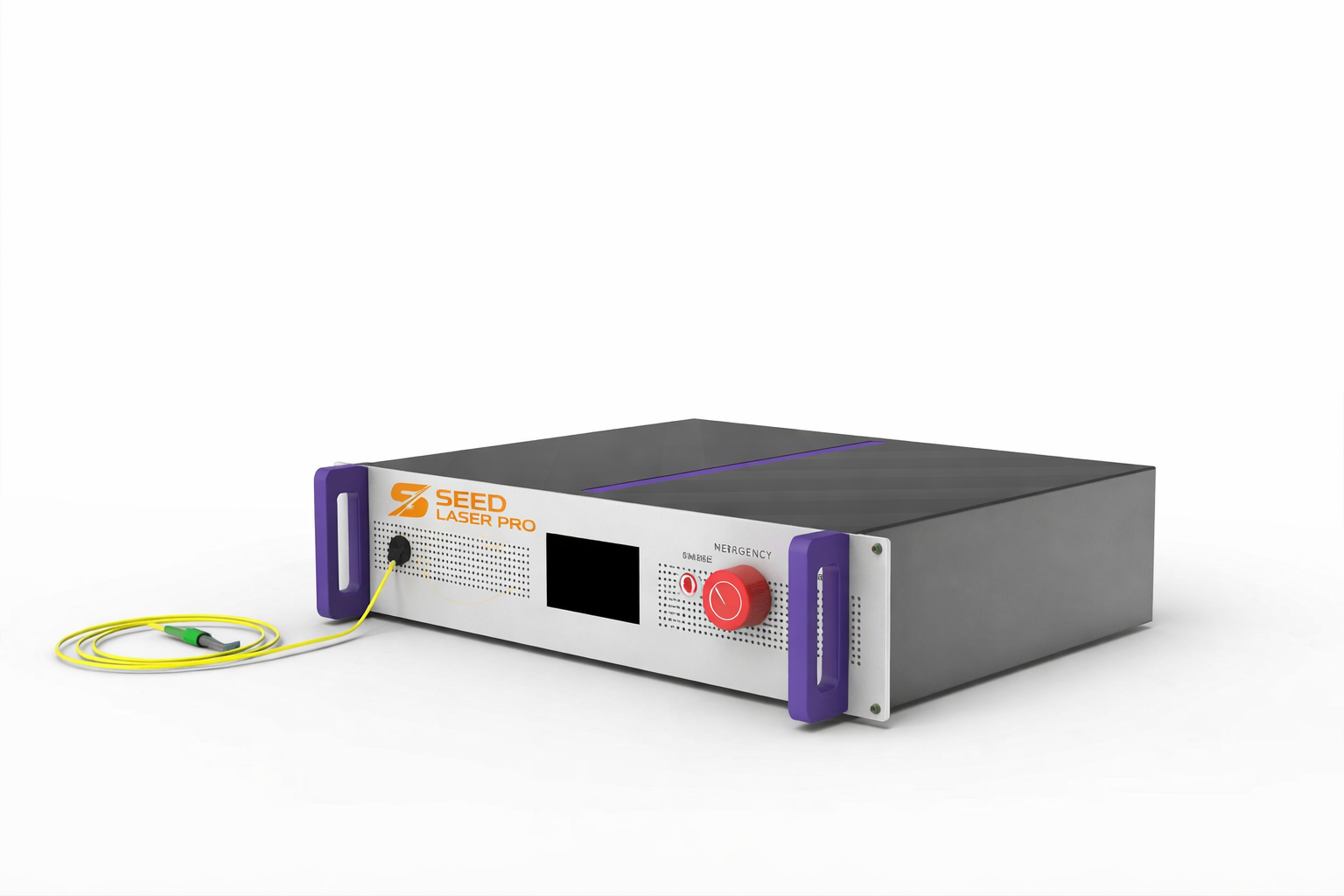
Seed Laser Pro’s 1.0 µm High-Power Single-Frequency Laser delivers 2 to 20W of CW output with linewidth as low as 500 Hz. Built on a two-stage MOPA architecture with integrated nonlinear effect suppression and noise suppression, it maintains single longitudinal mode operation and M² below 1.1 throughout the power range. PM10/125 fiber output, 2U rack mount, power consumption below 200W. Built for green light frequency doubling, coherent beam combining, and high-power fiber sensing.

Product Features

  • 2 to 20W CW output, linewidth 0.5 to 10 kHz, single longitudinal mode across full power range
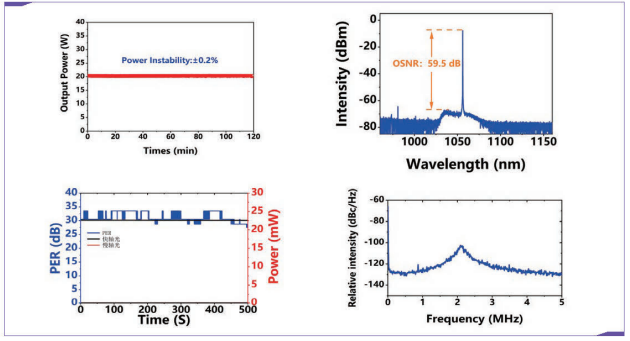
  • M² below 1.1, PM10/125 fiber output, PER 18 dB, quasi-collimator option available
  • Two-stage MOPA with nonlinear effect suppression and noise suppression integrated
  • RMS power stability below 0.2%, 2U rack format, power consumption below 200W

Typical Applications

  • Green light frequency doubling via SHG to 532 nm for quantum optics and precision processing
  • Coherent beam combining as master oscillator seed for parallel amplifier architectures
  • High-power fiber sensing and distributed acoustic sensing at 1 µm
  • Holography, laser Doppler velocimetry, and precision interferometry requiring high-power narrow linewidth
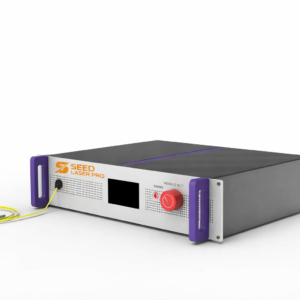
1.0 μm High-Power Single-Frequency Laser (2–20 W)
Technical ParameterUnitTechnical Specifications
MinTypicalMax
Wavelength Rangenm980–1120
Optical Mode/Single Longitudinal Mode, Continuous Wave
Output PowerW1020
LinewidthkHz0.510
Optical Signal-to-Noise RatiodB50
Output Power Stability%RMS < 0.2   /   P-P < 1
Output Power Adjustment%10100
Polarization Extinction RatiodB18
Beam Quality/M² < 1.1
Output Fiber Lengthm1
Power ConsumptionW200
Operating Temperature°C02230
Output Fiber Type/PM10/125, Optional
Output Fiber Connector/Quasi-Collimator, Optional
Dimensionsmm450(L) × 482.6(W) × 88.9(H) (2U Rack)

Step Up from 2W: Why This Power Tier Exists

The 0.2 to 2W tier seeds amplifier chains and drives low-power SHG stages. At 2 to 20W, the application requirements shift.

Green frequency doubling at this power level produces 600 mW to 6W of 532 nm output in an efficient SHG stage, covering quantum optics experiments, holographic recording, and precision processing applications that need more than a few hundred milliwatts of green. Coherent beam combining architectures seeded at this level can deliver combined outputs in the hundreds of watts range. High-power DAS and fiber sensing systems with long sensing ranges need this power level to maintain adequate signal-to-noise ratio over the full sensing fiber.

The two-stage MOPA architecture is what makes this power range possible at sub-kHz linewidth. A single amplifier stage at 20W output would face SBS limitations without linewidth management. The two-stage design with integrated nonlinear suppression maintains 0.5 to 10 kHz linewidth at full power.

Sub-kHz Linewidth at 20W

Sub-kHz linewidth at 20W output is not standard. Most 20W class 1064nm fiber lasers are multimode or have linewidths in the MHz range. Single-frequency operation at this power requires careful SBS suppression throughout the amplifier chain.

The 0.5 kHz minimum linewidth at 10W typical output gives a coherence length above 95 km. For coherent beam combining, this coherence length far exceeds the path-length differences between amplifier branches in any practical system. For SHG, the narrow linewidth maximizes phase-matching efficiency in the nonlinear crystal.

For applications needing higher power at the same spectral quality, see Seed Laser Pro’s 1.0 µm high-power laser in the 20 to 500W range. For 532 nm output directly, see the 532 nm frequency-converted laser.

FAQ

How does this differ from the 0.2 to 2W version?

The 0.2 to 2W version uses a single-stage MOPA in a compact 200 × 175 mm module. This 2 to 20W version uses a two-stage MOPA with integrated SBS suppression in a 2U rack format, reaching 10x higher output power at comparable linewidth. The output fiber is PM10/125 rather than PM980, suitable for higher power handling.

What is PM10/125 fiber and why is it used here?

PM10/125 is a large-mode-area polarization-maintaining fiber with a 10 µm core and 125 µm cladding. The larger core compared to PM980 reduces power density at a given output power, which raises the damage threshold and reduces nonlinear effects at watt-level output powers. It is the standard output fiber for the 2 to 20W power tier in single-frequency fiber laser systems.

What does nonlinear effect suppression mean in this context?

At 10 to 20W output in single-mode fiber, stimulated Brillouin scattering converts forward-propagating signal light into backward-propagating noise. This degrades SNR and limits achievable output power. Seed Laser Pro integrates suppression measures within the two-stage MOPA design to raise the SBS threshold, allowing full rated output power while maintaining sub-kHz linewidth.

Translate »