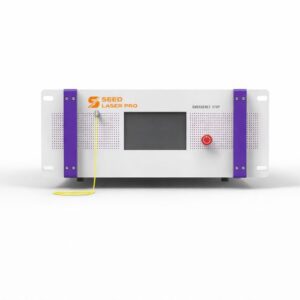
The Commercial Gap at 2 µm High Power
At 1064nm and 1550nm, multiple suppliers offer CW single-frequency fiber lasers above 10W. At 2 µm, the commercial market stops at 2W for single-frequency CW output. Above that, what is available is either multimode, pulsed, or comes with no linewidth specification at the output.
This creates a real problem for researchers and engineers who need 2 µm single-frequency CW power for OPO pumping, wind LiDAR, or high-power spectroscopy. They either use an underpowered seed module and add a custom amplifier chain, or they compromise on spectral quality by using a multimode source.
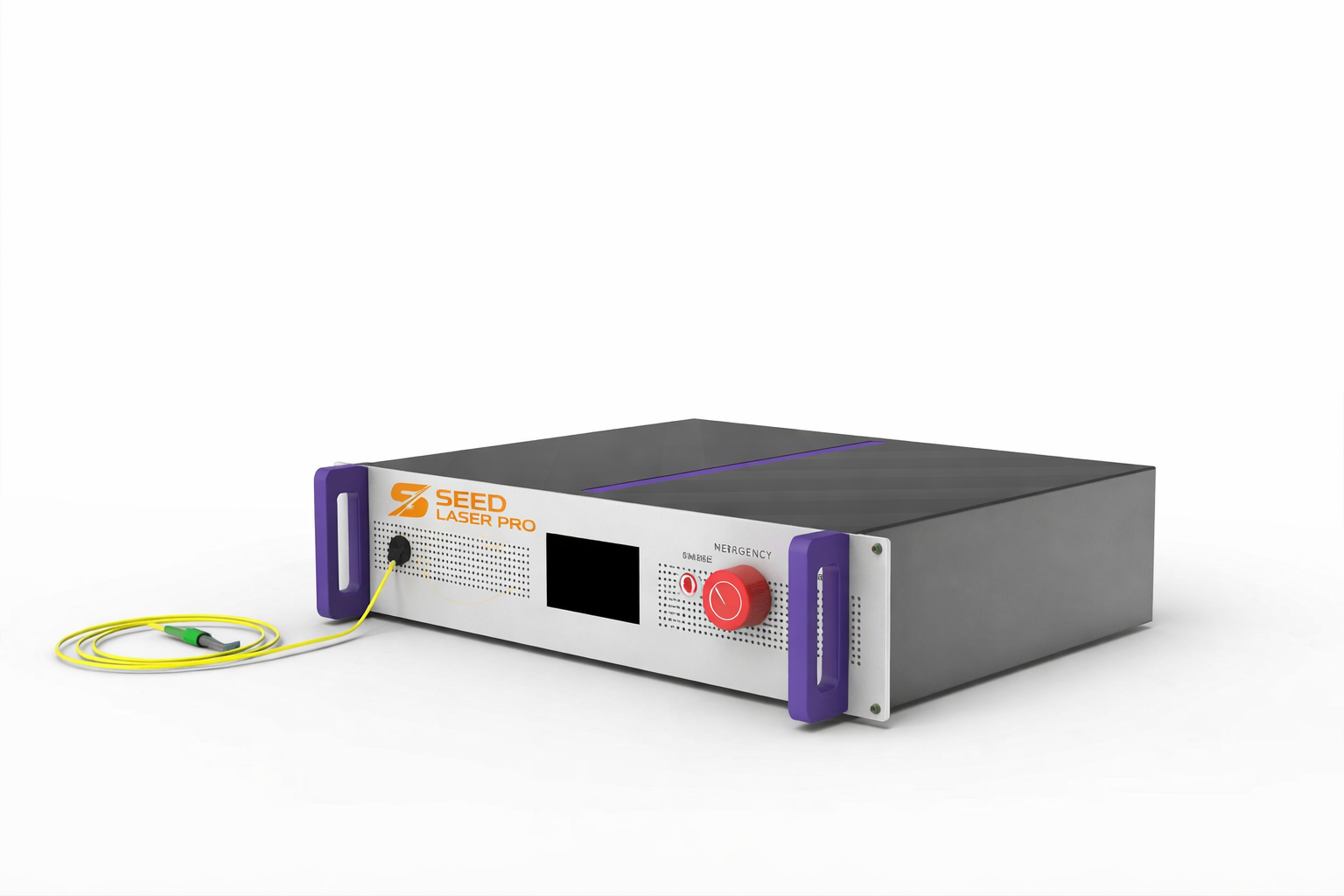
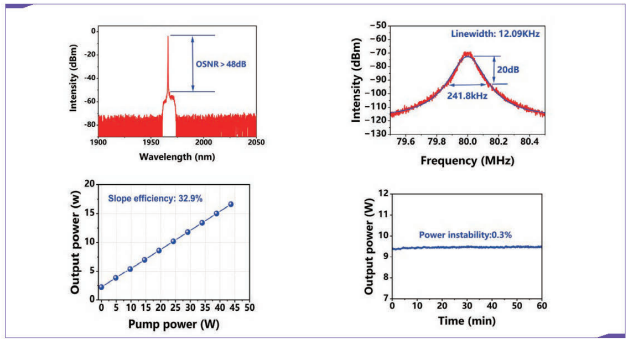
Seed Laser Pro’s 2 to 20W configuration closes that gap. It is a complete integrated MOPA delivering up to 20W at 1950nm in single-frequency CW operation with sub-30 kHz linewidth, in a single chassis with no external amplifier required. Doppler lidar wind measurements require highly reliable compact single-frequency laser output near 2 µm for use in airborne and space-borne platforms, and single-frequency pulsed 2 µm lasers also serve as pump sources for narrowband longer wavelength infrared generation via OPO or difference frequency generation. This laser addresses both CW requirements directly. Lastek
For lower power requirements at 2 µm, see the 2.0 µm 0.05 to 2W configuration. For the highest power tier, see the 2.0 µm 20 to 500W system.
Application
Nonlinear Frequency Conversion to Mid-Infrared
Optical parametric oscillators and difference frequency generation systems pumped at 2 µm produce output in the 3 to 5 µm molecular fingerprint region. This mid-infrared band covers the fundamental absorption features of hydrocarbons, refrigerants, explosives, and pharmaceutical compounds. Single-frequency input at the pump wavelength maximizes phase-matching efficiency in the nonlinear crystal and narrows the idler linewidth, enabling high-resolution molecular detection.
At 2W average CW pump power, OPO threshold can be reached with well-designed cavities. At 10 to 20W, conversion efficiencies producing 1 to 5W of mid-IR output become achievable. This power range covers the requirements of most laboratory and portable mid-IR spectroscopy systems.
Coherent Doppler Wind LiDAR at 2 µm
The 2 µm wavelength covers water vapor absorption features that make it sensitive to atmospheric humidity distributions used in weather forecasting and climate research. CW fiber lasers at 2 µm provide the single-mode, narrow linewidth output required for coherent Doppler sensing applications in this band. Higher average power directly extends detection range in coherent Doppler LiDAR, which relies on weak aerosol backscatter signals that scale with transmit power. SPIE Digital Library
The QBH output connector on this laser suits fiber-to-telescope coupling in airborne and ground-based LiDAR transceiver architectures. PM fiber output ensures polarization-sensitive receiver stages see a well-defined input state.
High-Power Biomedical Applications
At 10 to 20W average CW power, this laser operates in the range used for high-throughput soft tissue cutting and ablation in surgical systems. Medical fiber delivery systems for urological, general surgical, and endoscopic applications require stable average power delivery at 1950 nm. The all-fiber construction and stable output power of this laser suit integration into medical device fiber delivery architectures where reliability and consistency are certification requirements.
Why Single-Frequency Matters at 2 µm for These Applications
Many 2 µm fiber lasers on the market are multimode CW sources. They produce high average power but spread it across multiple transverse and longitudinal modes. For nonlinear conversion, the broad linewidth reduces phase-matching efficiency. For coherent LiDAR, multimode output cannot produce coherent interference with the return signal. For spectroscopy, broad linewidth cannot resolve individual molecular absorption lines.
Single-frequency CW operation concentrates all optical power at one frequency with sub-30 kHz linewidth. At 10W typical output, the optical power density per unit frequency bandwidth is orders of magnitude higher than a multimode source of equal average power. This is the physical reason that single-frequency operation is a hard requirement for coherent sensing, nonlinear conversion, and high-resolution spectroscopy — not a preference.
Frequently Asked Question
What is a 2 micron high power single frequency fiber laser?
A 2 micron high power single frequency fiber laser is a CW laser source using Thulium-doped silica fiber in a MOPA architecture to produce single-longitudinal-mode output at 1940 to 2000 nm at watt-level power. Single-frequency operation means all output power is at one optical frequency with sub-30 kHz linewidth. At 2 to 20W, this power range covers mid-IR OPO pumping, coherent Doppler wind LiDAR, and high-power biomedical applications that lower-power 2 µm seed modules cannot support.
Why is sub-30 kHz linewidth important for mid-infrared OPO pumping?
In optical parametric generation, the linewidth of the pump laser sets the lower limit on the idler linewidth through the energy conservation relationship. A pump with 30 kHz linewidth produces idler output with a minimum linewidth on the same order. For molecular spectroscopy in the 3 to 5 µm mid-IR region, idler linewidth determines spectral resolution. Narrow pump linewidth is therefore a hard requirement for OPO systems targeting high-resolution molecular absorption measurements.
What is the difference between the 0.05 to 2W and 2 to 20W 2 µm configurations?
The 0.05 to 2W version is optimized for lower power applications including direct spectroscopy, low-power OPO seeding, and biomedical delivery systems where less than 2W average power is sufficient. The 2 to 20W version delivers up to 10 times more CW power for higher-throughput OPO conversion, longer-range wind LiDAR, and high-power surgical systems. Both use the same Thulium MOPA architecture with sub-30 kHz linewidth but differ in chassis size, power consumption, and minimum output power.
Why is 2 µm eye-safe?
The 2 µm wavelength falls within the far-infrared edge of the eye-safe region under IEC 60825-1 safety standards. At these wavelengths, the cornea absorbs incident radiation before it reaches the retina, providing natural protection. This is the same physical property that makes 1550nm eye-safe and allows higher outdoor power levels than 1064nm systems under regulatory frameworks applicable to airborne and terrestrial LiDAR deployments.
Can this laser be supplied for OEM integration outside China?
Yes. Seed Laser Pro has an established supply chain for photonics companies, research institutions, and defense contractors in North America, Europe, Japan, and South Korea. Custom configurations including wavelength, fiber type, connector specification, and control interface are available. Contact Seed Laser Pro with your specification and delivery geography for lead time and pricing.