Why 2 µm for These Applications
The 2.0 µm Thulium band occupies a spectral region where three important physical properties converge.
First, water has strong absorption at 1940 to 2000 nm. In biomedical applications, this means 2 µm laser energy is absorbed in the first few hundred micrometers of soft tissue, enabling precise surgical cutting with minimal thermal damage to surrounding structures. This is why Thulium fiber lasers at 1950 nm are the standard wavelength for urological laser surgery, soft tissue resection, and minimally invasive procedures.
Second, CO2 has absorption features near 2000 nm, and CO and H2O both have transitions accessible in this band. High-resolution gas sensing systems using TDLAS or cavity-enhanced spectroscopy target these features for atmospheric monitoring, industrial process control, and breath analysis. A single-frequency CW source at sub-30 kHz linewidth resolves individual molecular absorption lines that broadband sources cannot distinguish.
Third, 1950 nm is the standard pump wavelength for Thulium-doped fiber amplifiers and a practical seed for mid-infrared parametric conversion. OPO and DFG systems targeting 3 to 5 µm use 2 µm single-frequency CW sources as the pump. Single-frequency input maximizes conversion efficiency by concentrating all optical power at one phase-matched frequency.
No Ytterbium or Erbium source reaches any of these application windows regardless of output power.
Entry-Level High Power: Bridging Seed and Amplifier
The 2.0 µm Industrial Seed Source at 10 mW is the right choice when you need a master oscillator for a downstream Thulium amplifier chain or a low-power source for laboratory spectroscopy setups.
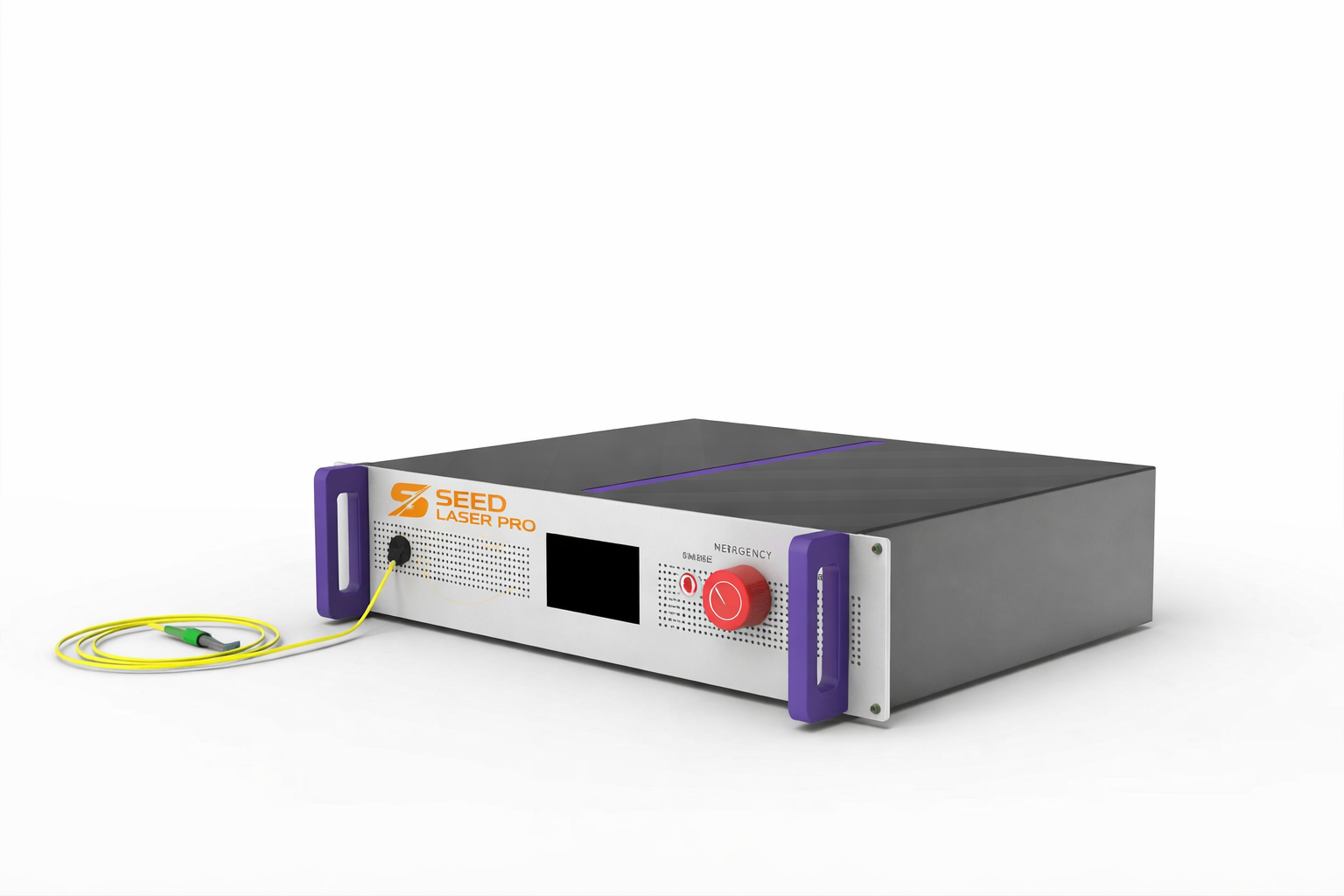
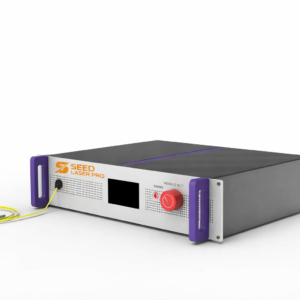
This 0.05 to 2W laser fills the next tier. It provides enough output power for direct use in most gas sensing and spectroscopy setups, direct coupling into biomedical fiber delivery systems, and seeding of OPO stages without a separate amplifier. At 2W maximum output, it eliminates the seed-plus-amplifier two-component architecture for applications that do not require higher power.
For requirements above 2W at 2.0 µm, see Seed Laser Pro’s 2.0 µm 2 to 20W configuration and the 2.0 µm 20 to 500W system.
Buyer Guide: How to Choose Between PM and Non-PM Output
PM output is required when downstream components are polarization-sensitive. This includes PM fiber circulators, PM-based OPO coupling stages, coherent detection receivers, and any Thulium fiber amplifier that uses PM gain fiber throughout. The QBH connector on the PM output option is specified for multi-watt power delivery without connector damage.
Non-PM output suits applications where polarization is managed externally or is not a system constraint, including most biomedical fiber delivery systems and free-space spectroscopy setups where a polarizer or half-wave plate handles polarization after the source.
If your downstream system includes any PM fiber splices or PM-based components, choose PM output. When in doubt, PM output is the safer specification choice.
Geo Supply and OEM Integration
Seed Laser Pro supplies 2.0 µm high-power single-frequency lasers to research institutions, medical device manufacturers, and photonics companies across North America, Europe, Japan, South Korea, and Southeast Asia.
OEM configurations available:
- Custom wavelength within 1940 to 2000 nm Thulium gain band
- Custom output fiber length and connector type
- Control interface options for OEM instrument integration
- Modified form factor for platform-specific requirements
- Volume pricing for production medical device or sensing instrument programs
Frequently Asked Question
What is a 2 micron single frequency fiber laser?
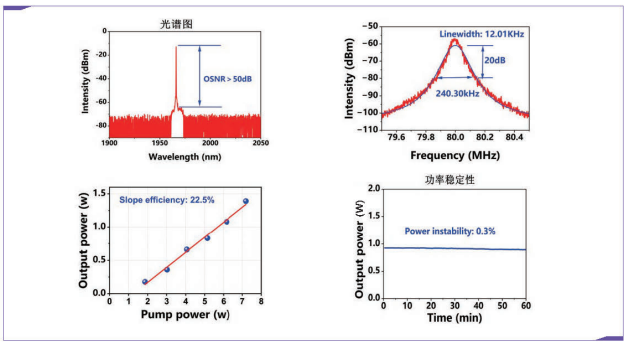
A 2 micron single frequency fiber laser is a CW laser source using Thulium-doped silica fiber to produce single-longitudinal-mode output in the 1940 to 2000 nm wavelength range. Single-frequency operation means all output power is concentrated at one optical frequency with sub-30 kHz linewidth. This gives a coherence length of several kilometers, which is required for coherent sensing, precision spectroscopy, and efficient nonlinear conversion at 2 µm.
Why is 1950 nm used for biomedical laser applications?
Water absorption in soft tissue is approximately 100 times stronger at 1950 nm than at 1064 nm. When a 2 µm laser pulse couples into tissue, energy is deposited in the first few hundred micrometers. This creates a highly localized ablation zone with minimal thermal spread to surrounding tissue. This property makes 1950 nm the standard wavelength for urological laser surgery, soft tissue cutting, and minimally invasive procedures where collateral thermal damage must be minimized.
What is the difference between the 2.0 µm seed source and this laser?
The 2.0 µm Industrial Seed Source produces 10 mW in a compact 175 × 140 mm module. It is designed as the master oscillator for a downstream Thulium amplifier chain. This 0.05 to 2W laser is a complete MOPA producing up to 200 times more output power in a larger chassis, suitable for direct application use without a separate amplifier. For systems requiring output above 2W, a downstream amplifier or higher-power configuration is needed.
What is the QBH connector and when is it required?
QBH is a high-power fiber connector with an end cap that expands the beam diameter at the output face, reducing optical power density at the connector tip. It is specified for reliable operation at watt-level continuous power in PM fiber. For 2 µm applications above approximately 1W average power, QBH is the appropriate connector. Standard FC/APC connectors are not rated for continuous watt-level operation at 2 µm and should not be used as the primary output connector at this power level.
Can this laser be integrated into a medical device?
Yes. The all-fiber design, stable CW output, 10 to 40°C operating range, and PM or non-PM fiber output options suit integration into medical fiber laser systems. Seed Laser Pro has experience supplying laser modules for OEM medical device integration. Contact the engineering team with your device specification, required certifications, and delivery geography.