What Makes This the Entry-Level MOPA Seed
The 0.2 to 2W power tier is the starting point for most 1064nm MOPA architectures. At this power level, the laser provides enough output to seed downstream amplifier stages directly, drive low-power SHG conversion stages for 532 nm generation, and deliver sufficient signal for coherent sensing and interferometry setups without the complexity of high-power thermal management.
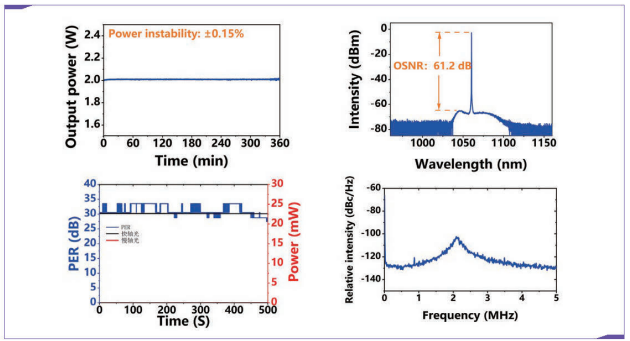
All-fiber construction and double-clad pumping deliver diffraction-limited output without free-space alignment. The microprocessor-based control system handles pump current regulation, temperature stabilization, and protection functions automatically. There are no user-adjustable optical elements. The laser runs.
Competitor products at this power tier, including high-power fiber laser systems at 1064 nm, typically start at 10W output. The 0.2 to 2W range fills the gap between seed-only modules and high-power systems, serving applications that need more than a standard seed laser but do not require tens of watts.
Green Frequency Doubling at 1064 nm
532 nm green light is produced by second-harmonic generation from 1064 nm. Two 1064 nm photons are converted to one 532 nm photon in a nonlinear crystal, typically LBO or PPKTP.
The efficiency of this conversion depends directly on the spectral purity and beam quality of the 1064 nm input. Single longitudinal mode operation ensures all power is concentrated at one frequency, maximizing the phase-matching efficiency in the SHG crystal. M² below 1.05 ensures the focused beam spot in the crystal is as tight as the diffraction limit allows, maximizing power density at the conversion point.
At 2W input power into an efficient PPKTP SHG stage, conversion efficiencies of 30 to 50% are achievable, producing 600 mW to 1W of 532 nm output. For quantum optics experiments, precision holography, and laser processing requiring coherent green illumination, this laser provides the 1064 nm foundation for that conversion chain.
For the 532 nm output directly, see Seed Laser Pro’s 532 nm frequency-converted laser.
Coherent Beam Combining
Coherent beam combining scales the output power of fiber laser systems beyond what a single aperture can deliver. Multiple fiber amplifiers are seeded from a common single-frequency master oscillator, amplified in parallel, and combined coherently at the output using active phase control. The combined beam has the spectral properties of the seed and the power of all amplifiers summed.
The single-frequency operation and stable phase of this laser make it suitable as the master oscillator in coherent beam combining architectures. The PM980 fiber output delivers a defined polarization state to each amplifier branch. The sub-30 kHz linewidth provides the coherence length required for the path-length matching tolerances of practical combining systems.
For higher-power MOPA configurations seeded from this laser, Seed Laser Pro’s 1.0 µm high-power single-frequency lasers cover the 2 to 20W and 20 to 500W tiers with the same all-fiber PM980 architecture.
All-Fiber Design: Why It Matters for Reliability
Free-space optics inside a laser require periodic alignment as the laser ages, as temperature cycles, and as vibration stresses optical mounts. In a deployed instrument or production environment, that maintenance requirement is a real cost.
The all-fiber MOPA design eliminates free-space elements between the seed and the output fiber connector. Every optical interface is a fiber splice or a qualified PM fiber connector. The optical path is sealed inside fiber with no moving parts and no alignment-sensitive free-space propagation. The result is a laser that maintains its output specifications across the -10 to 45°C operating range without recalibration.
FAQ SECTION
What is the difference between this laser and a standard 1064nm seed laser?
A standard seed laser operates at 10 to 100 mW and sets the spectral quality of the system. This laser is a complete MOPA in the 0.2 to 2W range. It integrates the seed and a first amplifier stage into one all-fiber module, providing output power sufficient for direct SHG conversion to 532 nm, coherent beam combining architectures, and fiber sensing systems without a separate amplifier stage.
Why is M² below 1.05 important for frequency doubling?
SHG conversion efficiency scales with the square of the power density at the nonlinear crystal. M² below 1.05 means the beam focuses to within 5% of the theoretical diffraction limit. A beam with M² of 1.3 focuses to a spot area approximately 70% larger, reducing the peak power density and conversion efficiency accordingly. For efficient 532 nm generation, near-diffraction-limited beam quality at 1064 nm is a practical requirement.
What does double-clad fiber pumping mean?
Double-clad fiber has a core where signal light propagates, surrounded by an inner cladding where multimode pump light is guided. The pump light overlaps with the signal core as it propagates, transferring energy to the Ytterbium dopant. This architecture allows high pump power to be delivered from low-brightness multimode diodes while maintaining single-mode signal output. It is the standard pumping architecture for high-power fiber amplifiers at 1 µm.
Is this laser suitable as an input seed for a standalone PM fiber amplifier?
Yes. The PM980 fiber output and single longitudinal mode CW operation make this laser directly compatible as the seed input for PM fiber amplifier stages. The 20 dB polarization extinction ratio ensures the amplifier sees a well-defined polarization state, which is required for PM amplifier chains where polarization alignment between seed and amplifier fiber is critical.
What power tiers are available above 2W at 1.0 µm?
Seed Laser Pro offers 2 to 20W and 20 to 500W configurations at 1.0 µm in the same all-fiber PM980 architecture. See the 1.0 µm high-power single-frequency laser range for the full power series.