
seed laser pro

532nm Low Noise Single-Frequency Laser

Green lasers are common. A 532nm low noise laser with single longitudinal mode operation, sub-10 kHz linewidth, and M² below 1.1 is not.

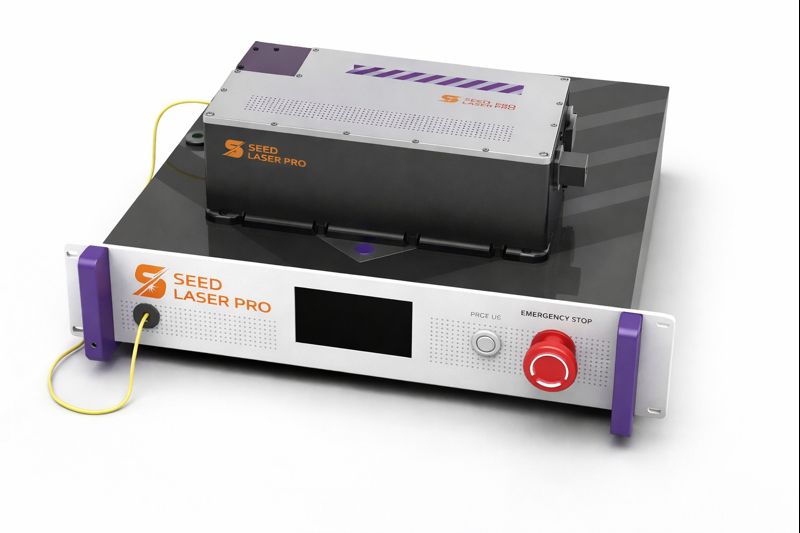
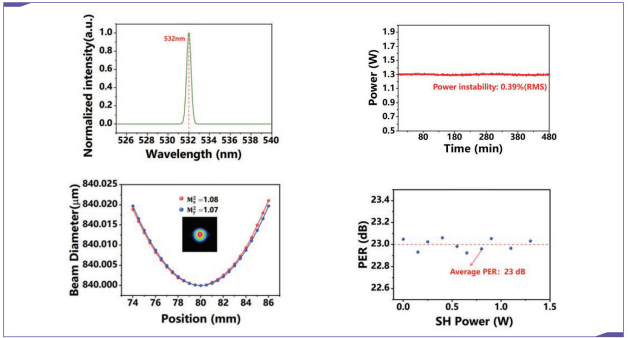
Techwin’s 532 nm frequency-converted laser produces 0.05 to 4 W of continuous-wave green output through second harmonic generation from a single-frequency fiber seed. Linewidth sits between 2 and 10 kHz. Output power stability holds at 0.3% RMS over six hours. Wavelength tuning range reaches 200 pm typically. Both free-space and fiber output options are available. This is a precision green laser source built for applications where intensity noise, beam quality, and spectral purity determine the quality of the result.

PRODUCT FEATURES

  • High-Efficiency Nonlinear Frequency Conversion:  Second harmonic generation from a single-frequency fiber seed produces 532 nm output with high conversion efficiency. The green output inherits the single longitudinal mode operation and low phase noise of the fiber seed, giving this laser its low noise character at 532 nm.
  • M² Below 1.1 Beam Quality:  Near-perfect Gaussian beam profile with output beam diameter of 0.7 to 1.2 mm and beam waist position within 1 m of the output port. Directly usable in tight-focus applications without additional spatial filtering.
  • Intelligent Power Stabilization: Active output power stabilization holds RMS power stability at 0.3% over six hours of continuous operation. Power adjustable from 10 to 100% of the set output level.

TYPICAL APPLICATIONS

  • Precision Processing:  Low noise, stable output power, and near-diffraction-limited beam quality make this laser suitable for precision microfabrication, laser scribing, and material processing applications where beam quality and power consistency directly affect process quality.
  • Biomedical Applications:  532 nm green light is strongly absorbed by oxyhemoglobin and melanin, making it the standard wavelength for retinal photocoagulation, dermatological treatments, and fluorescence excitation in biological imaging. The low noise and stable output of this system minimize unwanted tissue effects from power fluctuations.
  • Scientific Instruments and Quantum Optics:  Single-frequency, narrow-linewidth 532 nm output is used in holography, interferometry, Raman spectroscopy, optical tweezers, and as a pump source for optical parametric oscillators targeting visible and near-infrared wavelengths. Low intensity noise is the primary requirement across all of these.
532 nm Single-Frequency Frequency-Doubled Laser
Technical ParameterUnitTechnical Specifications
MinimumTypicalMaximum
Central Wavelengthnm532 (Customizable)
Optical Mode/Single Longitudinal Mode, Continuous Wave
Output PowerW0.0514
LinewidthkHz2310
Output Power Stability (RMS) @ 6h%0.31
Output Power Adjustment%10 – 100
Wavelength Tuning Rangepm100200300
Polarization Extinction RatiodB202325
Beam Quality/M² < 1.1
Operating VoltageVAC90–250V (50–60Hz)
Operating Temperature°C152535
Output Type/Free-Space Optical Output / Fiber Output
Output Beam Diametermm0.711.2
Beam Waist Position (Relative to Output Port)m< 1
Dimensionsmm297 (L) × 145 (W) × 93 (H)

Why Low Noise Matters at 532 nm

Most 532 nm green lasers on the market are based on intracavity frequency doubling of diode-pumped solid-state lasers. These systems have a well-known noise problem: green noise, or relaxation oscillation noise, caused by coupling between the infrared and green intracavity fields. Even at constant pump power, the green output fluctuates. For general-purpose applications this is manageable. For precision measurement, quantum optics, and sensitive biomedical imaging, it is a serious limitation.

A 532nm low noise laser that generates its green output through external frequency doubling of a single-frequency fiber seed avoids this problem entirely. The fiber seed operates in continuous wave with inherently low relative intensity noise. The frequency doubling stage converts the infrared output to 532 nm without introducing the cavity coupling dynamics that cause green noise in intracavity-doubled systems. The result is a green laser whose intensity noise floor is set by the fiber seed, not by intracavity dynamics.

That distinction is what separates this product from commodity 532 nm green lasers and makes it the right choice for applications where noise performance is a specification, not an afterthought.

Spectral Performance

Single longitudinal mode operation at 532 nm means all output power is concentrated at one optical frequency. Linewidth of 2 to 10 kHz gives a coherence length of approximately 5 to 25 km at 532 nm — far exceeding the path length requirements of any interferometric or holographic system.

Wavelength tuning range of 100 to 300 pm, with a typical value of 200 pm, allows the laser to be tuned across atomic or molecular absorption features in the green spectral region. This is relevant for Raman spectroscopy setups where the excitation wavelength needs to be offset from a specific molecular line, and for quantum optics experiments involving green atomic transitions.

Polarization extinction ratio of 20 to 25 dB ensures clean linear polarization, which matters for polarization-sensitive setups including holographic recording media, polarization-resolved microscopy, and electro-optic modulators in the beam path.

Output Configuration

Both free-space and fiber output options are available. The free-space output delivers a collimated beam with 0.7 to 1.2 mm diameter and M² below 1.1, suitable for direct insertion into optical setups. The fiber output suits applications requiring spatial mode cleaning or remote beam delivery.

Operating voltage accepts 90 to 250 VAC at 50 to 60 Hz, covering global power supply standards without an external converter. Operating temperature range is 15 to 35°C. The compact 297 × 145 × 93 mm footprint fits standard optical table and instrument rack configurations.

Output power range of 0.05 to 4 W covers the full range from low-power alignment and spectroscopy applications through to higher-power processing and pumping applications. Power adjustment is continuous from 10 to 100%.

For applications requiring a 532 nm source as part of a broader wavelength-converted fiber laser system, see Techwin’s full wavelength converted fiber laser range covering 193 nm to 795 nm. For the underlying 1064 nm single-frequency fiber seed technology that drives this frequency-doubled system, see the single frequency fiber seed laser range.

FAQ SECTION

What makes this a low noise 532 nm laser?

The 532 nm output is generated by external second harmonic generation from a single-frequency fiber seed laser. Fiber seed lasers have inherently low relative intensity noise. External frequency doubling transfers that low noise characteristic to the green output without introducing the intracavity coupling noise that affects conventional diode-pumped solid-state 532 nm lasers. The result is a 532nm low noise laser with RMS power stability of 0.3% over six hours and a noise floor suitable for sensitive measurement and quantum optics applications.

What is single longitudinal mode operation at 532 nm?

Single longitudinal mode means the laser emits at one precise optical frequency rather than across multiple modes. At 532 nm, single longitudinal mode operation with 2 to 10 kHz linewidth gives a coherence length of several kilometers. This is required for interferometric applications, holography, and coherent optical setups where multiple-mode emission would cause visibility degradation in interference fringes.

What applications need this level of noise performance at 532 nm?

Optical tweezers, where intensity noise creates unwanted trap depth fluctuations that heat trapped particles. Stimulated Raman spectroscopy, where noise sets the detection floor for weak molecular signals. Quantum optics experiments using 532 nm as a pump for spontaneous parametric down-conversion. Laser interferometry setups where intensity noise limits measurement sensitivity. Precision biomedical imaging where power fluctuations introduce artefacts. In all of these, the noise floor of the laser determines the sensitivity ceiling of the application.

Is the output power adjustable during operation?

Yes. Output power is continuously adjustable from 10 to 100% of the set level during operation via the intelligent control system. Power adjustment does not affect linewidth or single longitudinal mode operation within the specified range.

Can the wavelength be tuned to specific spectral lines?

Yes. The 100 to 300 pm tuning range at 532 nm allows access to specific atomic or molecular features in the green spectral region. Tuning is available through thermal and piezoelectric control of the seed laser. Contact Techwin with your target wavelength and tuning speed requirement to confirm compatibility with your application.

Translate »