
| 780 nm Single-Frequency Frequency-Doubled Laser | ||||
|---|---|---|---|---|
| Technical Parameter | Unit | Technical Specifications | ||
| Minimum | Typical | Maximum | ||
| Central Wavelength | nm | — | 780.2 (Customizable) | — |
| Optical Mode | / | Single Longitudinal Mode, Continuous Wave | ||
| Output Power | W | 0.05 | 1 | 3 |
| Linewidth | kHz | 1 | 3 | 5 |
| Output Power Stability (RMS) @ 6h | % | — | 0.3 | 1 |
| Output Power Adjustment | % | 10 – 100 | ||
| Wavelength Tuning Range | pm | 100 | 200 | 500 |
| Polarization Extinction Ratio | dB | 20 | 23 | 25 |
| Beam Quality | / | M² < 1.1 | ||
| Operating Voltage | VAC | 90–250V (50–60Hz) | ||
| Operating Temperature | °C | 15 | 25 | 35 |
| Output Type | / | Free-Space Optical Output / Fiber Output | ||
| Output Beam Diameter | mm | 0.7 | 1 | 1.2 |
| Beam Waist Position (Relative to Output Port) | m | < 1 | ||
| Dimensions | mm | 297 (L) × 145 (W) × 93 (H) | ||
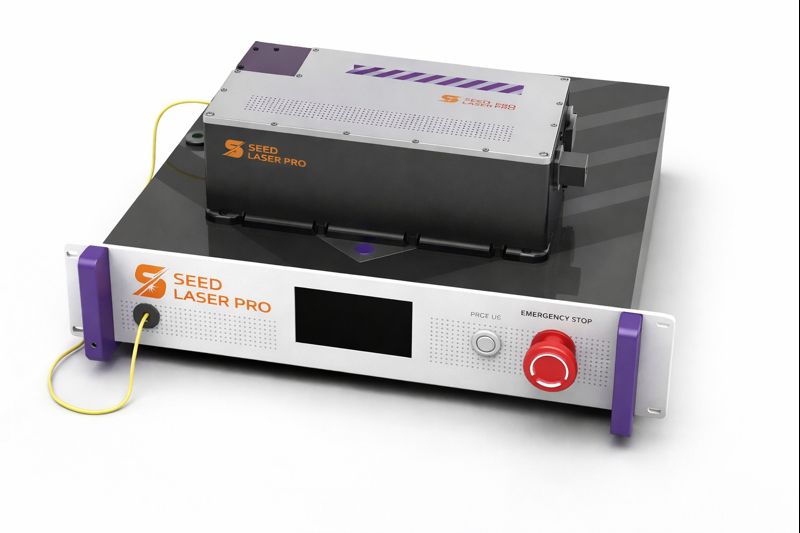
780.24 nm is the rubidium D2 line. Every laser cooling experiment, magneto-optical trap, atom interferometer, and rubidium atomic clock built around rubidium atoms needs a laser locked to this transition. Techwin’s 780 nm frequency-converted laser is purpose-built for that requirement.
The output is generated through second harmonic generation from a 1560 nm single-frequency fiber seed laser. The 780 nm output inherits the narrow linewidth, single longitudinal mode operation, and low phase noise of the fiber seed directly. High-efficiency nonlinear frequency conversion technology and power stabilization produce stable, low-noise output at 780 nm in a compact module format ready for integration into cold atom physics platforms and quantum sensing instruments.
PRODUCT FEATURES
- High-Efficiency SHG Frequency Conversion: Second harmonic generation from a 1560 nm single-frequency fiber seed produces 780 nm output with conversion efficiency optimized through nonlinear crystal design and optical path optimization. The 780 nm output carries the spectral purity of the fiber seed.
- Excellent Beam Quality: Near-diffraction-limited beam quality from the fiber-based source, optimized through beam quality correction in the output stage. Suitable for direct free-space coupling into vacuum chambers and optical setups without additional spatial filtering.
- Power Stabilization: Active power stabilization keeps output power consistent across operating conditions. Stable output power is a direct requirement for controlled optical pumping efficiency in rubidium cooling and trapping experiments.
TYPICAL APPLICATIONS
- Rubidium Laser Cooling and Magneto-Optical Trapping: The 780 nm D2 transition of rubidium-85 and rubidium-87 is the standard wavelength for laser cooling, magneto-optical trapping, and Bose-Einstein condensate experiments. This laser provides the frequency-stable, narrow-linewidth output required to maintain resonance with the D2 line throughout the cooling and trapping sequence.
- Atom Interferometry and Quantum Sensing: Rubidium atom interferometers used in gravimetry, inertial navigation, and fundamental physics require a 780 nm source with tight frequency control and stable output. This frequency-converted laser provides the spectral characteristics atom interferometric systems demand.
- Scientific Instruments and Atomic Physics Research: Rubidium atomic clocks, Rydberg atom experiments, quantum computing platforms using rubidium qubits, and precision spectroscopy all operate at or near the 780 nm D2 line. This laser serves as the primary light source for any rubidium-based experiment requiring single-frequency, stable 780 nm illumination.