
seed laser pro

266 nm Single-Frequency Frequency-Converted Laser

266 nm sits in the UV-C band, four times the wavelength of the 1064 nm fundamental. Reaching it requires fourth-harmonic generation from a near-infrared fiber seed. Doing it with narrow linewidth requires that every conversion stage preserves the spectral quality of the starting source.

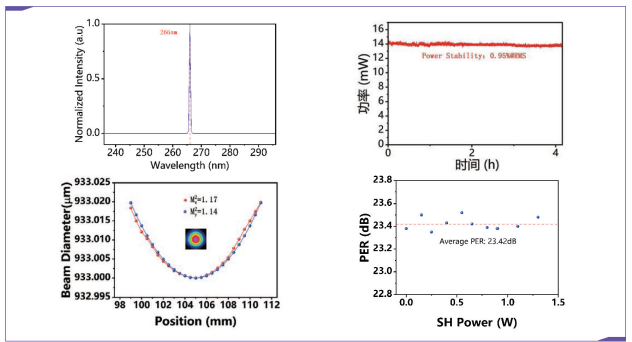
Seed Laser Pro’s 266 nm Single-Frequency Laser delivers 5 to 15 mW of CW output at 266 nm. Linewidth is 5 to 25 kHz. Power stability holds at 1% RMS over three hours. Wavelength tuning range covers 50 to 150 pm. Free-space output with M² below 1.3 and 1.0 mm typical beam diameter.

Built for semiconductor material processing, UV fluorescence analysis, photochemistry, and precision UV spectroscopy. Custom wavelength configurations are available.

PRODUCT FEATURES

  • Fourth-Harmonic Generation at 266 nm : CW output at 266 nm produced through two sequential second-harmonic generation steps from a 1064 nm single-frequency fiber seed. The conversion chain is designed to preserve narrow linewidth at each stage. The 266 nm output inherits the spectral purity of the fiber source.
  • Sub-25 kHz Linewidth : Linewidth between 5 and 25 kHz at 266 nm. Coherence length at this linewidth exceeds several kilometers. Sufficient for high-resolution UV spectroscopy, interferometric measurements, and precision material processing where coherence quality affects the result.
  • Active Power Stabilization : Output power stable at 1% RMS over three hours of continuous operation. Adjustable from 10 to 100% of the set output level throughout operation.
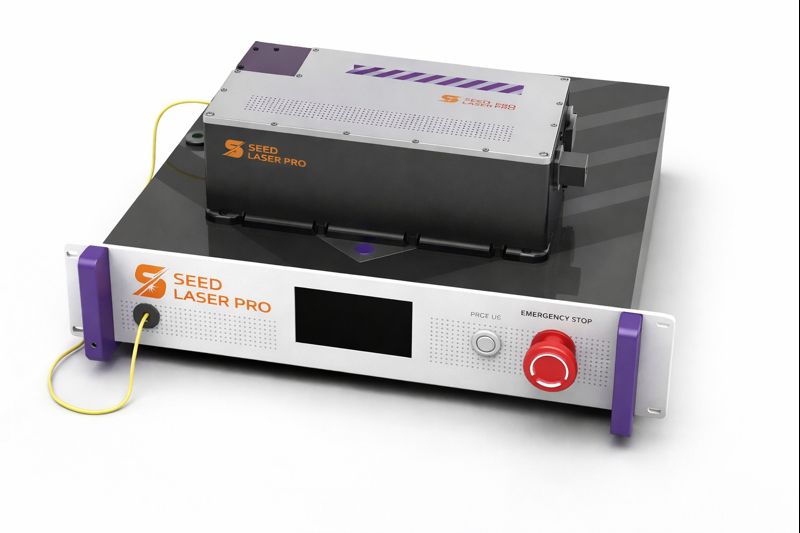
  • Clean Free-Space Output : M² below 1.3, 0.8 to 1.2 mm beam diameter, beam waist within 1 m of the output port. Fits standard optical tables at 290 × 500 × 130 mm.

TYPICAL APPLICATIONS 

  • Semiconductor Processing and Inspection : 266 nm photons carry 4.66 eV per photon. That energy level exceeds the bandgap of many semiconductor and dielectric materials, enabling direct photochemical processing without the thermal damage that longer UV wavelengths cause. Narrow linewidth CW output supports both direct processing and interferometric inspection of processed surfaces.
  • Material Analysis and UV Fluorescence : Many organic molecules, aromatic compounds, and biological markers have absorption and fluorescence excitation bands in the 260 to 270 nm range. A single-frequency, narrow-linewidth 266 nm source provides selective excitation of specific spectral features that broadband UV lamps cannot resolve.
  • Photochemistry Research : Photochemical reactions initiated at 266 nm are used in polymer synthesis, photocatalysis, and photodegradation studies. Narrow linewidth allows wavelength-selective excitation of specific reactant absorption bands for controlled reaction chemistry.
  • UV Spectroscopy and Metrology : Sub-25 kHz linewidth at 266 nm supports high-resolution absorption spectroscopy of UV-active species and interferometric metrology of UV optical components. Both applications require coherence far beyond what pulsed or broadband UV sources provide.

Need a custom configuration? Central wavelength is customizable. OEM integration, custom power levels, and engineering support available at the design stage.
266 nm Single-Frequency Frequency-Doubled Laser
Technical ParameterUnitTechnical Specifications
MinimumTypicalMaximum
Central Wavelengthnm266 (Customizable)
Optical Mode/ Single Longitudinal Mode, Continuous Wave
Output PowermW51015
LinewidthkHz51025
Output Power Stability (RMS) @ 3h%111
Output Power Adjustment%10 – 100
Wavelength Tuning Rangepm50100150
Polarization Extinction RatiodB182023
Beam Quality/M² < 1.3
Operating VoltageVAC 90–250V (50–60Hz)
Operating Temperature°C152535
Output Type/ Free-Space Optical Output
Output Beam Diametermm0.811.2
Beam Waist Position (Relative to Output Port)m< 1
Dimensionsmm 290 (L) × 500 (W) × 130 (H)

266 nm vs 193 nm: Choosing the Right DUV Wavelength

Both 193 nm and 266 nm sit in the deep ultraviolet. They are not interchangeable. The right wavelength depends entirely on what the application needs to interact with.266 nm offers higher output power, narrower linewidth, and a wider operating temperature range than 193 nm. It is also less strongly absorbed by oxygen in air, which simplifies beam path management. For semiconductor processing, UV fluorescence, and photochemistry, 266 nm is usually the more practical choice.

For applications specifically requiring the photon energy or material interaction of 193 nm, see Seed Laser Pro’s 193 nm single-frequency laser.

How Fourth-Harmonic Generation Produces 266 nm

The conversion chain starts with a single-frequency fiber seed at 1064 nm. That seed produces single longitudinal mode CW output with narrow linewidth and low phase noise.

Step 1: The 1064 nm output passes through a first second-harmonic generation (SHG) crystal, producing 532 nm green light.

Step 2: The 532 nm output passes through a second SHG crystal, producing 266 nm UV output.

Each step is a frequency doubling. Two photons at 1064 nm become one at 532 nm. Two photons at 532 nm become one at 266 nm. The linewidth and phase noise at 266 nm are determined by the starting seed and the efficiency of each conversion stage.

Preserving narrow linewidth through two conversion steps requires careful crystal selection, phase-matching optimization, and power density management in each stage. The 5 to 25 kHz linewidth at the output reflects that each stage was optimized to minimize linewidth degradation, not just to maximize output power.

Linewidth at 266 nm: Why It Matters

Most 266 nm sources on the market are pulsed Nd:YAG fourth-harmonic systems. They produce high peak powers in nanosecond pulses with MHz to GHz linewidths. For material ablation at high fluence, that is sufficient.

For high-resolution UV spectroscopy, interferometric surface metrology, and wavefront testing of UV optics, it is not.

Sub-25 kHz linewidth at 266 nm gives a coherence length above 2 km. That level of coherence enables:

  • Interference fringe visibility over large path differences in UV Fizeau interferometers
  • Resolved spectral features in molecular UV absorption measurements
  • Coherent illumination for lithography optics qualification at 266 nm
  • Raman spectroscopy with a well-defined excitation wavelength

A pulsed 266 nm source cannot provide any of these. This CW single-frequency source can.

Wavelength Tuning

Wavelength tuning range is 50 to 150 pm at 266 nm, with 100 pm typical. Tuning is achieved through thermal or piezoelectric control of the 1064 nm seed laser. At 266 nm, 100 pm of tuning corresponds to approximately 424 GHz of frequency range, which is sufficient to access multiple absorption features within a target molecule’s UV spectrum.

This tuning capability is directly relevant for spectroscopy applications where the laser needs to be positioned at a specific molecular absorption line, and for photochemistry setups where wavelength-selective excitation of one reactant over another requires precise frequency placement.

FAQ SECTION

What is a 266 nm single-frequency laser?

A 266 nm single-frequency laser produces CW coherent output in the UV-C band at 266 nm with narrow linewidth and stable power. This one uses fourth-harmonic generation from a 1064 nm single-frequency fiber seed, converting near-infrared light to 266 nm through two sequential SHG stages. The 266 nm output is single longitudinal mode with linewidth between 5 and 25 kHz, giving a coherence length of several kilometers at this wavelength.

How is 266 nm generated from a fiber laser?

The 1064 nm single-frequency fiber seed output is first doubled to 532 nm using SHG in a nonlinear crystal. The 532 nm output is then doubled again to 266 nm in a second SHG crystal. Each doubling stage converts pairs of input photons into single output photons at half the wavelength. The linewidth at each stage is set by the input linewidth. Starting from a sub-25 kHz fiber seed preserves narrow linewidth through both conversion steps.

What is the difference between 266 nm and 532 nm output from the same fiber seed?

The 532 nm output represents a single SHG conversion from the 1064 nm seed. The 266 nm output uses a second SHG stage on top of that, halving the wavelength again. The 266 nm photon energy of 4.66 eV accesses UV-active absorption bands in semiconductors, organics, and biological molecules that 532 nm cannot reach. Output power at 266 nm is lower than at 532 nm due to the additional conversion step. See Seed Laser Pro’s 532 nm low noise single-frequency laser for green wavelength applications.

Does 266 nm require beam path purging like 193 nm?

266 nm is less strongly absorbed by oxygen in air than 193 nm. For most laboratory and industrial setups with short beam paths, air transmission at 266 nm is adequate without purging. For long beam paths or applications sensitive to output power variation, dry nitrogen purging can reduce absorption-related power loss.

Is the wavelength customizable?

Yes. 266 nm is the standard configuration. Custom wavelengths within the UV range are available. Contact Seed Laser Pro’s engineering team with your target wavelength, required output power, and linewidth specification.

Translate »