Why 193 nm Is the Hardest Wavelength to Generate
Generating coherent light at 193 nm requires solving three problems simultaneously that are straightforward at longer wavelengths.
First, standard optical glass absorbs strongly below approximately 200 nm. Fused silica transmits at 193 nm, but standard BK7, borosilicate, and most coating materials do not. The entire optical path from generation to output must use DUV-grade fused silica and specialized coatings.
Second, most nonlinear crystals used for frequency conversion at visible and near-infrared wavelengths are opaque or unstable at 193 nm. Lithium triborate (LBO) is an ideal nonlinear crystal for frequency mixing at deep UV wavelengths because of its wide transparency range, high damage threshold, and excellent phase-matching properties. Reaching 193 nm requires carefully selected crystals and a multi-stage conversion architecture.
Third, the photon energy at 193 nm is high enough to cause color center formation in optical materials under prolonged illumination. This mechanism degrades transmission and conversion efficiency over time. Managing it requires careful material selection and power density control throughout the conversion chain.
Seed Laser Pro’s 193 nm laser addresses all three through proprietary deep UV generation technology built around narrow-linewidth fiber seed architecture and multi-stage frequency conversion.
How the Fiber Seed Architecture Produces 193 nm
The 193 nm output starts with a single-frequency fiber seed laser in the near-infrared. This seed produces narrow-linewidth, low-phase-noise output with the stability and coherence that fiber laser technology provides. The seed output then passes through a sequence of nonlinear frequency conversion stages.
One part undergoes fourth-harmonic generation to create a 258 nm laser, while another part pumps an optical parametric stage generating a 1553 nm signal. These beams are then combined in cascaded LBO crystals to produce the desired 193 nm laser output.
The key result of this architecture is coherence inheritance. The sub-80 kHz linewidth at 193 nm comes directly from the narrow-linewidth fiber seed. Each conversion stage preserves the spectral quality of the input. The final 193 nm output is a single-frequency, narrow-linewidth source with the stability of a fiber laser and the wavelength of deep UV.
This is what separates this product from ArF excimer lasers. An excimer generates 193 nm through electrical discharge in a gas mixture. The output is incoherent, has a broad linewidth, and requires regular gas replacement and maintenance. The solid-state approach produces coherent, narrow-linewidth CW output in a sealed system with no consumable gas and no high-voltage discharge circuitry.
Linewidth and Coherence at 193 nm
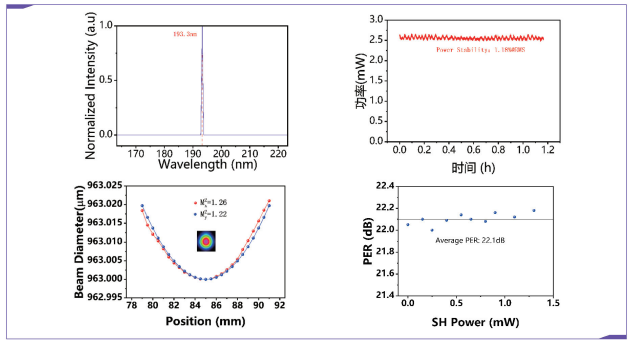
Sub-80 kHz linewidth at 193 nm corresponds to a coherence length of approximately 460 m. For lithography optics metrology and interferometric wavefront testing, this coherence length is sufficient for path differences far exceeding any realistic test setup.
For comparison, the narrowest linewidth reported for a 193 nm laser from LBO crystal systems is approximately 640 MHz. At sub-80 kHz, Seed Laser Pro’s fiber-seeded system is approximately 8,000 times narrower in linewidth than that benchmark. That difference in spectral purity is what makes this product usable for high-resolution spectroscopy and precision interferometry at 193 nm, applications that a 640 MHz source cannot serve.
Output and Operating Parameters
Free-space optical output with 1.0 mm typical beam diameter at the output port and M² below 1.4. Beam waist position within 1 m of the output port. Side-mode suppression ratio of 20 to 24 dB confirms clean single-mode operation throughout the operating range.
Output power is adjustable from 50 to 100% of the set level. Power stability holds at below 1% RMS over two hours of continuous operation. Operating temperature range is tightly specified at 20 to 30°C. DUV nonlinear conversion efficiency is sensitive to crystal temperature. Maintaining the operating temperature within this range ensures conversion efficiency and output power remain stable.
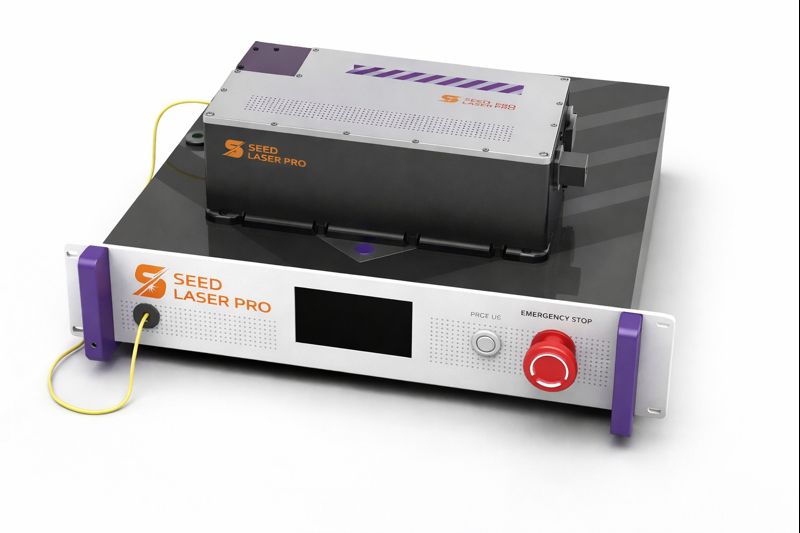
The compact 330 × 600 × 130 mm footprint fits standard optical tables. For system integration, OEM configurations and custom central wavelengths within the DUV range are available on request.
For the wavelength converted fiber laser range covering other UV and visible wavelengths, see Seed Laser Pro’s full converted laser portfolio from 193 nm to 795 nm.
FAQ SECTION
What is a 193 nm single-frequency laser and how is it different from an ArF excimer?
A 193 nm single-frequency laser produces continuous-wave coherent output at 193 nm with narrow linewidth and stable power from a solid-state architecture. An ArF excimer laser generates 193 nm through electrical discharge in a gas mixture of argon and fluorine. Excimer output is pulsed, incoherent, and has a broad linewidth measured in GHz. This solid-state CW source produces sub-80 kHz linewidth continuous output in a sealed system with no gas handling, no high-voltage discharge, and no fluorine gas replacement. The two products serve different application requirements within the 193 nm wavelength space.
What does deep UV mean and why does 193 nm require special handling?
Deep ultraviolet refers to wavelengths below approximately 300 nm. At 193 nm, photon energy is 6.4 eV. Standard optical glass absorbs at this wavelength. Most nonlinear crystals used at longer wavelengths are unsuitable. Oxygen in air absorbs 193 nm radiation. Operating a 193 nm laser system in air requires either purging the beam path with nitrogen or operating in a partial vacuum to avoid absorption losses. The tight operating temperature requirement of 20 to 30°C reflects the sensitivity of the nonlinear conversion stages to thermal variation.
What applications specifically require coherent CW output at 193 nm rather than a pulsed excimer?
Interferometric wavefront metrology of lithography optics, high-resolution absorption spectroscopy of UV-active molecular species, precision material ablation requiring controlled energy delivery rather than high-peak-power pulses, and refractive surgery research requiring stable continuous output. In all of these, the long coherence length and stable power of a CW single-frequency source provide advantages over pulsed incoherent excimer output.
Is the central wavelength customizable?
Yes. The central wavelength is listed as customizable in the specification. Contact Seed Laser Pro’s engineering team with your target wavelength within the DUV range to discuss feasibility and lead time.
What is the operating temperature requirement and why is it narrow?
Operating temperature is specified at 20 to 30°C, narrower than most laser products. Nonlinear frequency conversion efficiency in DUV crystal stages is sensitive to temperature. If the crystal temperature moves outside the phase-matching range, conversion efficiency drops and output power falls. Maintaining the operating environment within the specified 10°C window ensures the conversion stages remain at their design operating point throughout continuous use.