Why 509 nm Exists as a Laser Wavelength
Most laser wavelengths are defined by gain media. 509 nm is defined by an atom.
The 509 nm laser is a core component combined with an 852 nm laser for two-step cesium Rydberg transitions, where frequency stability is critical for quantum control and metrology precision. The 509 nm laser is also suitable for atomic radar, spectroscopy, and quantum precision measurement fields.
Cesium defines the SI second through its 9.192 GHz hyperfine transition. Its Rydberg states are used in quantum sensing, electric field measurement, and quantum computing. Reaching those states requires a two-photon excitation path. 509 nm is one step in that path.
Outside cesium research, 509 nm serves solar cell characterization and green-wavelength medical applications where the photon energy and wavelength match specific material or tissue interactions.
Competitor Landscape at This Wavelength
No commercial competitor currently has a dedicated product page for a single-frequency CW 509 nm laser. Most content at this wavelength is academic. Researchers and engineers looking to purchase a 509 nm source are finding papers, not products.
Seed Laser Pro fills that gap directly.
How the 509 nm Output Is Generated
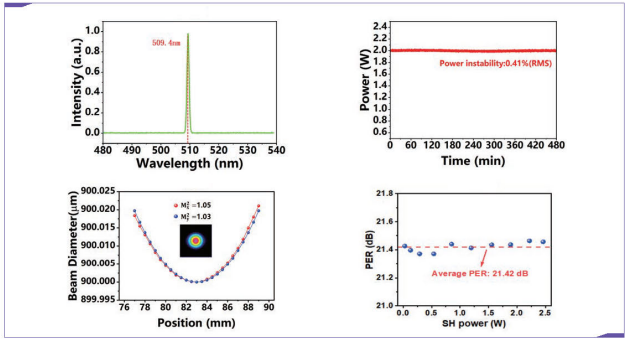
509.4 nm is produced through second-harmonic generation from a 1018.8 nm single-frequency fiber seed. The 1018.8 nm seed operates in the Ytterbium gain band and produces single longitudinal mode CW output with narrow linewidth and low phase noise.
That seed output passes through a nonlinear SHG crystal. Two 1018.8 nm photons convert to one 509.4 nm photon. The linewidth at 509 nm is set by the seed. Starting from a 2 to 5 kHz seed produces 2 to 10 kHz output at 509 nm.
The result is a green source with coherence properties inherited entirely from the fiber seed, not from a bulk solid-state cavity.
Linewidth and Coherence at 509 nm
Sub-10 kHz linewidth at 509 nm gives a coherence length above 5,000 km. For cesium Rydberg experiments where frequency stability directly affects quantum control fidelity, this coherence level is the requirement.
For solar cell characterization and precision processing, long coherence length enables interference-based measurement techniques that incoherent or broadband green sources cannot support.
Wavelength Tuning
100 to 300 pm tuning range at 509 nm covers the cesium transition fine structure and nearby spectral features. Tuning is via thermal and piezoelectric control of the 1018.8 nm seed. Fast tuning is available for experiments requiring frequency modulation or dithering.
OEM and Custom Configurations
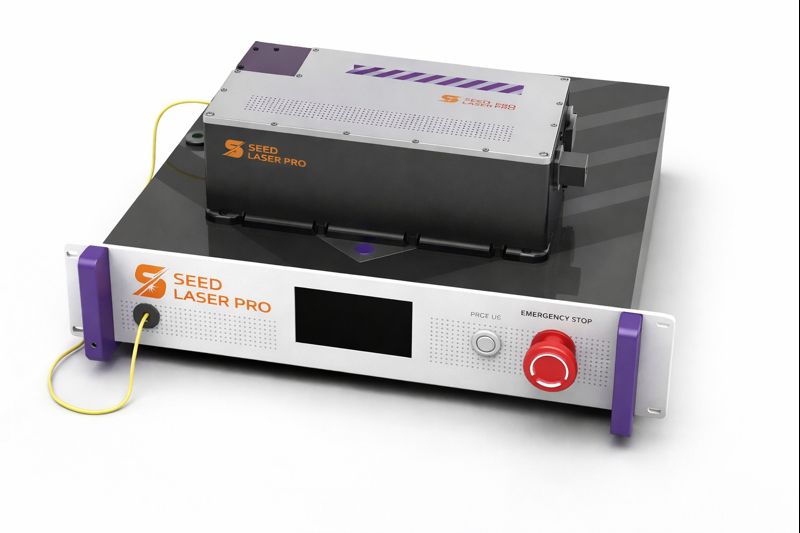
Standard unit is 297 × 145 × 93 mm, 90 to 250 VAC, 15 to 35°C operating range. Custom central wavelengths, output power levels, and OEM integration formats are available. Contact Seed Laser Pro’s engineering team before finalizing your system design.
For the full wavelength converted fiber laser range from 193 nm to 795 nm, see the wavelength converted fiber laser category.
FAQ SECTION
Why is 509 nm used in cesium Rydberg experiments?
509 nm combined with 852 nm drives two-step cesium Rydberg transitions. Frequency stability at 509 nm is critical for quantum control and metrology precision. The 509 nm photon drives the second excitation step from the cesium 6P state to the Rydberg level.
How is 509 nm generated?
A 1018.8 nm single-frequency fiber seed is frequency-doubled via SHG to 509.4 nm. Linewidth at the output is set by the seed. 2 to 5 kHz at 1018.8 nm gives 2 to 10 kHz at 509 nm.
Is the wavelength customizable?
Yes. Contact Seed Laser Pro with your target wavelength, required output power, and linewidth specification.
How does this differ from a 532 nm green laser?
509 nm and 532 nm are not interchangeable. 509 nm targets cesium atomic transitions and specific molecular features. 532 nm is the second harmonic of 1064 nm and targets different applications. See Seed Laser Pro’s 532 nm low noise laser for 532 nm requirements.