Why 795 nm Is the Rubidium D1 Wavelength
795 nm is not chosen arbitrarily. It is the wavelength of the rubidium D1 transition, connecting the 5S1/2 ground state to the 5P1/2 excited state in both rubidium-85 and rubidium-87.
The D1 line at 795 nm and the D2 line at 780 nm serve different experimental purposes. For SERF magnetometers, the D1 line at 795 nm is preferred for optical pumping because it offers advantages in pumping efficiency and reduced back-action on the atomic spin state compared to the D2 line.
In SERF magnetometers, the 795 nm laser must be tuned to a detuning within the GHz range of the rubidium D1 line, requiring both frequency stability and wide tunability simultaneously. That combination of narrow linewidth and wide tuning range is exactly what this laser provides.
SERF Magnetometers: Why This Laser Matters
SERF magnetometers operating on the rubidium 87Rb D1 transition at 795 nm achieve sensitivities approaching 1 fT/Hz, making them among the most sensitive magnetic field detectors available.
For SERF magnetometer applications, the pump laser must provide stable frequency control at the D1 line with a tuning range of approximately 0.2 nm for optimization, and output power on the order of 50 mW is sufficient for single-channel magnetometer cells. This laser covers that requirement with margin. 0.05 to 4 W output power, 100 to 300 pm tuning range, and sub-5 kHz linewidth give SERF magnetometer builders the optical pumping source their instrument needs, from prototype through to production.
Applications for SERF magnetometers built around this laser include:
- Magnetoencephalography for non-invasive brain imaging
- Magnetocardiography for cardiac monitoring
- Geophysical survey and navigation
- Fundamental physics experiments measuring anomalous magnetic moments
795 nm vs 780 nm: Choosing the Right Rubidium Wavelength
Both wavelengths address rubidium. They are not interchangeable.
| Feature | 780 nm (D2 line) | 795 nm (D1 line) |
| Transition | 5S1/2 to 5P3/2 | 5S1/2 to 5P1/2 |
| Primary use | Laser cooling, MOT, atom interferometry | SERF magnetometry, optical pumping |
| Natural linewidth | 6.07 MHz | 5.75 MHz |
| Pumping characteristics | Stronger cycling transition | Cleaner pumping, less back-action |
| | |
For rubidium cooling and magneto-optical trapping, see Seed Laser Pro’s 780 nm frequency-converted laser. For SERF magnetometry and D1 optical pumping, this 795 nm laser is the correct choice.
How 795 nm Is Generated from a Fiber Seed
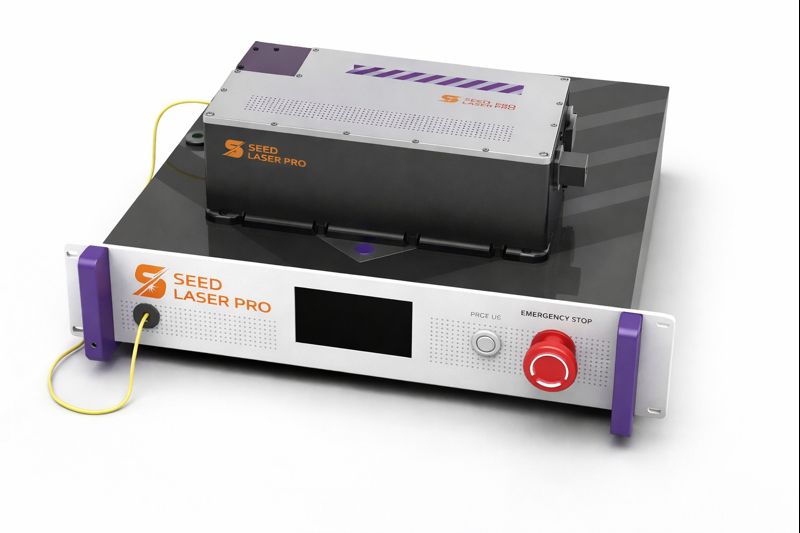
795 nm is produced through second-harmonic generation from a 1590 nm single-frequency fiber seed operating in the Erbium gain band. The 1590 nm seed provides single longitudinal mode CW output with sub-5 kHz linewidth. That output passes through a nonlinear SHG crystal. Two 1590 nm photons convert to one 795 nm photon.
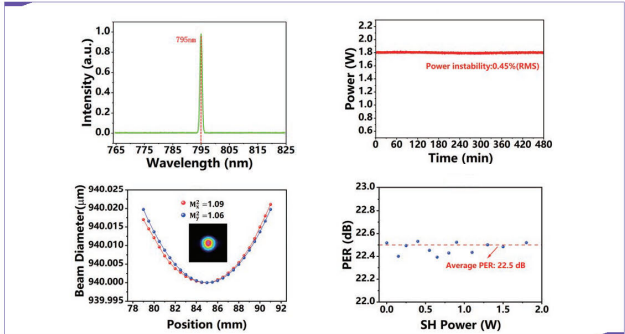
The sub-5 kHz linewidth at 795 nm is inherited directly from the 1590 nm seed. The fiber-based architecture provides the long-term frequency stability and mode-hop-free operation that SERF magnetometer and atomic physics applications require throughout extended measurement runs.
Wavelength Tuning for Magnetometer Operation
The 795 nm laser used in SERF magnetometers must be tunable within a GHz range of the rubidium D1 line for frequency locking and detuning optimization.
This laser provides 100 to 300 pm of wavelength tuning at 795 nm, corresponding to approximately 47 to 141 GHz of frequency tuning range. That range covers the full GHz-level detuning requirement for SERF magnetometer operation and frequency locking via modulation transfer spectroscopy or saturated absorption spectroscopy on the rubidium D1 line.
Tuning is via thermal and piezoelectric control of the 1590 nm seed. Fast frequency modulation for lock-in detection schemes is supported.
FAQ SECTION
What is the rubidium D1 line and why does it need a 795 nm laser?
The rubidium D1 transition connects the 5S1/2 ground state to the 5P1/2 excited state at 794.98 nm in rubidium-87. Rubidium has a useful spectroscopic wavelength of 795 nm on the D1 line, which is the standard wavelength for atomic magnetometers and atomic clocks based on rubidium. A laser operating at this precise wavelength is required to drive optical pumping in rubidium vapor cells used in magnetometers and atomic sensors.
What is a SERF magnetometer and why does it need this laser?
The SERF magnetometer requires the laser frequency to be stabilized at the rubidium D1 line and tunable within a GHz range for detuning optimization. SERF magnetometers operating on the 87Rb D1 transition at 795 nm achieve sensitivities approaching 1 fT/Hz. This laser provides the frequency stability, narrow linewidth, and GHz-range tunability those systems require.
What is the difference between the 780 nm and 795 nm rubidium lasers?
780 nm addresses the D2 transition and is used for laser cooling, magneto-optical trapping, and atom interferometry. 795 nm addresses the D1 transition and is the standard wavelength for SERF magnetometers and optical pumping applications. See Seed Laser Pro’s 780 nm frequency-converted laser for D2 line applications.
How is 795 nm generated from a fiber source?
A 1590 nm single-frequency Erbium fiber seed is frequency-doubled via SHG to produce 795 nm output. The sub-5 kHz linewidth of the 795 nm output comes directly from the 1590 nm seed. No free-running diode laser stabilization is required.
Is the wavelength customizable?
Yes. 795 nm is the standard configuration. Custom wavelengths are available on request. Contact Seed Laser Pro with your target wavelength, required output power, and linewidth specification.