What No Competitor Currently Offers
The 1550nm high-power single-frequency fiber laser market has a hard ceiling for most suppliers. CW single frequency laser PM output stops at 2W. Above that, what is available is either multimode, pulsed, or lacks a verifiable linewidth specification at the output.
Seed Laser Pro’s 20 to 120W configuration changes that. It is built on a three-stage MOPA architecture one stage more than the 2 to 20W system specifically to extend single-frequency CW operation into the hundred-watt range while maintaining sub-kHz linewidth verified at the output.
This matters for a specific set of buyers. Space laser communication terminal developers need coherent high-power 1550nm sources that are eye-safe and single-mode for fiber-coupled transceiver architectures. Quantum technology research programs running high-power atom interferometers need a stable, narrow-linewidth 1550nm source at power levels that seed-level modules cannot supply. Advanced scientific research setups that have maximized performance at the 2 to 20W tier need the next power step without changing the source architecture.
For the 0.2 to 2W tier, see the 1.5 µm 0.2 to 2W configuration. For the 2 to 20W tier, see the 1.5 µm 2 to 20W configuration.
Three-Stage MOPA: Why the Extra Stage Matters
Scaling from 20W to 120W in single-frequency CW operation at 1550nm is not a linear problem. Each additional watt of output in a single-mode fiber increases the power density in the core. SBS threshold in standard PM 1550 fiber limits CW single-frequency output to well below 100W without active countermeasures.
A three-stage MOPA addresses this by distributing power gain across three sequential amplifier stages with SBS management applied at each transition. The first stage amplifies the seed to an intermediate power level where SBS is not yet limiting. The second stage applies linewidth-narrowing and noise suppression before further gain. The third stage pushes to the final output power with large-mode-area fiber that physically increases the effective mode area, reducing power density and raising the SBS threshold.
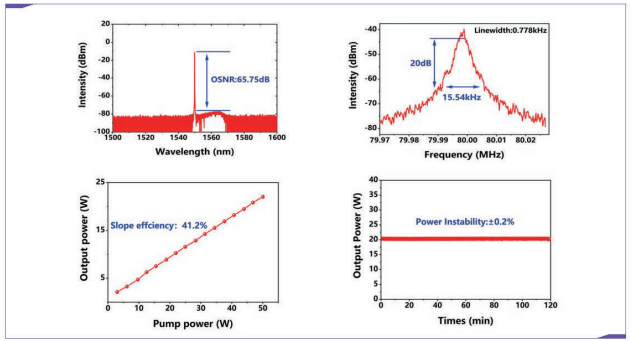
The result is 120W maximum output with sub-kHz linewidth maintained throughout the amplifier chain. At 100W typical output, linewidth stays well within the coherence requirements of space optical communication links, high-power atom interferometers, and coherent beam combining architectures.
Application Context
Space Laser Communication
Free-space optical communication links between satellites, between satellites and ground stations, and between airborne platforms require high-power coherent laser sources in the 1550nm eye-safe band. Single-frequency operation is required for coherent modulation formats. High output power extends the link budget for long-range links where geometric spreading loss dominates.
At 100W average power with Sub-kHz Fiber Laser and PM fiber output, this laser provides the optical power and spectral quality that space laser communication terminal developers need in a format compatible with fiber-coupled transceiver integration. QBH output suits high-power fiber-to-telescope coupling. Custom fiber length and OEM integration support are available for platform-specific integration requirements.
Quantum Technology
High-power single-frequency 1550nm sources are used in atom interferometry platforms measuring gravity gradients, rotation rates, and fundamental constants. The sensitivity of an atom interferometer scales with the momentum transferred to the atoms by the laser pulses, which increases with optical power. Research programs developing next-generation inertial navigation sensors and fundamental physics instruments require CW power levels in the tens-of-watts range with the single-frequency coherence that this laser provides.
Quantum key distribution (QKD) systems and quantum communication research programs also require high-power 1550nm sources for pump stages and local oscillator generation at power levels that low-power seed modules cannot support.
High-Power Scientific Research
Research programs in nonlinear optics, coherent beam combining experiments, and advanced LiDAR development require hundred-watt class single-frequency 1550nm sources. This laser serves as the master oscillator or direct power source for these setups, providing the spectral quality of a seed laser at power levels previously requiring multiple lower-power sources combined incoherently.
Why 1550nm at This Power Level Is Eye-Safe
1550nm falls within the eye-safe wavelength range under IEC 60825-1. At this wavelength, the cornea and lens of the human eye absorb incident light before it reaches the retina. This is in contrast to 1064nm, where retinal damage can occur at much lower power levels.
For space laser communication, airborne LiDAR, and outdoor quantum sensing platforms, eye-safety at 1550nm is a significant regulatory advantage. Higher outdoor transmit powers are permissible at 1550nm than at any shorter wavelength, which directly extends link range and detection capability in outdoor deployments. At 120W output with appropriate beam expansion optics, 1550nm systems can operate at power flux levels that would require strict access controls at other wavelengths.
Geo Supply and OEM Support
Seed Laser Pro supplies high-power single-frequency fiber lasers to space agencies, defense research programs, quantum technology institutes, and photonics companies across North America, Europe, Japan, and South Korea.
OEM configurations available for this product include:
- Custom wavelength within 1530 to 1570nm Erbium gain band
- Custom seed laser module: seed wavelength, PM or non-PM, module format
- Custom output fiber type, length, and high-power connector specification
- Control interface options for integration with existing instrument control systems
- Modified rack dimensions for non-standard chassis requirements
- Volume supply agreements for production programs
Custom configurations require engineering review before quotation. Contact Seed Laser Pro with your full specification, delivery geography, and program timeline.
Frequently Asked Question
Why is 120W CW single-frequency at 1550nm so rare?
Achieving CW single-frequency output above 20W at 1550nm requires solving SBS at each amplifier stage. Most suppliers stop at 2W because that is where standard PM fiber MOPA architectures hit their practical SBS ceiling without additional engineering. Going to 120W requires a three-stage architecture with large-mode-area fiber in the final stage, active linewidth management, and SBS suppression integrated at each gain transition. It is an engineering problem that only manufacturers with deep fiber laser development experience can solve reliably.
How is linewidth maintained at 100W output?
The three-stage MOPA applies linewidth-narrowing technology at the second amplifier stage, before final power scaling. This suppresses linewidth broadening from SBS and other nonlinear effects before they accumulate in the high-gain final stage. The 100W typical output linewidth is verified at the system output, not at the seed stage.
What is the difference between the 2 to 20W and 20 to 120W configurations?
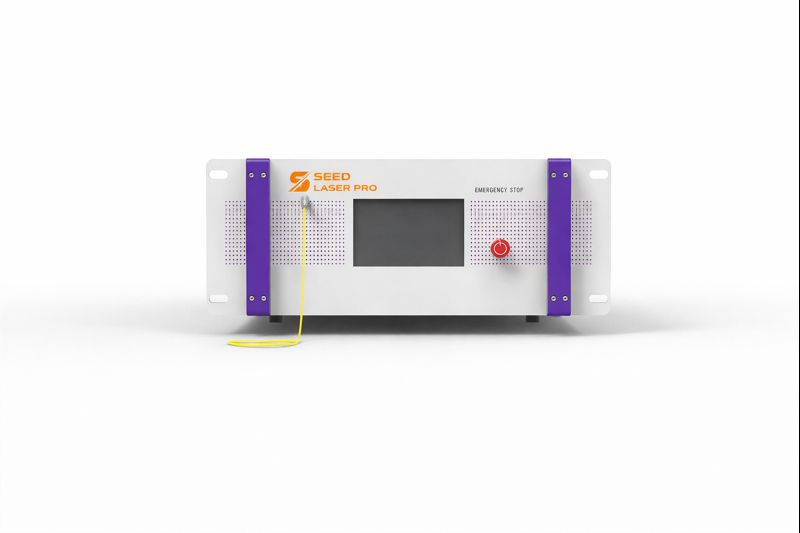
The 2 to 20W version uses a two-stage MOPA reaching 20W maximum at sub-kHz linewidth. The 20 to 120W version adds a third amplifier stage with large-mode-area fiber, enabling six-times higher output power at comparable spectral performance. Both use 2U rack format and the same output connector options. The 20 to 120W version has higher power consumption and more stringent operating temperature requirements reflecting the thermal load of the additional amplifier stage.
Is this laser suitable for space qualification?
This product is a commercial off-the-shelf configuration. For space-qualified versions requiring radiation hardening, thermal vacuum testing, vibration qualification, and outgassing certification, contact Seed Laser Pro’s engineering team. Custom programs for space-grade supply have been completed for research institutions and space agency contractors. Program timeline and specification requirements determine lead time and configuration options.
Can this laser be supplied to research institutions outside China?
Yes. Seed Laser Pro has an established track record of supply to research institutions, space technology companies, and defense contractors in North America, Europe, Japan, and South Korea. Export compliance is confirmed at the inquiry stage. Contact Seed Laser Pro with your institution, country, and application for an initial assessment.