Why 1550 nm Is the Most Important Wavelength in Fiber Photonics
1550 nm is not just another wavelength. It sits at the lowest-loss transmission window of standard silica optical fiber, approximately 0.2 dB/km in SMF-28. Every major fiber optic sensing, coherent communication, and LiDAR system built after 2000 is designed around this wavelength for that reason.
The component ecosystem at 1550 nm is the largest and most mature in fiber photonics. PM1550 fiber couplers, isolators, circulators, electro-optic modulators, avalanche photodiodes, and balanced detectors are all widely available, well-characterized, and competitively priced. Designing a coherent system at 1550 nm means accessing the full benefit of two decades of telecom-driven component development.
Beyond fiber properties, 1550 nm falls within the eye-safe wavelength range under international laser safety standards. High-power outdoor deployments for LiDAR and atmospheric sensing face fewer regulatory constraints at 1550 nm than at 1064 nm, which simplifies product development and certification for system builders.
What Separates This From a Standard 1550 nm Laser Module
Most 1550 nm fiber lasers in the market at this power level are either:
- Basic DFB seed modules at 10 to 50 mW with linewidths of 100 kHz to 1 MHz — suitable for sensing but not for demanding coherent detection
- Broadband multimode sources with no single-frequency operation
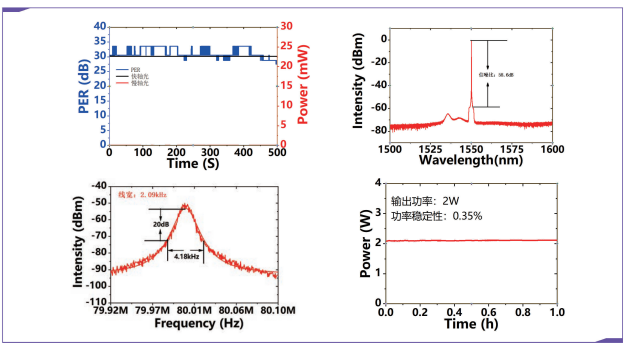
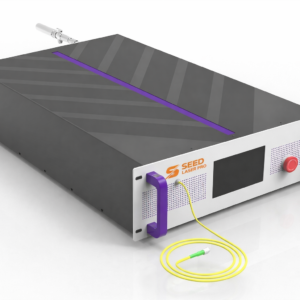
This laser is neither. It is a complete MOPA system delivering up to 2W in single longitudinal mode with 3 kHz linewidth. That means:
- Coherence length above 31 km at 3 kHz linewidth — sufficient for any practical long-range coherent sensing or ranging system
- PM1550 output throughout — no polarization scrambling between the laser and the downstream modulator or interferometer
- 1 to 100% power adjustment — full dynamic range from low-power alignment through to full operational power
- All-fiber construction — no free-space alignment, no mechanical degradation over time
For buyers evaluating this against similar products from suppliers in Shanghai or Shenzhen, Seed Laser Pro offers 20 years of single-frequency fiber laser manufacturing experience with individual unit testing on linewidth, power stability, and polarization extinction ratio before shipment.
How to Choose the Right 1550 nm Configuration
Do you need PM output?
If your downstream system includes any polarization-sensitive component — an electro-optic modulator, a PM fiber circulator, a coherent receiver with polarization diversity, or a PM fiber sensing coil — yes. PM1550 output is required. This product ships with PM1550 as standard.
Do you need more than 2W?
This 0.2 to 2W configuration suits coherent LiDAR seed stages, OPO pump stages, fiber sensing, and interferometry. For higher power requirements, see Seed Laser Pro’s 1.5 µm high-power laser in the 2 to 20W range and the 20 to 120W configuration.
Is 3 kHz linewidth sufficient?
For coherent LiDAR at ranges up to tens of kilometers, yes. For cavity-enhanced spectroscopy or optical frequency metrology, sub-kHz or Hz-level linewidth is required — see Seed Laser Pro’s single frequency fiber seed laser range.
What wavelength range do you need?
Standard range is 1530 to 1560 nm with ±0.2 nm thermal tuning. Custom wavelengths within the Erbium gain band (1530 to 1610 nm) are available on request.
What Others Do Not Tell You
Most 1550 nm high-power fiber laser product pages list specifications and stop there. What they do not explain:
Linewidth at power vs linewidth at seed level. Many MOPA systems list the seed linewidth in the datasheet but do not confirm whether linewidth is preserved at full output power. In a poorly designed amplifier chain, SBS can broaden the effective linewidth at the output. Seed Laser Pro’s 3 kHz specification is measured at the output of the complete MOPA system, not at the seed stage.
PM1550 vs standard SMF-28 output. Some products ship with SMF-28 output labeled as single-mode. At 1550 nm, SMF-28 is single-mode but it is not polarization-maintaining. A buyer connecting this to a PM fiber modulator will see polarization instability. Always confirm PM fiber type when evaluating 1550 nm sources for polarization-sensitive applications.
Power adjustment range. Some products specify 10 to 100% adjustment. Seed Laser Pro’s 1 to 100% range allows low-power alignment and testing at less than 1% of full output without a separate attenuator in the beam path.
OEM Integration and Global Supply
Seed Laser Pro supplies 1550 nm single-frequency fiber lasers to research institutions, defense contractors, photonics instrument manufacturers, and LiDAR system builders across North America, Europe, Japan, South Korea, and Southeast Asia.
OEM configurations available include:
- Custom wavelength within 1530 to 1610 nm Erbium gain band
- Custom output fiber length and connector type
- RS232 or analog control interface options
- Combined seed-and-amplifier configurations for simplified OEM integration
- Volume pricing for production quantities
Standard lead time applies for catalog configurations. Custom configurations: contact Seed Laser Pro’s engineering team at the design stage for lead time and minimum quantity information.
FAQ SECTION
What is a 1550nm single frequency fiber laser?
A 1550 nm single frequency fiber laser is a laser source that emits at one precise optical frequency in the 1530 to 1570 nm Erbium gain band, with a linewidth narrow enough for coherent detection applications. Single longitudinal mode operation means all output power is concentrated at one spectral line. At 3 kHz linewidth, this laser achieves a coherence length above 31 km, which is the key parameter for coherent LiDAR, interferometry, and fiber sensing applications that require phase coherence over long measurement paths.
Why is 1550nm preferred over 1064nm for coherent LiDAR?
1550 nm is eye-safe at higher outdoor power levels than 1064 nm, simplifying regulatory approval for airborne and terrestrial LiDAR deployments. It also has lower transmission loss in standard fiber (0.2 dB/km vs 0.35 dB/km at 1064 nm) and a larger ecosystem of compatible components originally built for telecommunications. For long-range outdoor coherent sensing, these advantages make 1550 nm the practical engineering choice for most system architectures.
What does PM1550 fiber mean and why does it matter?
PM1550 is polarization-maintaining fiber optimized for 1550 nm wavelength. It maintains a defined linear polarization state at the output connector, which is required when downstream components such as electro-optic modulators, coherent receivers, or fiber interferometers are polarization-sensitive. Standard SMF-28 fiber is single-mode at 1550 nm but does not preserve polarization. If your system uses any PM fiber components after the laser, PM1550 output is the required specification.
Can this laser be used as an OEM module in my instrument?
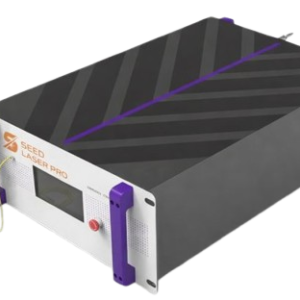
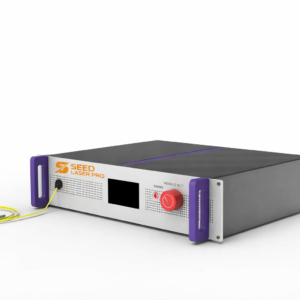
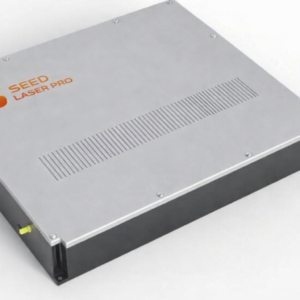
Yes. The compact 200 × 175 × 30 mm form factor, PM1550 output, and microprocessor control make this suitable for direct OEM integration. Seed Laser Pro works with instrument manufacturers globally. Contact the engineering team with your integration requirements including operating voltage, control interface, output fiber length, and environmental specifications.
What is the difference between this and a DFB seed laser at 1550nm?
A DFB seed laser at 1550 nm typically delivers 10 to 100 mW with linewidths from a few kHz to hundreds of kHz. This laser is a complete MOPA delivering up to 2W. It provides 10 to 20 times more output power than a standalone DFB seed module while maintaining 3 kHz linewidth. For applications requiring more than 100 mW in a single-frequency, PM1550 output, this MOPA configuration replaces the seed plus a separate amplifier stage with a single integrated module.