Why Intensity Noise Is the Limiting Factor, Not Linewidth
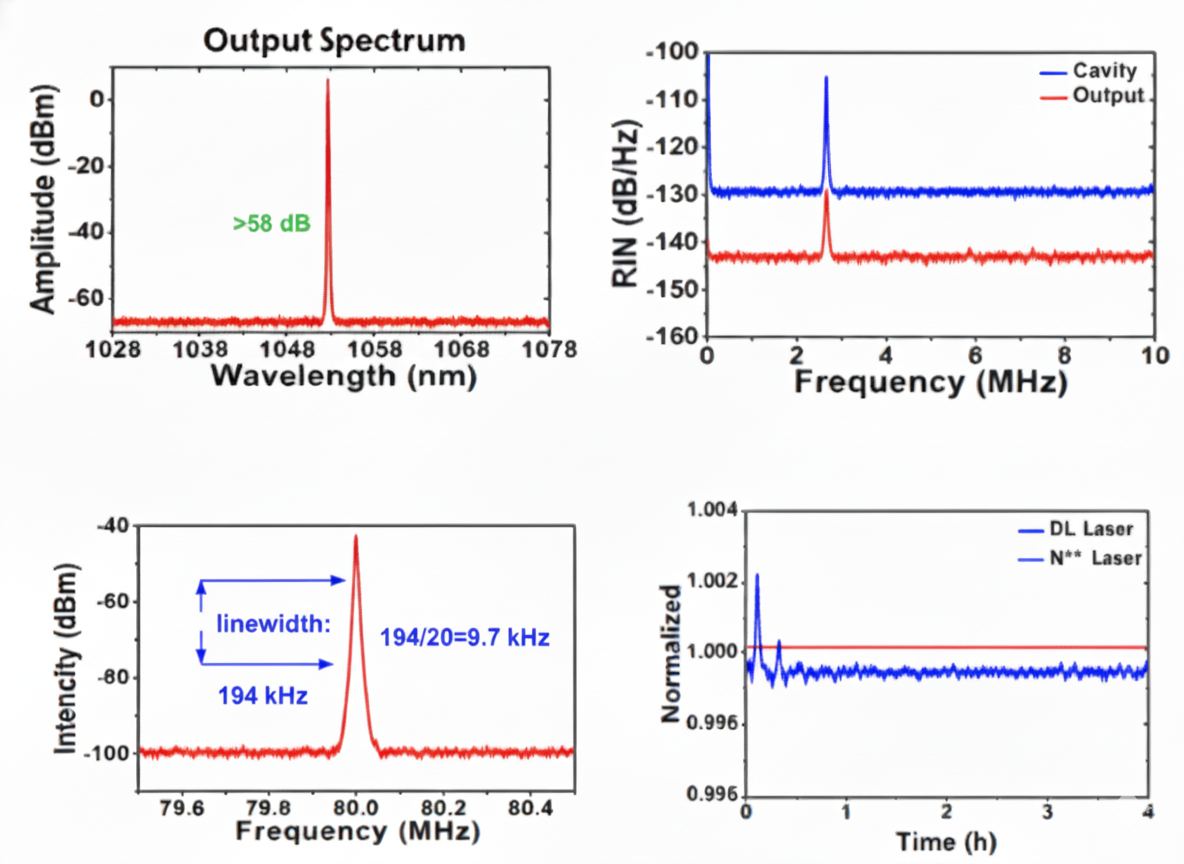
This product’s 10 kHz linewidth is unremarkable on its own — Seed Laser Pro’s standard industrial seed laser specifies sub-30 kHz, and several other products in the range achieve sub-kHz or Hz-level performance. What distinguishes this laser is not spectral width but intensity stability.
In quantum optics and quantum communication applications, the laser frequently serves as a local oscillator or reference beam in a measurement that is fundamentally limited by noise, not by spectral resolution. A homodyne or heterodyne detection scheme compares a weak signal against a strong local oscillator. Any intensity fluctuation in that local oscillator appears directly as noise in the measured signal. No amount of narrow linewidth compensates for a noisy local oscillator in this measurement architecture.
This is the gap this seed laser fills. Combined optical and power-control feedback specifically targets intensity noise suppression rather than linewidth narrowing, giving downstream systems a stable amplitude reference even when sub-kHz spectral performance is not the limiting requirement.
For applications where narrow linewidth is the primary requirement instead, see Seed Laser Pro’s 1.0 µm Industrial Single-Frequency Seed Laser or the Hz-Level Ultra-Narrow Linewidth Single-Frequency Fiber Laser.
Application Context
Quantum Communication and Quantum Optics
Continuous-variable quantum key distribution and squeezed-light generation experiments both depend on a local oscillator with intensity noise low enough that it does not mask the quantum-limited signal being measured. Excess classical intensity noise above the shot-noise floor directly degrades the security and fidelity of these protocols. A seed laser engineered for low intensity noise, rather than simply narrow linewidth, provides the cleaner reference these experiments require.
Distributed Fiber Sensing
In distributed sensing architectures using coherent detection along long fiber spans, laser intensity noise sets a floor below which weak physical signals — strain, temperature, vibration — cannot be reliably distinguished from the source’s own fluctuations. Reducing source RIN directly extends the achievable sensing range and improves the minimum detectable signal at any given point along the fiber.
Coherent Optical Measurement and Precision Interferometry
Interferometric measurements that rely on intensity detection at the output, rather than purely phase-based detection, inherit the amplitude noise of the source directly into the measurement noise floor. A stable, low-noise seed reduces this contribution, improving measurement repeatability over extended acquisition periods.
New Energy Laser Driving and Coherent Photoradar
In emerging applications such as laser-driven energy systems and coherent photoradar (LiDAR-adjacent coherent ranging), consistent power delivery without sudden fluctuations is a practical operational requirement. The highly stable power control architecture in this seed laser supports the predictable, repeatable output these systems depend on.
PM980 vs HI-1060: Choosing the Right Output Fiber
Both fiber types are available with this product, and the choice depends on downstream compatibility.
PM980 maintains a defined polarization state through the fiber, required when the laser feeds into polarization-sensitive components — balanced detectors with polarization diversity, electro-optic modulators, or PM fiber amplifiers.
HI-1060 is a non-PM single-mode fiber suited to applications where polarization is managed externally with free-space optics, or where the downstream system does not require a defined polarization state at the laser output.
If your application includes any PM fiber splice or PM-based component immediately after this laser, specify PM980.
Frequently Asked Question
What makes this laser “ultra-low noise” compared to a standard seed laser?
The defining specification is intensity noise suppression, not linewidth. This laser uses a combined optical and power-control feedback architecture specifically engineered to minimize relative intensity noise and achieve P-P power stability below 0.5%. Standard seed lasers in this wavelength range typically optimize for linewidth or output power rather than intensity stability as the primary design target.
Why does intensity noise matter more than linewidth for quantum optics applications?
Many quantum optics and quantum communication measurement architectures use the laser as an amplitude reference or local oscillator in a noise-limited detection scheme. Intensity fluctuations in that reference appear directly in the measured signal, regardless of how narrow the laser’s linewidth is. Linewidth determines spectral resolution; intensity noise determines the amplitude noise floor. For these applications, intensity noise suppression is the more relevant specification.
What is the difference between this seed laser and the 1.0 µm Industrial Single-Frequency Seed Laser?
The Industrial Seed Laser targets sub-30 kHz linewidth, mode-hop-free operation, and shock resistance for applications like gravitational wave research and LiDAR. This Ultra-Low Noise Seed Source targets intensity stability and low RIN for quantum optics, fiber sensing, and coherent measurement applications. Linewidth on this product is 10 kHz, broader than the industrial seed’s sub-30 kHz, reflecting the different optimization priority.
Can output power be adjusted without affecting noise performance?
Yes. Output power is adjustable from 10 to 100% through the highly stable power control architecture, which is designed to maintain consistent noise suppression performance across the adjustment range rather than only at one fixed operating point.
Is this laser suitable as a seed for a high-power MOPA system?
Yes, for applications where the priority is low-noise amplified output rather than the narrowest possible linewidth. PM980 output connects directly to Ytterbium fiber amplifier input stages. See Seed Laser Pro’s 1.0 µm high-power single-frequency laser range for downstream amplification options.