Linewidth vs Frequency Stability: Why Both Matter ?
These are two different specifications that buyers sometimes conflate.
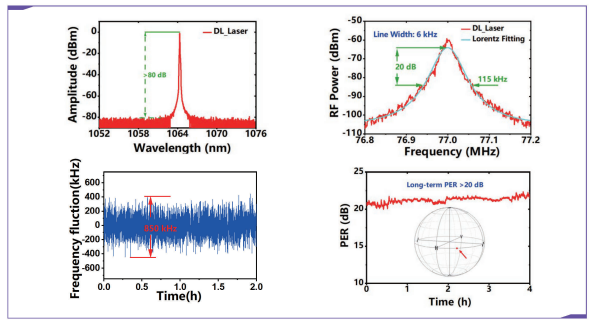
Linewidth describes the instantaneous spectral width of the laser output. A 10 kHz linewidth laser emits within a 10 kHz spectral band at any given moment. Coherence length at 10 kHz linewidth is approximately 9.5 km.
Frequency stability describes how much the center of that spectral band moves over time. A laser with excellent 10 kHz linewidth can still drift by hundreds of megahertz over an hour due to temperature changes in the fiber cavity, pump current variations, and mechanical stress in the fiber. That drift shifts the laser away from its operating point, introduces phase errors in interferometric systems, and degrades measurement repeatability over extended acquisition windows.
This laser specifies both. 10 kHz linewidth defines the instantaneous coherence. Below 1 MHz per hour frequency drift defines the long-term stability. For applications running interferometric measurements over minutes to hours, both numbers matter and cannot be substituted for each other.
For context, the seed laser has a large influence on the overall noise characteristics of high-power laser systems, and the use of the lowest-noise, frequency-stabilized seed laser is directly beneficial for interferometric applications.
What the Intelligent Frequency Stabilization System Does ?
The frequency stabilization scheme in this laser uses active feedback to correct for the sources of long-term frequency drift that affect any single-frequency fiber laser in real-world operation.
Thermal drift in the fiber cavity is the dominant long-term mechanism. As the cavity temperature changes, the optical path length changes, shifting the resonant frequency. The stabilization system monitors the cavity frequency and applies correction through a thermal actuator with sufficient range to hold drift below 1 MHz over an hour of continuous operation across the -10 to 45°C operating temperature range.
Short-term frequency noise from acoustic coupling and pump current fluctuations is addressed through a faster piezoelectric feedback path. Together, the dual-loop approach covers both fast noise and slow drift, keeping the output frequency within the specified stability window throughout extended measurement runs.
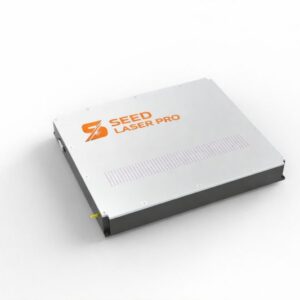
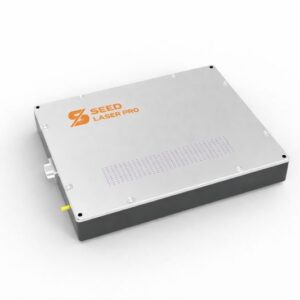
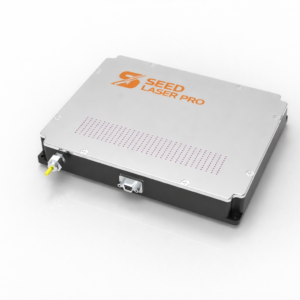
This is the same principle used in laboratory-grade frequency-stabilized systems but implemented in a compact 175 × 140 × 25 mm module that runs from 12 VDC at 20W.
Applications That Require Frequency Stability
Precision Interferometric Imaging
Interferometric imaging systems measure phase differences between two optical paths to reconstruct wavefronts, surface profiles, or refractive index distributions. The measurement accuracy depends on the laser frequency remaining constant during the acquisition window. A laser that drifts by 10 MHz during a 60-second acquisition introduces a systematic phase error that appears as a false wavefront in the reconstructed image.
Below 1 MHz per hour drift means less than 17 kHz per second average drift rate. For most interferometric imaging acquisition windows, this keeps laser-induced phase errors below the measurement noise floor.
Ultra-Long Baseline Measurement and VLBI
In Very Long Baseline Interferometry, multiple signals are recorded independently at telescopes separated by long baselines and coherently combined to produce very high-resolution images. Extending to space-based VLBI requires an ultra-stable laser reference at each telescope whose frequency is known and stable relative to a common reference.
Frequency-stabilized 1064nm seed lasers serve as the starting point for optical frequency chains used in these systems. The stability of the seed directly limits the achievable coherence between baselines. Below 1 MHz per hour drift is the stability class required for these reference applications.
Fiber Sensing Networks
In distributed fiber sensing systems using interferometric detection, laser frequency drift introduces a slowly varying background signal that is indistinguishable from a real physical event. A pressure or temperature change in the sensing fiber produces a phase shift at the receiver. Laser frequency drift produces an identical-looking phase shift. Without a frequency-stabilized source, the sensing system cannot reliably distinguish low-frequency physical events from laser drift artifacts.
Below 1 MHz per hour frequency drift keeps the laser-induced background below the signal levels of the physical events that fiber sensing networks are designed to detect.
Comparison: Standard vs Frequency-Stabilized at 1064nm
| Feature | Standard 1064nm Seed | This Frequency-Stabilized Seed |
| Linewidth | Sub-30 kHz typical | 10 kHz |
| Frequency drift | 10 to 100+ MHz/hour | Below 1 MHz/hour |
| Long-term coherence | Degrades with drift | Maintained by active stabilization |
| Best for | MOPA seeding, short-term coherence | Interferometry, sensing, long-acquisition |
| Operating range | -10 to 45°C | -10 to 45°C |
| Form factor | 175 x 140 x 25 mm | 175 x 140 x 25 mm |
For applications where frequency stability over time determines measurement quality, this laser is the correct choice. For applications where output power or linewidth alone matter, the 1064nm industrial single-frequency seed laser is available.
OEM and High-Power MOPA Applications
This laser is also used as the master oscillator in high-power 1064nm MOPA systems where the frequency stability of the seed determines the frequency stability of the amplified output. In gravitational wave detector input laser chains, frequency-stabilized seeds are used because the amplifier stages preserve frequency noise characteristics from the seed stage. A frequency-drifting seed produces a frequency-drifting high-power output regardless of how stable the amplifier is.
For high-power seeding applications, PM980 output connects directly to Ytterbium fiber amplifier input stages. See Seed Laser Pro’s high-power single-frequency fiber lasers at 1.0 µm for the complete MOPA range above this seed level.
Frequently Asked Question
What is a frequency-stabilized seed laser?
A frequency-stabilized seed laser is a single-frequency laser with an active feedback system that corrects for long-term frequency drift. Without stabilization, single-frequency fiber lasers drift in center frequency due to thermal and mechanical changes in the fiber cavity. This laser holds that drift below 1 MHz per hour at 1064nm, maintaining the frequency stability that precision interferometry, baseline measurement, and fiber sensing applications require throughout extended measurement runs.
What is the difference between linewidth and frequency drift?
Linewidth is the instantaneous spectral width of the laser output at any moment. Frequency drift is how much the center of that spectral line moves over time. A laser can have excellent 10 kHz linewidth but still drift by 100 MHz over an hour, which makes it unsuitable for long-duration interferometric measurements. This laser specifies both: 10 kHz instantaneous linewidth and below 1 MHz per hour long-term drift.
What applications need this over a standard 1064nm seed laser?
Any measurement system running over minutes to hours where laser frequency drift would introduce systematic errors. This includes precision interferometric imaging, ultra-long baseline measurement, VLBI reference chains, and distributed fiber sensing networks. For short-duration measurements or MOPA seeding where frequency drift within the measurement window is negligible, a standard 1064nm seed is sufficient.
Can this laser be used as a seed for a high-power MOPA?
Yes. PM980 output and single longitudinal mode CW operation make this directly compatible with Ytterbium fiber amplifier chains. The frequency stabilization benefit carries through amplification — the amplified output inherits the frequency stability of the seed. For high-power MOPA configurations, see Seed Laser Pro’s high-power 1.0 µm laser range.
What is the difference between PM980 and HI-1060 output fiber?
Both are single-mode at 1064nm. PM980 is polarization-maintaining and required when downstream components are polarization-sensitive. HI-1060 is a non-PM single-mode fiber with a slightly larger mode field diameter, suited for applications where polarization is managed externally or is not a system constraint. Both options are available at the same specifications.