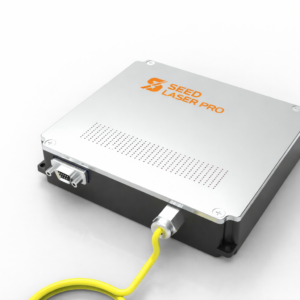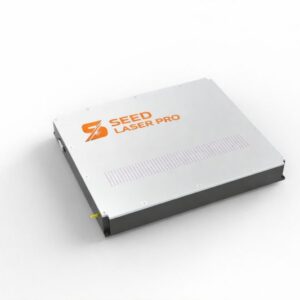
Low phase noise and an all-polarization-maintaining optical path. These two properties define what this seed source is built for and they separate it from every other phase-modulated seed in this wavelength range.
Seed Laser Pro’s 1.5 µm Laser Phase-Modulated Fiber Seed Source delivers 50 mW of CW output at 1530 to 1560 nm with adjustable bandwidth from 0.1 to 40 GHz, ultra-low phase noise, and an all-PM optical path throughout. PM1550 fiber output, PER above 20 dB, power stability P-P below 0.5%, ±0.2 nm wavelength tuning. Built for optical quantum communication, distributed acoustic sensing, coherent LiDAR, and femtosecond micromachining systems where controlled spectral broadening and phase noise performance determine system capability.
Product Features
- 0.1 to 40 GHz adjustable bandwidth, ultra-low phase noise, 50 mW CW at 1530-1560nm
- All-polarization-maintaining optical path throughout, PM1550 output, PER above 20 dB
- Power stability P-P below 0.5%, SNR above 50 dB, power adjustment 1-100%
- ±0.2nm wavelength tuning, -10 to 45°C operating range, 175x140x25mm compact module
Typical Applications
- Optical quantum communication systems requiring phase-modulated, low-phase-noise 1550nm seed
- Distributed acoustic sensing (DAS) using phase-modulated CW seed for coherent backscatter detection
- Coherent LiDAR transmitters using bandwidth-controlled 1550nm phase-modulated sources
- Femtosecond micromachining systems using 1550nm phase-modulated seed for ultrashort pulse chains
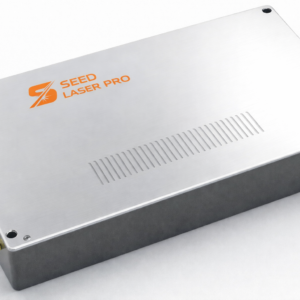
Eye-safe. Miniaturized. Wavelength-tunable. Three properties that make a 1550nm point light source genuinely useful in field-deployed LiDAR calibration, quantum technology instrument testing, and precision medical imaging setups.
Seed Laser Pro’s 1.5 µm Point Light Source delivers 25 mW of CW output at 1530 to 1560 nm with 0.04 nm spectral bandwidth and ±0.2 nm wavelength tuning range. PM1550 fiber output, P-P stability below 0.5%, power adjustment from 1 to 100%. Operating range -10 to 45°C, compact 175 × 140 × 25 mm module, 5 VDC. Built for LiDAR receiver alignment, scientific research, device testing, and precision measurement and imaging where an eye-safe, stable, tunable reference point source is needed.
Product Features
- 25 mW CW at 1530-1560nm, 0.04nm spectral bandwidth, single-mode output
- PM1550 fiber output, FC/APC, power stability P-P below 0.5%, 1-100% adjustment
- ±0.2nm wavelength tuning range, customizable fiber length above 0.8m
- Eye-safe 1550nm wavelength, 5 VDC, -10 to 45°C operating range, 175x140x25mm
Typical Applications
- LiDAR receiver calibration and alignment using a stable, eye-safe 1550nm point reference
- Scientific research and experimental teaching requiring a clean, tunable 1550nm reference source
- Device testing and measurement of PM1550 components, 1550nm detectors, and optical instruments
- Precision measurement and imaging systems requiring a stable, miniaturized infrared point source
The 1.5 μm ultra-low noise seed source features completely independent intellectual property rights and performance reaching an internationally leading level. It adopts an innovative combined optical and optoelectronic feedback noise suppression scheme, achieving intensity noise lower than −138 dB/Hz in the 1 MHz–100 MHz frequency range, and power stability better than 0.5% over 30 minutes.
Product Features
Ultra-Low Intensity Noise
Excellent Power Stability
Completely Independent Intellectual Property Rights
Typical Applications
Quantum Communication
Distributed Fiber Sensing
Coherent Optical Measurement
The 1.5 μm hundred-hertz ultra-narrow linewidth fiber laser is a laser with completely independent intellectual property rights and performance reaching an internationally advanced level. It adopts a special resonant cavity structure design and combines noise suppression and linewidth-narrowing technologies to achieve ultra-narrow linewidth laser output as low as the hundred-hertz level.
Product Features
Ultra-Narrow Linewidth
Low Intensity Noise
High Environmental Adaptability
Typical Applications
High-Precision Fiber Sensing
Quantum Computing
Quantum Precision Measurement
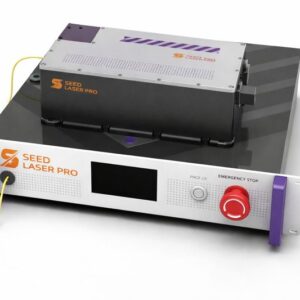
193 nm is one of the most demanding wavelengths in photonics. Generating coherent output here requires multi-stage frequency conversion, DUV-grade optics, and a fiber seed stable enough to preserve narrow linewidth through every conversion step.
Seed Laser Pro’s 193 nm Single-Frequency Laser delivers 1 to 3 mW of CW output at 193.3 nm. Linewidth stays below 80 kHz. Side-mode suppression ratio reaches 20 to 24 dB. The free-space output beam is clean, with M² below 1.4 and 1.0 mm diameter at the output port.
Built for semiconductor lithography research, precision microfabrication, DUV spectroscopy, and medical applications. Custom wavelength configurations are available on request.
PRODUCT FEATURES
- Deep UV Single-Frequency Output at 193.3 nm : Continuous-wave single longitudinal mode output in the deep ultraviolet. Coherent, stable, and fully solid-state. No gas mixtures. No high-voltage discharge. No fluorine handling.
- Sub-80 kHz Linewidth from Fiber Seed Architecture : Spectral purity inherited directly from the narrow-linewidth fiber seed. To optimize seeding for an ArF amplifier, linewidth must be controlled below 4 GHz. At sub-80 kHz, this laser sits three orders of magnitude inside that threshold.
- Active Power Stabilization : Output power stability within 1% RMS over two hours. Thermal and conversion efficiency drift in the DUV stage are actively compensated throughout continuous operation.
TYPICAL APPLICATIONS
- Semiconductor Lithography Research and Metrology : 193 nm is the wavelength of ArF excimer lithography, used across the industry for DUV patterning. This CW single-frequency source is not a production lithography laser. It serves as a coherent reference for optics metrology, interferometric wavefront testing, and defect inspection setups where excimer coherence is too limited.
- Precision Microfabrication : 193 nm photons carry 6.4 eV each. That energy level enables direct ablation of polymers, carbon compounds, and biological tissue. Thermal damage to surrounding material is minimal because energy coupling happens at the photochemical level rather than through heat.
- Medical Applications : 193 nm is the clinical wavelength for corneal reshaping in refractive surgery. Coherent CW output with stable power and narrow linewidth supports both surgical laser systems and the calibration and research setups around them.
- Deep UV Spectroscopy : Sub-80 kHz linewidth at 193 nm resolves fine spectral features in UV absorption spectra of molecules, ions, and semiconductor materials that broadband or incoherent DUV sources cannot distinguish.
Custom wavelength or output power required? The central wavelength is customizable. Custom power configurations and OEM integration support are available. Contact Seed Laser Pro’s engineering team at the design stage.
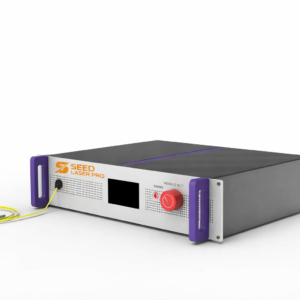
Seed Laser Pro’s 2.0 µm ASE Light Source delivers 39 nm of broadband output from 1926 to 1976 nm for 2 µm fiber component characterization, CO2 and water vapor gas sensing, Thulium fiber amplifier testing, and spectral analysis in the 2 µm band.
Output power is 10 mW through SM1950 single-mode fiber, with 3 dB spectral flatness and RMS stability below 0.2%. The system ships in a standard 2U rack-mount chassis at 88.9 × 48.26 × 450 mm, drawing 20 W. Custom fiber types, OEM configurations, and PM output options are available. Contact Seed Laser Pro’s engineering team to discuss integration requirements.
Product Features
- 39 nm Coverage, 1926 to 1976 nm, 3 dB Flatness — Broadband output across the Thulium gain band centered at 1950 nm. 3 dB spectral flatness across 39 nm gives a uniform illumination profile suited for component loss measurement and gas absorption spectroscopy across multiple molecular absorption features simultaneously.
- SM1950 Single-Mode Fiber Output — SM1950 is the standard single-mode fiber for 2.0 µm wavelength systems. Direct connection to 2 µm fiber components without mode mismatch. FC/APC connector minimizes back-reflections. Custom fiber types and lengths available on request.
- Precision ATC and ACC Control — Automatic temperature and current control maintain output power at RMS below 0.2% and peak-to-peak below 1% across the full 0 to 40°C operating range. Output adjustable from 10 to 100%.
- 2U Rack-Mount Chassis — Ships in a standard 2U rack-mount chassis at 88.9 × 48.26 × 450 mm. Designed for integration into rack-based test stations and laboratory instrument setups where bench space is limited.
Typical Applications
- CO2 and Water Vapor Gas Sensing — The 2.0 µm band covers strong molecular absorption features of CO2, water vapor, and CO. Broadband illumination from 1926 to 1976 nm simultaneously covers multiple absorption lines across these species, allowing multi-gas detection from a single source in absorption spectroscopy setups.
- 2 µm Fiber Component Testing — Thulium-doped fiber amplifiers, 2 µm couplers, isolators, and WDMs require a broadband source at their operating wavelength for insertion loss, return loss, and spectral transmission characterization. This source covers the Thulium band operating range for component test setups that cannot use C-band or 1 µm equipment.
- Thulium Fiber Amplifier Characterization — Measuring the gain spectrum and noise figure of Thulium-doped fiber amplifiers requires a broadband seed source covering the amplifier gain bandwidth. This source provides the input signal for amplifier gain measurements across the 1926 to 1976 nm range.
- Spectral Analysis and Mid-Infrared Research — Research programs developing 2 µm fiber laser systems, mid-infrared nonlinear sources, and 2 µm sensing instruments all require a stable broadband reference source at this wavelength for calibration, component evaluation, and system characterization.
Need a custom 2.0 µm configuration? PM fiber output, custom fiber length, OEM module format, and alternative operating voltage are available. For gas sensing setups requiring specific wavelength coverage or flatness specifications, contact Seed Laser Pro’s engineering team.
Seed Laser Pro’s 2.0 µm High-Power Single-Frequency Laser delivers 0.05 to 2W of CW output at 1940 to 2000 nm with linewidth below 30 kHz. Built on an all-fiber MOPA with double-clad pumping, it maintains single-frequency CW operation and M² below 1.1 across the full power range. PM and non-PM fiber output, bare fiber, QBH, and QCS collimator connector options. 10 to 40°C operating range. Built for precision gas sensing, molecular spectroscopy, biomedical laser systems, and mid-infrared research. OEM and custom configurations available globally.
Product Features
- 0.05 to 2W CW output, sub-30 kHz linewidth, single-frequency single longitudinal mode, M² below 1.1
- PM and non-PM fiber output, bare fiber / QBH / QCS collimator connector, 1.2 m fiber length
- All-fiber MOPA design, double-clad pumping, RMS power stability below 0.2%, P-P below 1%
- Operating range 10 to 40°C, power adjustment 1 to 100%, optical SNR above 40 dB
Typical Applications
- Precision molecular spectroscopy and gas sensing targeting CO2, H2O, and CO absorption at 2 µm
- Biomedical fiber laser systems for soft tissue surgery and urological applications at 1950 nm
- Mid-infrared OPO and DFG pumping targeting 3 to 5 µm output from a 2 µm single-frequency seed
- Fundamental research requiring stable, narrow-linewidth CW output in the Thulium gain band
2 to 20W of CW output at 1950nm from a single all-fiber MOPA. No free-space elements. No alignment. Sub-30 kHz linewidth across the full power range.
Seed Laser Pro’s 2.0 µm High-Power Single-Frequency Laser delivers this in a 483 × 362 × 110 mm chassis. Double-clad Thulium fiber pumping maintains M² below 1.2 and single-frequency single longitudinal mode operation from 2W minimum to 20W maximum. PM and non-PM output both available. Bare fiber, QBH end-cap, and QCS collimator connector options. Operating range 10 to 40°C. Built for nonlinear frequency conversion to mid-IR, Doppler wind LiDAR, high-power biomedical laser systems, and fundamental 2 µm research. OEM supply available globally.
Product Features
- 2 to 20W CW output, sub-30 kHz linewidth, single-frequency single longitudinal mode, M² below 1.2
- PM and non-PM fiber output, bare fiber / QBH end-cap / QCS collimator, 1.2 m fiber length
- All-fiber MOPA, double-clad Thulium pumping, RMS power stability below 0.2%, P-P below 1%
- Power adjustment 1 to 100%, optical SNR above 40 dB, operating range 10 to 40°C
Typical Applications
- Mid-infrared OPO and DFG pumping at 2 µm targeting 3 to 5 µm output for chemical sensing and spectroscopy
- Coherent Doppler wind LiDAR at 2 µm requiring high average CW power and single-frequency coherence
- High-power biomedical fiber laser systems for surgical and therapeutic applications at 1950 nm
- Fundamental 2 µm research requiring multi-watt single-frequency CW output in the Thulium gain band
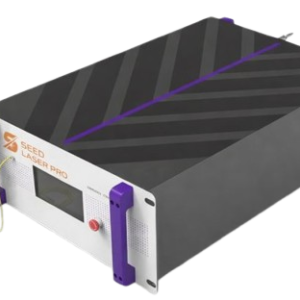
500W of CW single-frequency output at 1950nm. No other commercial supplier currently offers this.
Seed Laser Pro’s flagship 2.0 µm High-Power Single-Frequency Laser delivers 20 to 500W of continuous-wave output in the Thulium gain band with sub-30 kHz linewidth and M² below 1.4. All-fiber MOPA architecture with double-clad pumping. Intelligent control system with 10 to 100% power adjustment. QBH, bare fiber, and QCS collimator output options. 10 to 40°C operating range. Built for high-power industrial processing, long-range LiDAR, atmospheric gas detection, and kilowatt-class mid-infrared pump applications. Global OEM supply available.
Product Features
- 20 to 500W CW output, sub-30 kHz linewidth, single-frequency CW, M² below 1.4
- All-fiber MOPA with double-clad Thulium pumping, intelligent control, 10 to 100% power adjustment
- QBH end-cap / bare fiber / QCS collimator output, 1.2 m fiber length customizable
- Power stability P-P below 1.5%, optical SNR above 40 dB, 10 to 40°C operating range
Typical Applications
- High-power industrial laser processing and manufacturing using 2 µm eye-safe wavelength
- Long-range atmospheric LiDAR and remote sensing requiring maximum 2 µm transmit power
- Gas detection and atmospheric sensing for CO2, water vapor, and molecular species at 2 µm
- High-efficiency mid-infrared OPO pump source targeting multi-watt 3 to 5 µm output
The 2.0 μm DBR (Distributed Bragg Reflector) single-frequency seed source is a high-performance laser device designed for applications requiring high coherence and low noise. It is widely used in quantum information, high-resolution spectroscopy, LiDAR, and nonlinear frequency conversion. Its core advantages include kHz-level narrow linewidth, wide-range mode-hop-free tuning, high-power amplification compatibility, and a compact, environmentally robust design.
Product Features
kHz-Level Narrow Linewidth
Mode-Hop-Free Wide Tuning
High Power Stability
Compact Design
Typical Applications
Gas Detection
Quantum Computing
Quantum Precision Measurement
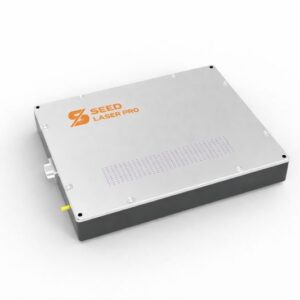
Seed Laser Pro’s 2.0 µm Industrial Single-Frequency Seed Source operates at 1950 nm with sub-50 kHz linewidth and PM1950 fiber output. All-fiber construction, mode-hop-free operation, and -10 to 45°C operating range make it suitable for both industrial deployment and laboratory use. Designed as the master oscillator for Thulium MOPA systems, coherent 2.0 µm LiDAR, and mid-infrared nonlinear conversion. PM and SM output options available.
PRODUCT FEATURE
- Sub-50 kHz linewidth, single longitudinal mode CW at 1950 nm, optical SNR above 50 dB
- PM1950 output with 23 dB PER, SM1950 also available, FC/APC connector standard
- All-fiber construction, no free-space elements, -10 to 45°C operating range
- Mode-hop-free, power stability P-P below 1%, optimized for Thulium MOPA amplifier seeding.
APPLICATIONS
- Mid-infrared pumping for OPO and DFG systems targeting 3 to 5 µm output wavelengths
- Coherent Doppler wind LiDAR at 2.0 µm as direct seed or MOPA master oscillator
- Medical fiber laser systems for soft tissue surgery, urological, and minimally invasive procedures
- Seed source for high-power Thulium fiber amplifier chains requiring PM1950 compatible input
Seed Laser Pro’s 2.0 µm Phase-Modulated Fiber Seed Source uses electro-optic phase modulation to intentionally broaden output linewidth from 0.1 to 5 GHz at 1950 nm. That controlled linewidth broadening suppresses stimulated Brillouin scattering in downstream high-power MOPA amplifier chains, allowing watt-to-kilowatt output power delivery through single-mode fiber without SBS-induced power rolloff or backscattering damage. Output power is 8 to 15 mW. PM1950 or SM1950 fiber output, P-P stability below 0.5%, power adjustment 1 to 100%. Built for seeding high-power 2 µm LiDAR transmitters, medical and material processing laser systems, and gas detection platforms requiring maximum amplifier output.
PRODUCT FEATURES
- Phase modulation with adjustable linewidth 0.1 to 5 GHz for tunable SBS threshold control
- 8 to 15 mW CW output at 1950 nm, single longitudinal mode, SNR above 50 dB
- PM1950 or SM1950 fiber output, P-P stability below 0.5%, power adjustment 1 to 100%
- All-fiber construction, 24 VDC, -10 to 45°C operating range, FC/APC connector
TYPICAL APPLICATIONS
- High-power 2 µm MOPA seeding where SBS suppression is required above watt-level output
- LiDAR transmitters requiring maximum eye-safe 2 µm power from single-mode fiber delivery
- Medical and material processing fiber laser systems with kilowatt-class Thulium amplifiers
- High-power gas sensing and fundamental research requiring phase-modulated 1950 nm seed input