
seed laser pro

2.0 μm ASE Light Source

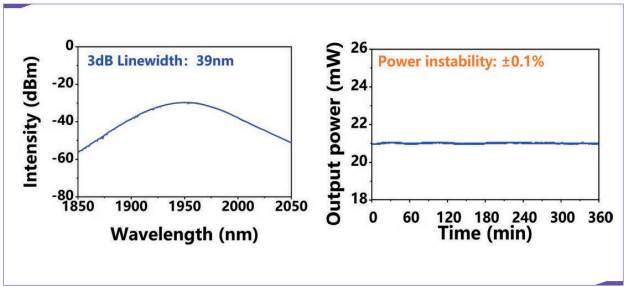
Seed Laser Pro’s 2.0 µm ASE Light Source delivers 39 nm of broadband output from 1926 to 1976 nm for 2 µm fiber component characterization, CO2 and water vapor gas sensing, Thulium fiber amplifier testing, and spectral analysis in the 2 µm band.

Output power is 10 mW through SM1950 single-mode fiber, with 3 dB spectral flatness and RMS stability below 0.2%. The system ships in a standard 2U rack-mount chassis at 88.9 × 48.26 × 450 mm, drawing 20 W. Custom fiber types, OEM configurations, and PM output options are available. Contact Seed Laser Pro’s engineering team to discuss integration requirements.

Product Features

  • 39 nm Coverage, 1926 to 1976 nm, 3 dB Flatness — Broadband output across the Thulium gain band centered at 1950 nm. 3 dB spectral flatness across 39 nm gives a uniform illumination profile suited for component loss measurement and gas absorption spectroscopy across multiple molecular absorption features simultaneously.
  • SM1950 Single-Mode Fiber Output — SM1950 is the standard single-mode fiber for 2.0 µm wavelength systems. Direct connection to 2 µm fiber components without mode mismatch. FC/APC connector minimizes back-reflections. Custom fiber types and lengths available on request.
  • Precision ATC and ACC Control — Automatic temperature and current control maintain output power at RMS below 0.2% and peak-to-peak below 1% across the full 0 to 40°C operating range. Output adjustable from 10 to 100%.
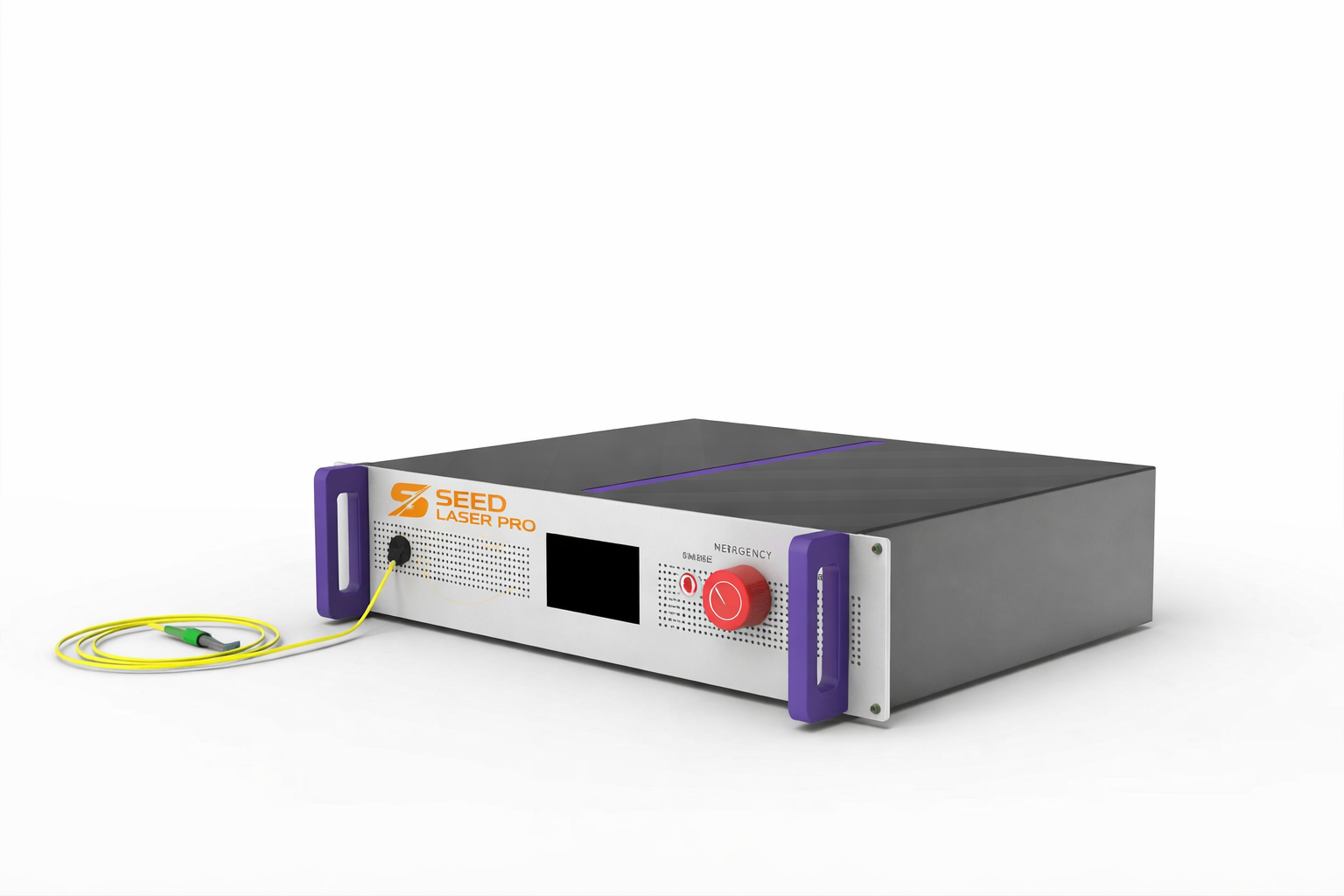
  • 2U Rack-Mount Chassis — Ships in a standard 2U rack-mount chassis at 88.9 × 48.26 × 450 mm. Designed for integration into rack-based test stations and laboratory instrument setups where bench space is limited.

Typical Applications

    • CO2 and Water Vapor Gas Sensing — The 2.0 µm band covers strong molecular absorption features of CO2, water vapor, and CO. Broadband illumination from 1926 to 1976 nm simultaneously covers multiple absorption lines across these species, allowing multi-gas detection from a single source in absorption spectroscopy setups.
  • 2 µm Fiber Component Testing — Thulium-doped fiber amplifiers, 2 µm couplers, isolators, and WDMs require a broadband source at their operating wavelength for insertion loss, return loss, and spectral transmission characterization. This source covers the Thulium band operating range for component test setups that cannot use C-band or 1 µm equipment.
  • Thulium Fiber Amplifier Characterization — Measuring the gain spectrum and noise figure of Thulium-doped fiber amplifiers requires a broadband seed source covering the amplifier gain bandwidth. This source provides the input signal for amplifier gain measurements across the 1926 to 1976 nm range.
  • Spectral Analysis and Mid-Infrared Research — Research programs developing 2 µm fiber laser systems, mid-infrared nonlinear sources, and 2 µm sensing instruments all require a stable broadband reference source at this wavelength for calibration, component evaluation, and system characterization.

Need a custom 2.0 µm configuration? PM fiber output, custom fiber length, OEM module format, and alternative operating voltage are available. For gas sensing setups requiring specific wavelength coverage or flatness specifications, contact Seed Laser Pro’s engineering team.
2.0 μm ASE Light Source
Technical ParameterUnitTechnical Specifications
MinimumTypicalMaximum
Wavelength Rangenm1926 – 1976
Optical Bandwidthnm39
Output PowermW10
Spectral FlatnessdB3.0
Output Spectral DensitydB30
Output Power Stability%RMS < 0.2 / Peak-to-Peak < 1
Output Power Adjustment%10 – 100
Operating VoltageVDC12 V or Others
Power ConsumptionW20
Operating Temperature°C040
Storage Temperature°C-4570
Output Fiber Type/SM1950 or Others
Output Fiber Lengthm0.6
Output Fiber Connector/FC/APC
Dimensionsmm88.9 (H) × 48.26 (W) × 450 (D), 2U Chassis

What Is a 2.0 µm ASE Light Source?

A 2.0 µm ASE light source generates broadband low-coherence light between 1926 and 1976 nm using Thulium-doped fiber pumped by a semiconductor laser diode. Like all ASE sources, it operates without optical feedback. Output is spectrally broad, spatially single-mode, and low in temporal coherence.

That combination matters at 2.0 µm for the same reasons it matters at 1.0 µm and 1.5 µm. Broadband coverage allows simultaneous illumination of multiple spectral features. Low coherence eliminates multi-path interference artefacts in component testing. Single-mode fiber output ensures measurement accuracy is not degraded by mode mixing.

For applications requiring narrow linewidth and long coherence length at 2.0 µm, Seed Laser Pro’s 2.0 µm single frequency seed lasers cover that requirement. For high-power 2.0 µm broadband output, Seed Laser Pro’s high power single frequency fiber lasers in the Thulium band provide the amplification stage.

Why 2 µm Is Different from C-Band and 1 µm

The 2.0 µm Thulium band is not a scaled copy of the more familiar 1.5 µm and 1.0 µm systems. It accesses a distinct spectral region with different material properties, different atmospheric transmission characteristics, and different molecular absorption features.

Water vapor has strong absorption bands around 1900 to 2000 nm. CO2 has absorption features near 2000 nm and 2700 nm. CO has features near 2300 nm. These are the molecular targets for environmental gas monitoring, industrial process sensing, and breath analysis systems. No 1.5 µm or 1.0 µm source reaches these features.

Standard SMF-28e fiber, which handles 1.5 µm applications well, is not single-mode at 2.0 µm. SM1950 fiber is used instead. Similarly, InGaAs detectors optimized for 1.5 µm have sharply reduced responsivity above 1700 nm. Extended InGaAs or InAs detectors are required at 2.0 µm. Building a 2.0 µm test bench requires components specified for this wavelength throughout, starting with the source.

This is why a dedicated 2.0 µm ASE source is needed rather than adapting C-band test equipment.

3 dB Spectral Flatness Across 39 nm

The 2.0 µm source achieves 3 dB flatness across its 39 nm bandwidth. This matches the flatness of the 1.0 µm source and is better than the 7 dB native flatness of the C-band Erbium source.

Thulium-doped fiber has a broader and more uniform gain profile in the 1900 to 2000 nm region compared to Erbium in the C-band. This allows 3 dB flatness without external flattening filters.

For gas sensing applications, flat spectral output matters. If the source has significantly more power at some wavelengths than others, absorption measurements at less-illuminated wavelengths have worse signal-to-noise ratio. Flat output across the full 39 nm measurement window ensures consistent sensitivity across all molecular absorption features within the band.

2U Rack-Mount Form Factor

Unlike the compact 175 × 140 × 25 mm module format used by the 1.0 µm and 1.5 µm ASE sources, this unit ships in a standard 2U rack-mount chassis at 88.9 × 48.26 × 450 mm.

The 2U form factor reflects the higher power consumption of 20 W required for Thulium fiber pumping, compared to 5 W for the Ytterbium and Erbium sources. The rack format integrates directly into standard 19-inch laboratory and industrial test racks. Power is supplied at 12 VDC with other voltage options available.

For OEM applications where the rack chassis is not suitable and a compact module format is required, contact Seed Laser Pro to discuss custom packaging options.

SM1950 Fiber and Connector Options

SM1950 is designed for single-mode operation at 1950 nm. It is the correct fiber type for Thulium band systems, maintaining single-mode guidance at 2.0 µm where standard SMF-28e supports multiple modes.

Output fiber length is 0.6 m standard. Alternative fiber types and lengths are available on request. FC/APC is the standard connector. If your test setup uses a different connector standard, contact Seed Laser Pro when placing your inquiry.

PM fiber output is available as a custom option for applications requiring defined polarization state. Contact Seed Laser Pro’s engineering team with your PM fiber type and PER requirement.


FAQ SECTION

What is a 2.0 µm ASE light source?

A 2.0 µm ASE light source generates broadband low-coherence light between 1926 and 1976 nm using Thulium-doped fiber. The output covers the Thulium fiber gain band, accessing molecular absorption features of water vapor, CO2, and CO that are not reachable with 1.5 µm or 1.0 µm sources. It is used for gas sensing, 2 µm component testing, Thulium amplifier characterization, and spectral analysis in this wavelength region.

Why is the power consumption 20 W when the 1.0 µm and 1.5 µm sources only use 5 W?

Thulium-doped fiber requires higher pump power to achieve comparable ASE output compared to Ytterbium or Erbium fibers. The Thulium gain cross-section and pump-to-signal conversion efficiency in this band require more pump drive current, which raises the total system power consumption to 20 W. This also explains the 2U chassis format rather than the compact module used for the other two ASE sources.

What molecular species can be measured with this source?

The 1926 to 1976 nm range covers absorption features of water vapor (H2O), carbon dioxide (CO2), and carbon monoxide (CO). These are among the primary target species in environmental gas monitoring, industrial combustion analysis, and medical breath testing. The broadband output allows simultaneous measurement across multiple absorption lines of these species from a single source.

Why is SM1950 fiber used instead of SMF-28e?

SMF-28e supports multiple transverse modes at 2.0 µm. SM1950 is designed for single-mode operation at 1950 nm, ensuring the output is spatially single-mode at the operating wavelength. Using SMF-28e at 2.0 µm would produce multimode output that degrades measurement accuracy in component testing and sensing setups where single-mode guidance is required.

Is PM fiber output available for this source?

Yes. PM fiber output is available as a custom configuration. Contact Seed Laser Pro with your PM fiber type, required polarization extinction ratio, and application requirements. Standard units ship with SM1950 single-mode output.

Can this source be used as a seed for a Thulium fiber amplifier?

It can provide a broadband seed for measuring the gain spectrum of a Thulium amplifier. For seeding a Thulium MOPA system as the master oscillator, a single-frequency Thulium seed laser rather than a broadband ASE source is the correct choice. See Seed Laser Pro’s 2.0 µm single frequency seed lasers for that application.

Translate »