seed laser pro

1.0 μm ASE Light Source

The 1.0 µm band is where Ytterbium fiber technology lives. FBG sensors written at 1060 nm, fiber components designed for the Ytterbium amplifier band, and OCT systems targeting near-infrared tissue imaging all need a broadband source at this wavelength to test, characterize, and calibrate against.

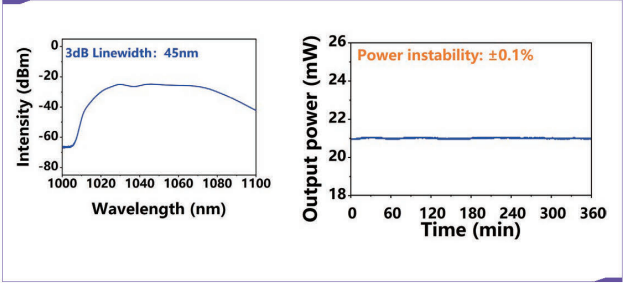
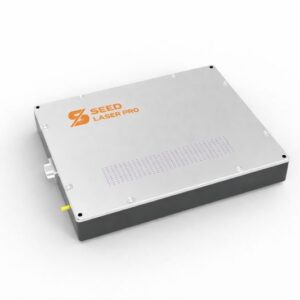
Seed Laser Pro’s 1.0 µm ASE Light Source produces 45 nm of optical bandwidth centered in the 1020 to 1065 nm range, with 10 mW output power and spectral flatness within 3 dB. High-precision ATC and ACC control circuits keep output power stable at RMS below 0.2% and peak-to-peak below 1%. Single-mode HI1060 fiber output, compact 175 × 140 × 25 mm module, 5 W power draw. Built for fiber component testing, FBG sensor interrogation, and spectral analysis at 1 µm.

Product Features

  • 45 nm Optical Bandwidth, 1020 to 1065 nm — Ytterbium-doped fiber ASE sources cover a spectrum from approximately 1020 to 1080 nm, and this source delivers 45 nm of usable bandwidth centered in that range. Wide enough to simultaneously illuminate multiple FBG sensors at different reflection wavelengths or to characterize the full passband of a fiber component in a single measurement.
  • Spectral Flatness Within 3 dB — Flat spectral output across the 45 nm bandwidth means component insertion loss measurements are not skewed by uneven source power distribution across the test wavelength range. 3 dB flatness is the standard specification for production-grade FBG and fiber component testing sources.
  • High-Precision ATC and ACC Control — Automatic temperature control (ATC) and automatic current control (ACC) circuits maintain stable output power with RMS stability below 0.2% and peak-to-peak stability below 1% throughout continuous operation. Output power is adjustable from 10 to 100%.

Typical Applications

  • FBG Sensor Testing and Interrogation — 1064nm ASE broadband light sources are suitable for testing fiber optic device loss, polarization degree, and FBG grating production. Each FBG in a sensor array reflects a narrow band of the incident broadband light. The reflection wavelength shifts with the physical quantity being measured. Illuminating the full array simultaneously with a flat broadband source covers all sensors in one measurement pass without wavelength scanning.
  • Fiber Component Characterization — Measuring insertion loss, return loss, and spectral transmission of fiber components designed for the 1 µm band requires a broadband source covering the component’s full operating wavelength range. This source covers 45 nm across the 1020 to 1065 nm range, matching the operating band of Ytterbium fiber amplifiers, couplers, isolators, and WDMs.
  • Spectral Analysis and Instrument Calibration — Optical spectrum analyzers, spectrometers, and wavelength meters used in 1 µm fiber laser development and production require a known broadband reference source for calibration and performance verification. This source provides a stable, flat broadband reference at 1 µm for these setups.
1.0 μm ASE Light Source
Technical ParameterUnitTechnical Specifications
MinimumTypicalMaximum
Wavelength Rangenm1020 – 1065
Optical Bandwidthnm45
Output PowermW10
Spectral FlatnessdB3
Output Spectral DensitydB30
Output Power Stability% RMS < 0.2 / Peak-to-Peak < 1
Output Power Adjustment%10 – 100
Operating VoltageVDC 12 V or Others
Power ConsumptionW5
Operating Temperature°C040
Storage Temperature°C-4570
Output Fiber Type/ HI1060 or Others
Output Fiber Lengthm0.6
Output Fiber Connector/ FC/APC
Dimensionsmm 175 (L) × 140 (W) × 25 (H)

Why 1.0 µm Needs Its Own ASE Source

The 1.5 µm Erbium band has the widest component ecosystem in fiber optics. It is tempting to assume that testing equipment for 1.5 µm can be repurposed for 1.0 µm work. It cannot.

Optilab’s ASE-1064-B is a Ytterbium-doped fiber ASE broadband light source in the wavelength range of 1020 nm to 1080 nm, particularly useful for 1064 nm fiber laser component characterization. The reason a dedicated source is needed is straightforward: photodetectors, fiber components, and connectors optimized for 1.5 µm have different characteristics at 1.0 µm. InGaAs detectors have lower responsivity at 1.0 µm than at 1.55 µm. Fiber couplers and splitters designed for 1.55 µm have different splitting ratios at 1.0 µm. Calibrating a 1 µm system using a 1.5 µm source gives you nothing useful.

Seed Laser Pro’s 1.0 µm ASE Light Source is built on Ytterbium-doped fiber, which is the native gain medium for the 1020 to 1065 nm band. The output is spectrally matched to the operating range of Ytterbium fiber amplifiers, FBG sensors written at 1060 nm, and fiber components designed for 1 µm systems.

Low Coherence: Why It Is an Advantage

An ASE source generates light through amplified spontaneous emission without optical feedback. The output is broadband and low in temporal coherence. That low coherence is not a limitation — it is what makes the source useful.

In FBG interrogation, low coherence light illuminates multiple gratings simultaneously without the interference fringes that a coherent narrowband source would produce between adjacent reflections. In fiber component testing, low coherence avoids multi-path interference artefacts in Fabry-Perot-like structures within the component under test. In OCT imaging, low coherence is the fundamental mechanism that enables depth-resolved imaging.

For all of these, a highly coherent single-frequency laser would produce worse results than this broadband low-coherence source. The two product types serve opposite purposes. See Seed Laser Pro’s single frequency fiber seed lasers for applications requiring narrow linewidth and long coherence length.

ATC and ACC Control: What They Do

Two independent control circuits maintain stable output in this source.

ATC (automatic temperature control) stabilizes the junction temperature of the pump laser diode. Pump diode emission wavelength shifts with temperature. In a Ytterbium ASE source, pump wavelength affects which part of the absorption spectrum is driven, which in turn affects the spectral shape and total output power of the ASE. Holding the pump diode temperature constant keeps the spectral output stable.

ACC (automatic current control, also called APC — automatic power control) regulates the drive current to the pump diode to maintain a constant output power setpoint. As the pump diode ages and its efficiency decreases, ACC increases drive current to compensate, keeping output power at the set level rather than allowing it to drift.

Together, ATC and ACC give this source its RMS stability below 0.2% over the operating temperature range of 0 to 40°C. For long-duration FBG sensor measurements or component characterization runs where the source power must be constant throughout, this stability level is the practical requirement.

HI1060 Fiber Output

HI1060 is a single-mode fiber type optimized for the 980 to 1060 nm wavelength range. It is the standard fiber used in Ytterbium fiber amplifiers, 1 µm fiber sensing systems, and fiber components designed for this wavelength band. Output through HI1060 ensures single-mode guidance with low splice loss to other HI1060 fiber components in the test setup.

Output fiber length is 0.6 m standard, with customizable length available. The FC/APC connector is the standard for low back-reflection fiber connections in sensitive optical measurement setups.

For applications requiring ASE light sources at 1.5 µm or 2.0 µm, Seed Laser Pro’s ASE light source range covers all three main fiber laser wavelength bands.

FAQ SECTION

What is a 1.0 µm ASE light source?

A 1.0 µm ASE light source generates broadband light in the 1020 to 1065 nm range through amplified spontaneous emission in Ytterbium-doped fiber. Unlike a single-frequency laser that emits at one precise wavelength, an ASE source spreads its output across a wide bandwidth with low temporal coherence. This makes it suitable for FBG sensor interrogation, fiber component testing, and spectral analysis applications that require a broadband illumination source rather than a narrow coherent beam.

Why is HI1060 fiber used instead of standard SMF-28?

SMF-28 is optimized for 1310 nm and 1550 nm operation. At 1.0 µm, SMF-28 supports multiple transverse modes, which means the output is not single-mode at this wavelength. HI1060 is designed for single-mode operation at 980 to 1060 nm, giving true single-mode output matched to the operating wavelength of Ytterbium fiber components and 1 µm FBG sensors.

What does spectral flatness of 3 dB mean?

3 dB spectral flatness means the output power per unit wavelength does not vary by more than a factor of 2 across the 45 nm bandwidth. For component testing, this ensures that insertion loss measurements at different wavelengths within the test band are not dominated by the uneven power distribution of the source. For FBG interrogation, it ensures all sensors in the array receive comparable illumination power regardless of their reflection wavelength.

Can this source be used for FBG sensor writing as well as interrogation?

Broadband 1060nm ASE sources can be used in FBG grating writing systems as well as fiber optic device testing. For FBG writing, the broadband source illuminates the grating region during the writing process to monitor the grating reflection as it develops. For FBG interrogation in a deployed sensor system, the source illuminates the sensor array and the reflected spectrum is analyzed to extract measurements. Both uses require the same broadband, spectrally flat output that this source provides. RP Photonics

What is the difference between this source and a tunable laser for component testing?

A tunable laser sweeps through wavelengths sequentially, measuring the component response at each wavelength one at a time. A broadband ASE source illuminates the full wavelength range simultaneously, and an optical spectrum analyzer at the output captures the full spectral response in one measurement. The ASE approach is faster for characterizing broadband components such as WDMs, couplers, and isolators. A tunable laser gives better wavelength accuracy and dynamic range for measuring narrow spectral features. For most production component testing at 1 µm, the ASE source approach is the practical choice.

Translate »