
seed laser pro

1.5 μm ASE Light Source

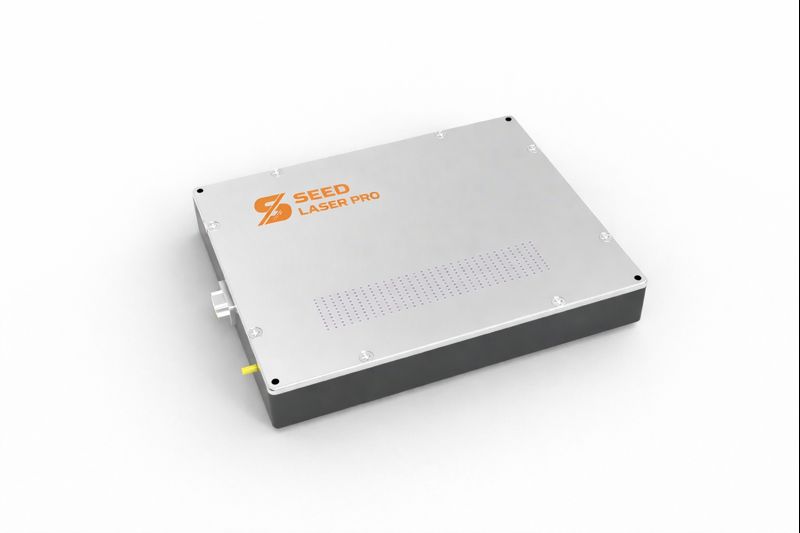
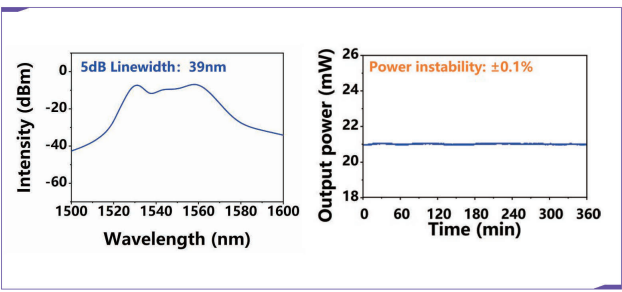
Seed Laser Pro’s 1.5 µm ASE Light Source delivers 39 nm of broadband output from 1528 to 1567 nm for FBG sensor interrogation, telecom component testing, fiber optic gyroscopes, and OCT applications. Output power is 10 mW through SMF-28e fiber, with RMS stability below 0.2% maintained by precision ATC and ACC control circuits.

PM fiber output and custom configurations including filtered flat-spectrum versions are available. If you need a C-band broadband source for OEM integration or a specific output specification not listed here, contact Seed Laser Pro’s engineering team directly.

Product Features

  • 39 nm C-Band Coverage, 1528 to 1567 nm: Full C-band coverage from 1528 to 1567 nm. Covers the standard FBG sensor reflection range, the operating band of Erbium fiber amplifiers, and C-band WDM component passbands simultaneously. One source for multiple test setups.
  • Single-Mode SMF-28e Output: SMF-28e is the universal standard fiber for 1.5 µm systems. Direct connection to any C-band component without mode mismatch or adapters. FC/APC connector minimizes back-reflections in sensitive measurement setups. Custom fiber type, length, and connector available on request.
  • High-Precision ATC and ACC Control: Automatic temperature and current control maintain output power at RMS below 0.2% and peak-to-peak below 1% across the full 0 to 40°C operating range. Power adjustable from 10 to 100%.
  • PM Fiber and Custom Configurations Available: Standard output is SMF-28e. PM fiber output is available for fiber gyroscope and polarization-sensitive applications. Filtered configurations for improved spectral flatness are available for setups requiring better than the native 7 dB flatness of Erbium-band ASE output.

Typical Applications

  • FBG Sensor Testing and Interrogation: C-band FBG arrays reflect wavelengths across 1528 to 1567 nm depending on grating period and applied strain or temperature. This source illuminates the full array simultaneously. All sensor reflections are captured in one spectrum acquisition without wavelength scanning. Stable output power ensures consistent sensor readings throughout long-duration monitoring runs.
  • Telecom Component Testing: C-band couplers, WDM multiplexers, circulators, isolators, and EDFAs are all characterized using broadband sources covering their full operating range. This source covers the core C-band for fast production-line insertion loss, return loss, and spectral transmission measurements without a tunable laser sweep.
  • Fiber Optic Gyroscopes: FOG systems require a broadband, low-coherence C-band source to suppress coherence noise from backscattering within the sensing coil. PM fiber output option available for gyroscope architectures requiring defined polarization state at the source output.
  • Optical Coherence Tomography: 39 nm bandwidth at 1.5 µm gives axial resolution on the order of 40 µm, suitable for cardiovascular imaging, industrial inspection, and non-destructive testing OCT systems at this wavelength band.

Need a custom configuration? PM fiber output, filtered flat-spectrum output, custom fiber length, or OEM module format are all available. Seed Laser Pro’s engineering team works with you at the design stage.
1.5 μm ASE Light Source
Technical ParameterUnitTechnical Specifications
MinimumTypicalMaximum
Wavelength Rangenm1528 – 1567
Optical Bandwidthnm39
Output PowermW10
Spectral FlatnessdB≤ 7
Output Spectral DensitydB30
Output Power Stability% RMS < 0.2 / Peak-to-Peak < 1
Output Power Adjustment%10 – 100
Operating VoltageVDC 12 V or Others
Power ConsumptionW5
Operating Temperature°C040
Storage Temperature°C-4570
Output Fiber Type/ SMF-28e or Others
Output Fiber Lengthm0.6
Output Fiber Connector/ FC/APC
Dimensionsmm 175 (L) × 140 (W) × 25 (H)

What Is a C-Band ASE Light Source?

A C-band ASE source is a broadband optical source that generates low-coherence light between 1528 and 1567 nm using Erbium-doped fiber pumped by a semiconductor laser diode. There is no optical feedback cavity. Light is generated through spontaneous emission and amplified as it propagates through the gain fiber. The output is spectrally broad, spatially single-mode, and low in temporal coherence.

That combination — broadband spectrum, single-mode fiber delivery, low coherence — is exactly what FBG sensing, FOG systems, and OCT require. A single-frequency laser at 1550 nm would produce strong coherence noise in all three applications. This source suppresses it by design.

For applications requiring narrow linewidth and long coherence length at 1.5 µm, Seed Laser Pro’s single frequency fiber seed lasers cover the 1550 nm band from standard sub-10 kHz through to Hz-level linewidth.

Why 1.5 µm Is the Default Fiber Sensing Wavelength

1.5 µm sits at the lowest-loss transmission window of standard silica fiber. Attenuation at 1550 nm is approximately 0.2 dB/km in SMF-28e. That fundamental property drove the entire fiber optics industry to build around C-band, and the ecosystem that resulted makes it the practical default for any fiber sensing or measurement system.

Every component needed in a C-band test bench is widely available: couplers, circulators, isolators, WDMs, detectors, spectrum analyzers, and patch cables — all in SMF-28e. Connecting this source to a C-band setup requires no special adapters and no wavelength conversion.

For applications requiring 1.0 µm or 2.0 µm broadband coverage, Seed Laser Pro’s ASE light source range covers all three main fiber bands.

A Note on Spectral Flatness

This source specifies 7 dB spectral flatness. The 1.0 µm ASE source specifies 3 dB. That difference is not a quality gap — it is a physical property of Erbium gain.

Erbium-doped fiber has a non-uniform gain profile across the C-band, with a characteristic peak near 1530 nm and a broader, flatter region out to 1565 nm. Achieving better than 7 dB flatness across the full 39 nm bandwidth requires external spectral flattening filters. For most FBG interrogation and component testing applications, 7 dB flatness is well within acceptable limits.

If your application requires flatter spectral output, filtered configurations are available. Contact Seed Laser Pro to discuss your spectral flatness requirement.

ATC and ACC: How Stability Is Maintained

Two independent control loops keep output stable throughout continuous operation.

ATC holds the pump diode temperature constant using a thermoelectric cooler. In an Erbium ASE source, pump wavelength falls around 980 nm. Temperature drift in the pump diode shifts that wavelength, changes the overlap with the Erbium absorption peak, and alters the spectral shape and output power of the ASE. ATC prevents that drift.

ACC regulates pump drive current to maintain a constant output power setpoint. As the pump diode ages or ambient temperature changes, ACC adjusts current to compensate. The result is RMS stability below 0.2% and peak-to-peak below 1% throughout continuous operation.

OEM and Custom Integration

The standard module measures 175 × 140 × 25 mm and operates from 12 VDC at 5 W. This form factor suits direct integration into instrument enclosures and rack-mounted test systems.

Available custom options include:

  • PM fiber output for polarization-sensitive FOG and sensing applications
  • Filtered flat-spectrum output for applications requiring spectral flatness better than 7 dB
  • Custom output fiber length beyond the standard 0.6 m
  • Alternative fiber connector types
  • Custom operating voltage configurations
  • OEM PCB driver integration for compact instrument builds

Contact Seed Laser Pro’s engineering team with your integration requirements. Lead time for custom configurations depends on specification. Standard catalog units ship on standard lead time.

FAQ SECTION

What is a 1.5 µm C-band ASE light source?

A C-band ASE source is a broadband optical source generating low-coherence light between 1528 and 1567 nm using Erbium-doped fiber. Unlike a single-frequency laser, it spreads output across 39 nm of bandwidth with low temporal coherence. This makes it the standard source for FBG sensor interrogation, fiber gyroscopes, C-band component testing, and OCT applications at 1.5 µm.

Why does spectral flatness read 7 dB rather than the 3 dB on the 1.0 µm source?

Erbium-doped fiber has a non-uniform gain profile across the C-band. Achieving 3 dB flatness across 39 nm at 1.5 µm requires external spectral flattening filters, which add cost and insertion loss. The 7 dB native flatness of this source is sufficient for FBG interrogation and most component testing applications. For applications requiring flatter output, contact Seed Laser Pro for filtered configurations.

Is PM fiber output available?

Yes. PM fiber output is available as a custom configuration for fiber gyroscope and polarization-sensitive sensing applications. Contact Seed Laser Pro with your PM fiber type, required PER, and connector specification. Standard catalog units ship with SMF-28e output.

What is the difference between using this source and a tunable laser for C-band component testing?

A tunable laser sweeps wavelengths sequentially and measures one wavelength at a time. This ASE source illuminates the full 1528 to 1567 nm range simultaneously. An optical spectrum analyzer at the output captures the full spectral response in one measurement. For broadband components such as WDMs, couplers, and isolators, the ASE approach is significantly faster. A tunable laser provides better wavelength accuracy and dynamic range for narrow spectral features but is slower for full-band characterization.

Can this source be used for fiber gyroscope applications?

Yes. FOG systems require a broadband, low-coherence 1.5 µm source with stable output power. This source meets those requirements in standard SMF-28e output. For FOG architectures requiring PM fiber throughout the optical path, PM output configuration is available on request.

What OEM integration support does Seed Laser Pro provide?

Seed Laser Pro offers OEM PCB driver integration, custom mechanical configurations, and engineering support for instrument integration at the design stage. Contact the engineering team early in the design cycle for best results on lead time and configuration fit.

Translate »