Why RIN Measurement Is Harder Than It Appears
RIN is specified in units of Hz-1, or in logarithmic form as dB/Hz, with typical values of -110 to -130 dB/Hz for inexpensive multimode edge emitters. It can be less than -170 dB/Hz for high-quality distributed-feedback lasers.
That 60 dB range is the problem. A system calibrated for -120 dB/Hz cannot measure a -160 dB/Hz laser. Below a certain noise floor, the instrument stops measuring the laser and starts measuring itself.
Advanced RIN measurement systems use cross-correlation with two detectors and a beamsplitter to eliminate the inherent noise of the detectors and amplifiers, allowing measurement of laser noise levels below the instrument’s thermal and shot noise floor.
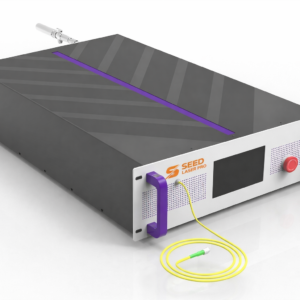
Seed Laser Pro’s system addresses this through balanced detection. Two matched low-noise detectors receive equal portions of the laser output. Their outputs are subtracted electronically. Common-mode noise, thermal noise and amplifier noise cancels. The differential signal carries only laser intensity noise and shot noise. The instrument floor tracks the shot noise limit, reaching -160 dB/Hz under well-controlled conditions.
This is why the system can characterize ultra-low-noise sources including Seed Laser Pro’s own broadband ultra-low-noise single-frequency fiber laser, where a standard single-detector setup would hit its own floor before reaching the actual laser noise level.
Full Bandwidth: Why Both FFT and RF Analysis Are Needed
The high-frequency RIN spectrum of a laser often contains a well-defined peak at the relaxation oscillation frequency, and in many classes of lasers this peak can be used to deduce the maximum intrinsic modulation frequency for a specific laser.
Relaxation oscillation peaks in semiconductor lasers typically appear from hundreds of MHz into the GHz range depending on bias current and device design. Low-frequency technical noise from pump current fluctuations, temperature drift, and acoustic coupling appears from DC through a few hundred kHz. Capturing both in one measurement gives the complete noise picture.
Most laboratory setups require two separate instruments for this. A baseband FFT analyzer for DC to a few MHz. An RF spectrum analyzer for higher frequencies. Switching between them introduces calibration inconsistencies at the handover frequency and requires managing different input impedances and detector bandwidths.
Seed Laser Pro’s system integrates both from the same balanced detector output through the same calibrated signal chain. The PSD from DC to the GHz range is captured without instrument switching or calibration gaps.
Multi-Band Coverage
Five wavelength bands are supported. This is the practical differentiator between this system and general-purpose RIN setups assembled from telecom-band components.
C-band (1530 to 1570 nm): The Erbium fiber laser band. Largest commercial demand for RIN characterization in both R&D and production.
1 µm band: Ytterbium fiber lasers used in LiDAR, DAS, and high-power MOPA systems. Requires 1 µm-compatible detectors rather than C-band InGaAs components.
780 nm: Rubidium cooling lasers and frequency-converted sources. Relevant for verifying the noise performance of 780 nm frequency-converted lasers after the SHG stage and for quantum sensing laser verification.
2 µm band: Thulium fiber lasers for wind LiDAR, mid-infrared generation, and medical systems. Requires extended InGaAs detector front-ends rarely found in general-purpose RIN systems.
Visible wavelengths: 532 nm green lasers and other visible sources. Requires silicon detector front-ends. RIN measurement at visible wavelengths is relevant for quantum optics pump sources and precision spectroscopy excitation lasers.
Who This System Is Built For
During the manufacturing phase of a laser, RIN measurements can verify that the laser’s intensity noise is within acceptable limits and conforms to product specifications. Evaluation with a RIN measurement system is an essential step in assuring the quality of the laser and maximizing its performance.
Three buyer types use this system in practice.
Laser manufacturers: Production QC for single-frequency fiber lasers and semiconductor sources. Every unit shipped with a RIN specification needs a system that can verify it repeatedly at the stated noise floor.
Research laboratories: Characterizing prototype laser sources, validating active noise suppression systems, and verifying that sources meet the RIN requirements of gravitational wave, quantum sensing, or precision interferometry experiments.
Photonics instrument companies: OEM builders who specify low-RIN lasers as components and need in-house verification rather than relying on supplier datasheets alone.
For complete laser characterization covering both RIN and linewidth, this system and the Laser Linewidth Measurement System together cover the two primary noise metrics that define single-frequency fiber laser performance.