
Gas-phase spectroscopy identifies a molecule by the wavelengths it absorbs and measures concentration by how much light disappears. A fiber laser for spectroscopy makes that measurement field-ready: a single-frequency source at 1.5 µm or 2.0 µm that holds its wavelength, adds little intensity noise and works outside the lab. This guide compares the main techniques (TDLAS, CRDS, Raman and LIBS), lists where common gases absorb, and sets out the linewidth and noise figures that decide detection limits.
Why spectroscopy needs a single-frequency laser
A single-frequency laser puts all of its power into one narrow line, so the entire beam probes the absorption feature. As the RP Photonics overview of laser spectroscopy explains, narrow linewidth improves sensitivity as well as resolution, because absorption is easier to see when it acts on all of the probe light. A narrow linewidth laser for gas detection also tunes cleanly across one line without mode hops, which keeps scans free of artifacts.
The near-infrared suits this work. Lasers there are relatively low-cost, stable, spectrally narrow and easy to fiber-couple, so major combustion species are routinely measured in this region. The vibrational overtone lines are weaker than the fundamental lines in the mid-IR (acetylene absorbs more strongly near 3.0 µm than near 1.53 µm), and fiber sources compensate with long paths, cavity enhancement and steady power. Our single-frequency fiber seed lasers cover the 1.0, 1.5 and 2.0 µm bands, and the post on single-frequency versus single-mode lasers explains why that label matters.
Spectroscopy techniques and what each asks of the laser
The four techniques below use light very differently, so their laser requirements differ. Only the first two depend on a narrow, tunable single-frequency source.
Technique | What the laser does | Linewidth requirement | Main noise or stability concern |
|---|---|---|---|
TDLAS (direct and wavelength-modulated) | Scans across one absorption line | Well below the line width; typical sources are about 30 MHz or narrower | Intensity noise and residual amplitude modulation; mode-hop-free tuning |
CRDS (continuous-wave) | Fills a high-finesse cavity, then is switched off or detuned | Narrower than the cavity mode spacing; kHz-class fiber lasers demonstrated | Matching laser frequency to a cavity mode; frequency jitter |
Raman (gas phase) | Illuminates the sample at one fixed wavelength | Narrow-band, continuous-wave | Stable power and wavelength |
LIBS | Delivers a high-peak-power pulse that creates a plasma | Not critical; resolution comes from the detector side | Pulse energy, not single-frequency behavior |
TDLAS is the workhorse for gas sensing. In wavelength modulation spectroscopy, a high-frequency modulation moves the signal to where technical noise is lower, and the method is then limited by residual amplitude modulation from the laser or from etalons in the optics. A low-RIN source lowers that floor.
CRDS adds a coupling requirement. When the laser linewidth is smaller than the cavity’s free spectral range, only one cavity mode is excited, but the laser or cavity must be tuned or locked so the two overlap. LIBS is the exception: it relies on pulse energy rather than spectral purity, so a continuous-wave seed laser is not the relevant tool there.
Molecule-to-wavelength reference table
These are approximate band positions for near-IR gas spectroscopy, drawn from HITRAN-based literature. Confirm the exact line in HITRAN or HITEMP for your temperature and pressure before you specify a laser.
Molecule | Approximate absorption region | Seed laser band | Note |
|---|---|---|---|
C₂H₂ (acetylene) | 1520–1535 nm | 1.5 µm | A line at 1533.456 nm has been used for ppm-level detection |
NH₃ (ammonia) | About 1532 nm | 1.5 µm | Lines near 6528.8 cm⁻¹ |
CO | About 1570 nm | 1.5 µm | Edge of the standard 1530–1560 nm range; confirm tuning |
CO₂ | 1530 and 1570 nm bands; stronger near 1960 nm | 1.5 µm or 2.0 µm | The 2.0 µm band gives stronger absorption |
CH₄ (methane) | About 1650 nm | Outside the standard bands | Lines near 6046.9 cm⁻¹; ask about custom wavelengths |
H₂O (water vapor) | About 1390 nm; strong near 2.0 µm | 2.0 µm, or custom at 1390 nm | The 1390 nm region is outside the standard bands |
Two habits prevent most line-selection mistakes. First, pick a line that other species in your gas mixture do not overlap: in one acetylene study, simulations with 10% water, 1% CO₂ and 1% CH₄ guided the choice of 1533.456 nm. Second, treat database pressure-broadening coefficients with caution, since measurements show larger uncertainty there than in line position and strength.
SNR and linewidth requirements
Four numbers decide whether a laser limits your detection limit:
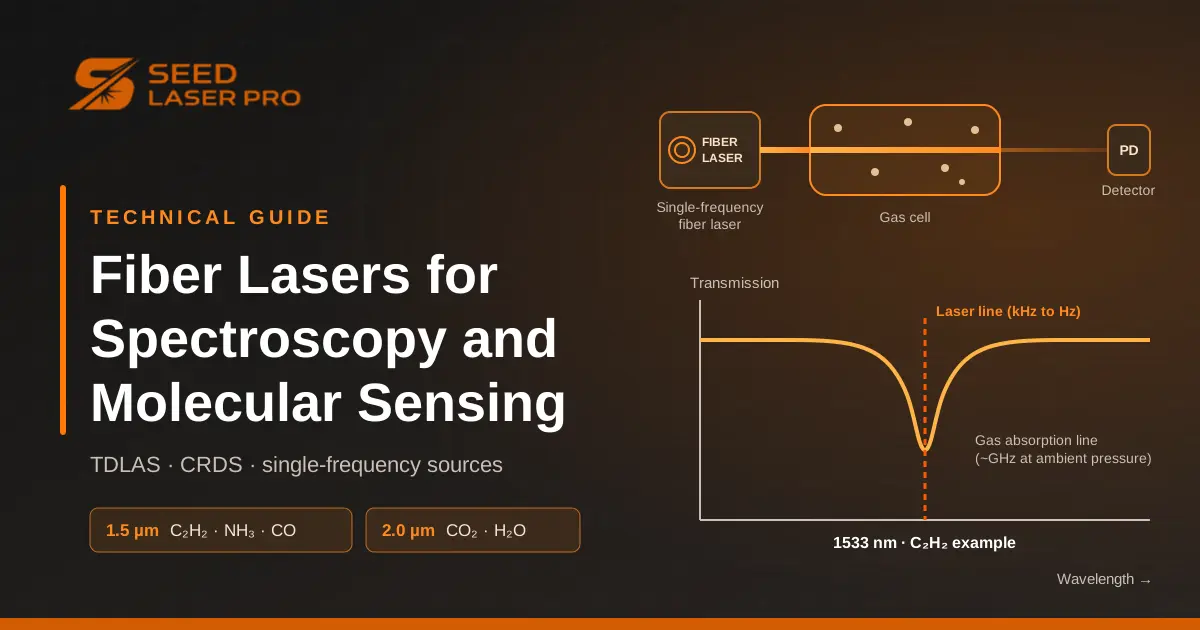
Linewidth versus line width. Gas absorption lines near 1.53 µm are often over 1 GHz wide at ambient pressure, and typical TDLAS sources are about 30 MHz (10⁻³ cm⁻¹) or narrower. A kHz-class laser is therefore far narrower than needed to resolve the line.
When narrower pays off. Low-pressure, Doppler-limited lines are only a few hundred MHz wide. CRDS needs linewidth below the cavity mode spacing, and locking to a reference cavity rewards Hz-level sources. A 25 Hz fiber laser covers these cases, and our Hz-level linewidth explainer shows how to read that spec.
Wavelength stability. Drift must stay small against the line. Our 1.5 µm frequency-stabilized seed holds drift below ±500 kHz RMS over two hours, about 0.05% of a 1 GHz line, and its ±0.2 nm thermal tuning equals roughly ±25 GHz at 1550 nm.
RIN and spectral purity. Intensity noise sets the baseline against which small absorptions are read, and side modes or amplified spontaneous emission add unabsorbed light that shrinks apparent absorption depth. Our guide on how low RIN needs to be covers the measurement side.
In practice, specify wavelength first, drift second, RIN third and linewidth last, because linewidth is rarely the limiting item for ambient-pressure gas detection.
The 1.5 µm and 2.0 µm bands, and matching sources
The 1.5 µm erbium band is the standard choice for fiber sensing and telecom-grade coherent systems, and its overlap with acetylene and CO₂ features makes it the usual start for TDLAS. The 2.0 µm thulium band reaches strong water vapor and CO₂ absorption, and is used in molecular spectroscopy and medical sensing. The post on 1.0, 1.5 and 2.0 µm wavelengths compares the bands in more depth.
Matching a source to your gas and technique is then a short list:
TDLAS on a fixed line: the 1.5 µm frequency-stabilized seed source offers 20 kHz linewidth, an error-signal port for external locking and PM1550 output.
Sub-kHz, mode-hop-free operation: the 1.5 µm high-reliability seed source has linewidth below 1 kHz across 1530–1560 nm.
Cavity locking and CRDS: the Hz-level linewidth laser reaches below 25 Hz at 1550 nm.
Water vapor and CO₂ near 2.0 µm: the 2.0 µm ultra-narrow linewidth laser targets this band.
High-power combustion work: the 1950 nm kilowatt-class laser is listed under our high-power single-frequency fiber lasers.
If your line sits outside the standard bands, such as methane near 1650 nm, contact the engineering team about custom modules.
Application case summaries
Acetylene detection near 1.53 µm. A near-infrared TDLAS system detected ppm-level acetylene over a 15 cm absorption path. Simulations of water, CO₂ and methane interference led to the 1533.456 nm line. The takeaway is that careful line selection matters more than extra power. The study used a tunable diode laser; the same line-selection logic applies to a fiber source.
Trace N₂O by fiber-laser CRDS. An erbium fiber laser tunable from 1542 to 1600 nm, with kHz-class linewidth, was used for continuous-wave CRDS. It recorded N₂O spectra near 1.544 µm across a range from pure gas down to tens of ppb, with a minimum measurable absorption of about 10⁻¹⁰ cm⁻¹. The kHz linewidth is what makes efficient coupling to a high-finesse cavity possible.
Combustion diagnostics. Near-IR TDLAS tracks water vapor, CO₂, methane and acetylene in combustion, where lines broaden with pressure and temperature. For turbines, scramjets and industrial combustors, our 1950 nm kilowatt-class laser uses phase modulation to broaden its linewidth to 3.9 GHz so power can be raised without stimulated Brillouin scattering, a case where a wider line is a design choice, not a flaw.
FAQ
What linewidth does a laser for gas spectroscopy need?
For ambient-pressure TDLAS, tens of MHz or narrower is enough, since gas lines are often over 1 GHz wide. CRDS and cavity locking benefit from kHz-class or narrower sources.
Why use 1.5 µm for gas detection?
Acetylene, ammonia, CO and CO₂ all absorb in this region, and mature erbium fiber technology supplies stable, fiber-coupled, narrow-linewidth sources.
When is 2.0 µm the better band?
When you need stronger water vapor or CO₂ absorption, as in combustion and molecular spectroscopy.