
Objective
This guide can help you understand the ways that master oscillators and the seed laser differ, and why this distinction is crucial in real-world lasers.
We’ll go over the ways these components impact performance to ensure that you are able to pick the most appropriate configuration without hesitation.
Key Takeaways
- Laser linewidth defines signal purity and stability
- Hz-level linewidth enables extreme precision and low noise performance
- Ultra-narrow linewidth fiber laser systems deliver better sensing and communication results
- Matching the linewidth to your application is key to performance and cost efficiency
Introduction
What if a tiny fluctuation in your laser signal was enough to ruin a million‑dollar experiment?
Did you know that in advanced optical systems, even a slight increase in linewidth can dramatically reduce measurement accuracy and signal quality? In many applications, like LiDAR, sensing, and quantum research, the performance of the entire system depends on how stable and “pure” the laser signal is.
In this guide on Hz-level linewidth fiber laser explained, we’ll break everything down in a simple, practical way. You’ll learn what linewidth actually means, why engineers care about Hz-level precision, and how it directly impacts system accuracy. Whether you’re designing a device or selecting a laser source, this knowledge helps you make smarter decisions from the start.
| Table Of Content |
|---|
| What Is Laser Linewidth? |
| Understanding Hz-Level Precision |
| Why Linewidth Matters |
| Hz vs kHz vs MHz Comparison |
| How Ultra-Narrow Linewidth Lasers Work |
| Real-World Applications |
| Case Example |
| Choosing the Right Laser |
| Common Misconceptions |
| FAQs |
| Final Takeaway |
What Does Laser Linewidth Really Mean?
Before we talk about Hz-level precision, let’s start with the basics. If you don’t understand linewidth, it’s easy to choose the wrong laser or misunderstand why your system isn’t performing as expected.
Laser Spectral Purity Definition Using a Simple Analogy
Think of a laser like a musical note.
- A perfect note = one clean frequency
- A messy chord = many frequencies mixed together
Linewidth tells us how “clean” that note is.
- Narrow linewidth → pure signal
- Wide linewidth → noisy signal
In technical terms, linewidth is the spread of frequencies the laser emits.
That’s what people mean by laser spectral purity definition: how focused and stable the signal is.
Connection Between Linewidth and Coherence Length
Here’s a simple formula:
- Coherence Length ≈ Speed of Light ÷ Linewidth
What this really means is:
- Smaller linewidth → longer coherence length
- Longer coherence → better precision
This is why narrow linewidth lasers are essential in systems where signals travel long distances or require high accuracy.
Why Laser Frequency Stability Hz Matters for Real Systems
It’s not just about narrow linewidth; it’s also about stability over time.
- Frequency drift = errors
- Instability = unreliable measurements
In high-end systems, even minor instability can destroy performance. That’s why laser frequency stability, Hz, is a critical parameter.
Understanding Hz-Level Precision in Fiber Laser Linewidth
Now let’s get to the real topic, Hz-level linewidth and why it changes everything.
Hz Level Linewidth Fiber Laser Explained in Simple Terms
In simple terms:
- MHz linewidth → basic precision
- kHz linewidth → improved stability
- Hz linewidth → ultra-high precision
When we say Hz-level linewidth fiber laser explained, we’re talking about lasers with extremely narrow frequency spread, down to just a few Hertz.
That leads to:
- Very low phase noise
- Extremely long coherence
- Highly stable output
Sub-kHz Linewidth Laser Meaning vs Hz-Level Performance
Let’s break it down clearly:
| Linewidth Type | Performance |
| MHz | Standard lasers |
| kHz | Improved stability |
| Sub-kHz | High precision |
| Hz-level | Maximum precision |
The sub-kHz linewidth laser, meaning refers to lasers already considered very stable, but the Hz-level goes even further.
How Ultra-Narrow Linewidth Fiber Laser Achieves Stability
Modern designs use:
- Single-frequency operation
- Short cavity structures
- Thermal control systems
- Vibration isolation
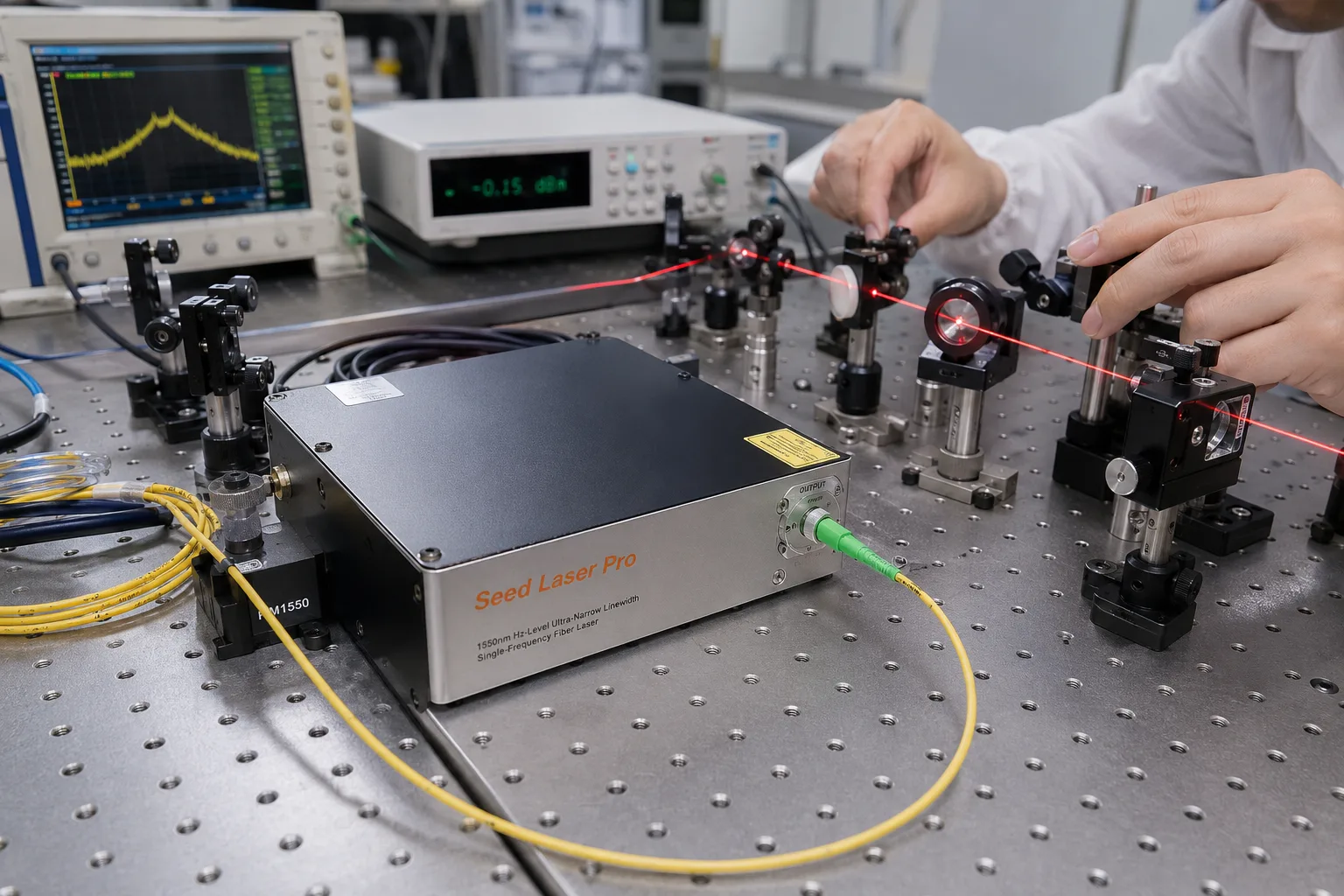
Products like those from SeedLaserPro achieve:
- High coherence
- Low noise
- Stable output in tough environments
Why Linewidth Matters More Than You Think in Real Applications
Here’s the thing: many systems don’t fail because of insufficient power. They fail because of instability and noise.
Impact on Measurement Accuracy
In precision systems:
- Narrow linewidth = clearer signal
- Better signal = higher accuracy
Applications like sensing depend on this completely.
Role in Coherent Communication Systems
In telecom systems:
- Stable signals reduce transmission errors
- Narrow linewidth improves data integrity
This is why narrow-linewidth lasers are used in optical communication.
Why Engineers Prefer Single-Frequency Seed Laser Sources
Engineers prefer Single Frequency Seed Laser because they provide:
- Narrow linewidth
- Stable output
- Low noise
These features directly improve performance in high-precision systems.
Hz vs kHz vs MHz Linewidth – A Clear Comparison
Not all lasers are equal. Let’s simplify it.
Visual Concept (Spectrum Comparison)
Imagine three peaks:
- MHz → wide and blurry
- kHz → narrower
- Hz → sharp and clean
That’s the difference in spectral purity.
Performance Differences
- MHz: short coherence
- kHz: moderate precision
- Hz: long coherence and ultra stability
Where Sub-kHz Linewidth Laser Meaning Fits
Sub-kHz lasers are often used as a middle ground:
- Cheaper than Hz-level
- Good for many applications
But for extreme precision, Hz-level wins.
How Ultra-Narrow Linewidth Fiber Laser Technology Works
Let’s break this down simply.
Core Design Principles
Modern fiber lasers use:
- Special fiber materials
- Precise resonator design
- Single-mode operation
These systems ensure narrow linewidth and stability.
Temperature and Vibration Control
Even small vibrations can affect performance.
Design improvements include:
- Shock resistance
- Thermal stabilization
SeedLaserPro lasers are designed to remain stable even under harsh conditions.
Laser Frequency Stability Hz and Noise Reduction
Advanced systems reduce:
- Phase noise
- Frequency drift
This ensures consistent output over time.
Real-World Applications That Demand Hz-Level Linewidth
Let’s talk about where these lasers are actually used.
Precision Sensing
Used in:
- Structural monitoring
- Fiber sensing
Narrow linewidth improves sensitivity.
LiDAR Systems
Used in:
- Autonomous vehicles
- Mapping
Better linewidth = clearer distance measurement.
Quantum Research
Applications include:
- Atomic clocks
- Cold atom physics
These require extremely stable signals.
Coherent Communication
Used for:
- High-speed data
- Long-distance transmission
These lasers reduce errors and improve reliability.
Case Example: When Linewidth Makes or Breaks Performance
Let’s consider a fiber sensing system.
Scenario
- Wide linewidth laser → noisy signal
- Narrow linewidth → clean readings
Result
- System accuracy improves dramatically
- Data becomes reliable
What This Means
Choosing the right linewidth is not optional; it’s essential.
How to Choose the Right Laser for Your Application
Let’s make this practical.
Key Factors
- Required precision
- Environmental conditions
- System sensitivity
When to Use Single Frequency Seed Laser
Use it when:
- You need high stability
- Accuracy is critical
- Noise must be minimized
Matching Specs to Needs
Here’s the rule:
- Don’t overcomplicate
- Focus on performance needs
Choosing the right laser saves cost and improves results.
Common Misconceptions About Laser Linewidth
Let’s clear up some confusion.
Myth 1: Lower Linewidth Is Always Better
It’s not always the case. Some systems don’t need extreme precision.
Myth 2: Power Matters More Than Stability
Incorrect.
Stability is often more important than power in precision systems.
Myth 3: Environment Doesn’t Affect Performance
It does.
Even strong lasers can fail in unstable conditions.
The Hidden Factor That Defines Laser Performance – Are You Missing It?
Here’s the bottom line.
If your system depends on precision, then linewidth is not just a technical spec; it’s a deciding factor.
Understanding Hz level linewidth of a fiber laser helps you:
- Improve accuracy
- Reduce errors
- Build better systems
And in high-performance environments, that difference matters more than anything else.
Ready to take your system performance to the next level?
Explore the most advanced solutions from SeedLaserPro and find out what the most suitable laser source can enhance the results you get. If you require stability, precision, or dependability, the right option can make all the difference.
Frequently Asked Questions (FAQ)
What Is Hz-Level Linewidth in Simple Terms?
It’s a measure of how stable and narrow the frequency of a laser is; lower values indicate higher precision.
Why Is Linewidth Important in Fiber Lasers?
It is because it affects the quality of the signal, stability, and the accuracy of the measurement.
What is the Difference Between kHz and Hz Linewidth?
linewidth at Hz offers more precision and a longer time to coherence over kHz.
Where Are Ultra-Narrow Linewidth Lasers Used?
In communications, sensing quantum research, as well as LiDAR systems.
How Does Linewidth Affect Coherence Length?
The smaller linewidth translates into longer coherence lengths, which can improve the performance of precision systems.