
Objective
This guide provides coherence length fiber laser explained in clear technical terms and shows how linewidth, temporal coherence, and real application needs should guide your laser choice.
Key Takeaways
- Coherence length describes the distance over which light maintains a predictable phase relationship.
- A narrower laser linewidth generally supports a longer coherence length.
- Long coherence is important for coherent LiDAR Light Source, interferometry, and precision sensing.
- Longer coherence is not always better. Some OCT and FBG systems need low-coherence broadband light.
- Always compare linewidth, noise, stability, and your optical path difference before selecting a source.
Introduction
A laser can look perfect on a datasheet and still be the wrong source for your optical system.
Did you know that coherence length measures the distance over which the optical phase remains well defined? According to RP Photonics, it is a measure of temporal coherence and is inversely related to optical linewidth. That small linewidth value on a laser specification sheet can therefore have a major effect on interferometry, coherent LiDAR, spectroscopy, and fiber sensing.
Here’s the thing: when you are buying a laser, power and wavelength are only part of the decision. You also need to know how long the light maintains useful phase coherence.
Table of Contents
- What Is Coherence Length?
- How Linewidth Affects Coherence Length
- Why Coherence Length Matters When Buying a Laser
- Long Coherence Laser Applications
- How to Choose the Right Coherence Length
- Final Laser Buying Advice
- FAQs
What Is Coherence Length in a Fiber Laser?
Coherence length is the propagation distance over which a light wave maintains a useful optical phase relationship. In simple terms, it tells you how far the laser light can travel before random phase changes reduce its ability to produce stable interference.
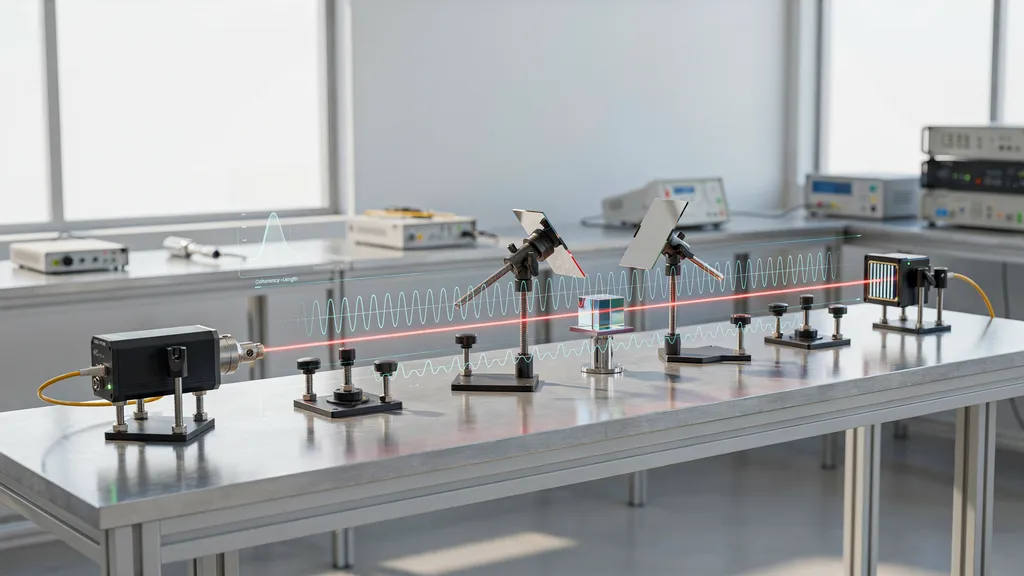
It is a measure of temporal coherence, not spatial coherence. A temporal coherence laser source maintains phase correlation over time. This matters when a beam is split, sent through different optical paths, and later recombined.
Think about an interferometer. One part of the beam travels along a short path while the other travels farther. If the optical path difference becomes much greater than the source’s coherence length, fringe visibility falls.
What this really means is simple: your required coherence length should match the measurement distance and optical design of your system.
How Does Laser Linewidth Affect Coherence Length?
The narrow linewidth coherence relationship is one of the most useful ideas to understand before comparing laser sources.
For a Lorentzian optical spectrum, the coherence length formula linewidth relationship is commonly written as:
Lc = c / (πΔν)
Where:
- Lc = coherence length
- c = speed of light in vacuum
- Δν = full-width-at-half-maximum laser linewidth
The formula shows an inverse relationship. As the linewidth becomes narrower, the coherence length becomes longer.
However, do not use the formula without checking the spectral line shape and coherence definition. The exact numerical relationship can vary with the spectrum and measurement method.
| Laser Linewidth | Approximate Coherence Behaviour | Typical System Need |
| Hz to sub-kHz | Extremely long | Precision metrology |
| Few kHz | Very long | Coherent LiDAR, fibre sensing |
| Tens of kHz | Long | Spectroscopy, coherent systems |
| Broad optical bandwidth | Short | OCT, FBG testing, low-coherence sensing |
For a practical example, Seed Laser Pro lists a 1.5 µm single-frequency laser with a 3 kHz linewidth and coherence length above 31 km. Its 2.0 µm high-power single-frequency laser operates with a linewidth below 30 kHz for applications including molecular spectroscopy and gas sensing.
Why Does Coherence Length Matter When Buying a Laser?
When we review a laser for a real optical system, the question should not be, “Which laser has the longest coherence length?”
A better question is, “How much coherence does our system actually need?”
Suppose you are building a coherent Doppler LiDAR system. The returned signal must interfere with a local oscillator so that small frequency shifts can be measured. A narrow-linewidth source with long coherence is valuable because the system depends on stable phase behavior over the measurement path.
Now consider an OCT or FBG test system. In that case, very long coherence can cause unwanted interference from multiple reflections and scattering. Seed Laser Pro’s ASE light source range uses broadband, low-temporal-coherence output for FBG sensor arrays, fiber gyroscopes, and OCT systems.
Longer is not automatically better. Application fit matters more than the biggest number on a datasheet.
Where Are Long Coherence Lasers Used?
The most common long coherence laser applications depend on stable interference or narrow spectral output.
Coherent LiDAR and Remote Sensing
Coherent LiDAR uses interference between received light and a reference source to detect small Doppler shifts. Long coherence and low phase noise support accurate velocity and distance measurements.
Laser Interferometry and Precision Metrology
If two optical paths have a large path difference, your laser must maintain enough temporal coherence for visible, stable interference fringes.
High-Resolution Spectroscopy
Narrow-linewidth lasers can resolve fine molecular absorption features that broad sources may not separate clearly. Seed Laser Pro’s 2.0 µm laser range includes single-frequency sources designed for gas sensing and molecular spectroscopy.
Fibre Sensing
Distributed acoustic sensing and coherent optical time-domain systems can require narrow linewidth and long coherence to track small phase changes along fiber paths.
A Practical Laser Buying Check: Match Coherence to the System
Before requesting a quote, use this quick engineering check:
- Define your maximum optical path difference – Do not estimate from the physical size of the setup alone.
- Check the specified linewidth – Confirm whether the supplier states the measurement method or observation time.
- Estimate coherence length – Use the correct formula for the laser’s spectral profile.
- Review phase and frequency noise – A narrow headline linewidth does not tell you everything about long-term frequency drift.
- Decide whether high or low coherence is required – Coherent detection may need long coherence; OCT or broadband component testing may need short coherence.
This check can save you from buying an expensive narrow-linewidth source when a low-coherence source fits better, or choosing a broad source that cannot maintain interference across your optical path.
The Best Laser Is the One That Fits Your Coherence Requirement
Coherence length is not a side specification. For many precision optical systems, it directly affects whether your interference signal remains useful.
The core rule is clear: narrower linewidth generally means longer temporal coherence, but the right coherence length depends on your application.
When comparing single-frequency fiber lasers, review linewidth alongside phase noise, frequency stability, wavelength, power, and fiber output. If your project needs a narrow-linewidth source for coherent LiDAR, spectroscopy, or precision sensing, the engineering team at Seed Laser Pro can help you compare source specifications against your system requirements.
Need help selecting a laser?
Review the available single-frequency fiber laser and ASE source options, then share your wavelength, linewidth, power, and application requirements with our team for a technical recommendation.
Frequently Asked Questions
Coherence length is the distance over which laser light maintains a useful phase relationship. It is mainly used to describe the temporal coherence of an optical source.
No. Long coherence is useful for interferometry and coherent sensing, while low-coherence sources are often better for OCT, FBG testing, and systems where unwanted interference must be reduced.
Laser linewidth and coherence length are inversely related. A narrower linewidth generally produces a longer coherence length and higher temporal coherence.
For a Lorentzian spectrum, the coherence length can be calculated using Lc = c/(πΔν). The exact result depends on the spectral line shape and the definition used.
It affects how well light can interfere after travelling along different optical paths. This is important in coherent LiDAR, fiber sensing, interferometry, and precision optical measurement.