
Objectives
- Explain RIN in plain terms. No formulas, no jargon dump
- Show why RIN gets watched more closely on seed lasers than on standalone laser sources
- Walk through how RIN actually gets measured, and what that dB/Hz number is really telling you
- Clear up RIN vs. phase noise, since people mix these up constantly
- Give a practical sense of what “low enough” RIN looks like for LiDAR, sensing, and coherent detection
Key Takeaways
- RIN is basically how much a laser’s power wobbles over time, shown as a ratio against its average power
- It’s given in dB/Hz because the noise changes across frequency. Where it peaks matters more than a single average would
- RIN and phase noise are different animals. One’s about power swings, the other’s about frequency stability. A laser can be great at one and just okay at the other
- There’s no universal “good” RIN number. What counts as fine for a spectroscopy setup won’t cut it for a LiDAR system
- Seed lasers get held to a tighter RIN standard than standalone lasers, mainly because whatever noise they carry gets dragged along through every amplification stage after them
Introduction
Read enough fiber laser datasheets and sooner or later you’ll spot a RIN spec sitting next to the linewidth number, something like “-150 dB/Hz.” Most people skip right past it. It’s not as dramatic as a linewidth spec, and it doesn’t have the obvious appeal of an output power figure. But if you’re building something that depends on a clean, steady optical signal, coherent LiDAR, precision sensing, heterodyne detection, whatever your case is, RIN is quietly one of the specs that decides whether the whole system holds up.
Part of the problem is that nobody bothers explaining it properly. It shows up as a number with a “lower is better” footnote, and that’s the extent of it most of the time. So here, we’re actually going to slow down and get into what relative intensity noise seed laser RIN means, why it shows up as a spectrum instead of one flat figure, how it’s measured, and the thing people actually want to know: how low does your seed laser’s RIN need to be before it stops being a headache.
Table of Contents
- What Is RIN, in Plain Terms?
- Why RIN Is Reported as a Spectrum, Not a Single Number
- RIN vs. Phase Noise: They’re Not the Same Thing
- How RIN Is Actually Measured
- Q&A: Your RIN Questions, Answered
- How Low Is Low Enough? A Practical Look
- Where RIN Actually Bites You
What Is RIN, in Plain Terms?
Even a genuinely good laser doesn’t put out perfectly flat power. Look closely enough and you’ll see it drift a little, up and down, a kind of jitter riding on top of the average output. That jitter is intensity noise. RIN is just a way of saying how big that jitter is next to the average power the laser is actually putting out.
Here’s a rough way to picture it. Someone’s holding a laser pointer and their hand shakes a bit. What matters isn’t the raw shake, it’s how much that shake matters given how far away the target sits. RIN works the same way, it’s a ratio, not a raw number, and that’s the whole reason it’s expressed in decibels instead of watts or volts.
Low RIN means the power stays close to rock-steady. High RIN means it wanders around noticeably, even if your eyes would never catch it and you’d only see it show up on a photodetector hooked to a spectrum analyzer.
Why RIN Is Reported as a Spectrum, Not a Single Number
This is usually where people get tripped up. RIN isn’t one flat number across all frequencies, it shifts depending on where you’re looking. A laser could be dead quiet at 10 MHz and noisier down near 1 kHz. Sometimes it’s the other way around.
That’s why RIN specs are given in dB/Hz, decibels per hertz of measurement bandwidth, and usually plotted across a frequency range running anywhere from a few kHz up into several GHz. A single dB/Hz number on a datasheet, “-150 dB/Hz” say, is basically always a peak value or a reading at one specific frequency. It’s not a blanket statement about the whole curve.
Why does this matter? Because different applications only care about a slice of that curve. A system detecting a signal at one particular modulation frequency really only cares about the RIN right around that point. The rest of the plot barely matters for that use case, even if it looks noisy elsewhere.
RIN vs. Phase Noise: They’re Not the Same Thing
Probably the biggest mix-up out there. RIN and phase noise both point at some kind of instability in a laser’s output, but they’re not talking about the same thing at all.
RIN is amplitude, how much the power level bounces. Phase noise, tied closely to linewidth, is timing, how much the phase (and so the instantaneous frequency) wanders off from where it should sit.
A laser can have great phase noise and a tight linewidth while its RIN sits somewhere in the middle. Or the reverse. Different mechanisms inside the cavity and gain medium are behind each one, so cleaning up one doesn’t automatically clean up the other.
Why bring this up? Because different applications lean on different halves of it. Coherent communication and precision frequency references lean hard on phase noise, which usually means needing a genuinely narrow linewidth fiber laser to begin with. Direct-detection sensing and anything riding on amplitude stability cares about RIN instead. Plenty of systems need both handled well, which is exactly why datasheets list them separately rather than lumping them together.
How RIN Is Actually Measured
The idea isn’t complicated, even if the equipment involved has to be pretty precise. Roughly:
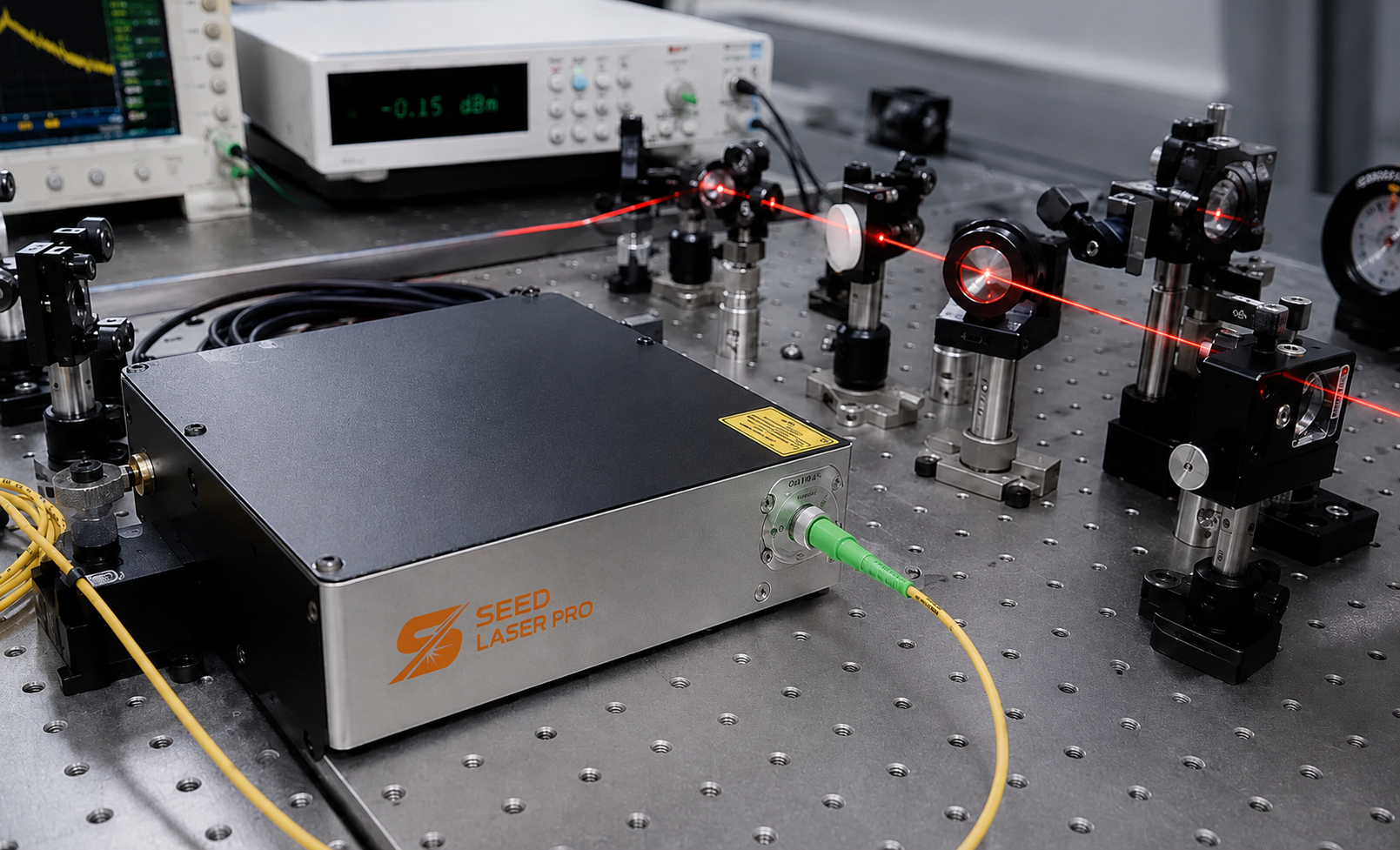
- Laser output hits a fast, low-noise photodetector, converting the optical power fluctuations into an electrical signal.
- That signal goes into an electrical spectrum analyzer, which breaks it down by frequency.
- The analyzer checks how much noise power shows up at each frequency compared to the average detected power. That’s the “relative” bit.
- Everything gets normalized to a 1 Hz measurement bandwidth, which is where dB/Hz comes from.
A few things can mess with a RIN measurement if you’re not paying attention. Detector shot noise, thermal noise in the electronics, and the photodetector’s own bandwidth limits can all creep in and make a laser look noisier, or occasionally cleaner, than it really is. That’s part of why serious labs use dedicated laser noise measurement systems rather than cobbling something together from general test equipment. Your measurement setup’s own noise floor has to sit well below the laser’s real RIN, otherwise you’re just measuring your own gear.
Q&A: Does RIN Really Matter for Your Application?
Q: My system doesn’t touch power measurements directly. Does RIN even affect me?
A: More often than you’d guess. Even in systems built around phase or frequency, intensity noise can creep into the detection chain sideways, through nonlinear effects, amplitude-to-phase conversion in certain components, or just by raising the noise floor under the signal you’re trying to pull out. If photodetection shows up anywhere in your setup, check RIN. Don’t just assume it doesn’t apply.
Q: Is lower RIN always better?
A: Generally yes, a more negative dB/Hz value means less noise. But going after the lowest number on the shelf isn’t really the point. Once RIN drops below whatever’s actually limiting your system, shot noise, thermal noise, or something else entirely, pushing it any lower doesn’t change much. It’s about matching the spec to your actual noise budget, not chasing a number because it looks good on paper.
Q: Does amplifying a seed laser make its RIN worse?
A: It can, and that’s a big reason seed laser RIN gets so much attention in the first place. Amplification stages don’t just boost signal, they add their own noise, and in some cases amplify whatever intensity noise was already sitting there. A noisy seed laser feeding a high-power amplifier chain usually comes out noisier still, which is exactly why a clean seed source matters even though it’s just a small, low-power piece at the front of a much bigger system.
How Low Is Low Enough? A Practical Look
No single RIN number separates “fine” from “not fine.” It comes down to what your application can tolerate and where in the spectrum that noise actually lands. Still, a few rough numbers to keep in mind:
- General-purpose sources and lower-precision sensing: somewhere around -120 to -140 dB/Hz usually works, since other noise sources tend to dominate the system anyway. A magnetometer laser source often lands around here.
- Coherent LiDAR and precision optical sensing: you’re generally looking at -150 dB/Hz or better, especially in whatever frequency band the detection scheme cares about, since intensity noise can eat directly into detection sensitivity and range. Something like a single-frequency fiber laser built for long-range LiDAR, or a high-sensitivity magnetic detection laser for precision sensing.
- High-sensitivity metrology and low-noise amplifier seeding: people are often after RIN at or below -160 dB/Hz here, since whatever noise the seed laser carries gets passed down, and sometimes amplified, by everything downstream. A properly built single-frequency fiber seed laser earns its cost right here.
The honest answer is to work backward from your own noise budget. Figure out how much amplitude noise your detection scheme can absorb before signal-to-noise or measurement precision starts to suffer, then make sure the seed laser’s RIN sits well under that, with room left for whatever noise amplifiers and downstream electronics add on their own.
<a id=”where-rin-bites”></a>
Where RIN Quietly Decides Whether Your System Works
RIN doesn’t announce itself the way a bad linewidth spec does. No obvious glitch, no clean failure to point at. Instead you get a system that just never quite hits the sensitivity or range you expected, or measurement noise that won’t go away no matter what else you clean up. That’s usually when people finally go back and actually read the RIN spec on their seed laser.
Once you get what that number is telling you, and how it was actually measured, it stops being a mystery buried on page three of a datasheet. It’s just another design parameter at that point, budgeted the same way you’d budget for power, wavelength, or linewidth.
Ready to Spec a Laser with RIN You Can Actually Trust?
If you’re picking a seed laser for a system where amplitude noise actually matters, find a supplier that hands you real RIN plots instead of one cherry-picked figure, and one that can walk you through what that plot actually means for your setup. Seed Laser Pro’s single-frequency fiber seed lasers are built and tested with low RIN as a priority, not an afterthought, and our laser noise measurement systems let you check performance directly instead of taking a datasheet on faith. Get in touch with our team to talk through your noise budget and find the right seed source for what you’re building.
Frequently Asked Questions
What does a negative RIN value mean, and is more negative always better?
Yes. RIN is given in decibels, and since it’s a ratio of noise power to signal power, a more negative number means less noise relative to the signal. -150 dB/Hz beats -130 dB/Hz.
Can RIN change depending on how the laser is operated?
Yes. It can shift with output power, temperature, drive current, even where the laser sits relative to threshold. Whatever RIN number is on a datasheet was measured under specific stated conditions, so check whether your setup actually matches those.
Does a narrower linewidth automatically mean lower RIN?
No. Linewidth ties to phase noise, RIN ties to amplitude noise. Different mechanisms are behind each, so a laser can have an extremely narrow linewidth and still not have particularly low RIN. Or the other way around.
How is RIN different from intensity noise caused by vibration or temperature drift?
RIN as a spec is usually the laser’s own intrinsic noise, measured under controlled lab conditions. Once that laser’s out in the real world, vibration, temperature swings, or electrical interference can stack more intensity noise on top, so field performance can end up noisier than the datasheet suggested if those factors aren’t kept in check.
Is it worth paying more for a seed laser with better RIN if I'm not sure I need it?
Depends on whether photodetection is part of your system, and how sensitive your detection scheme is to amplitude noise. If you’re not sure, work through your actual noise budget first, or just ask your laser supplier, rather than assuming you need the lowest RIN on the market since that’s usually priced at a premium.