
Objective
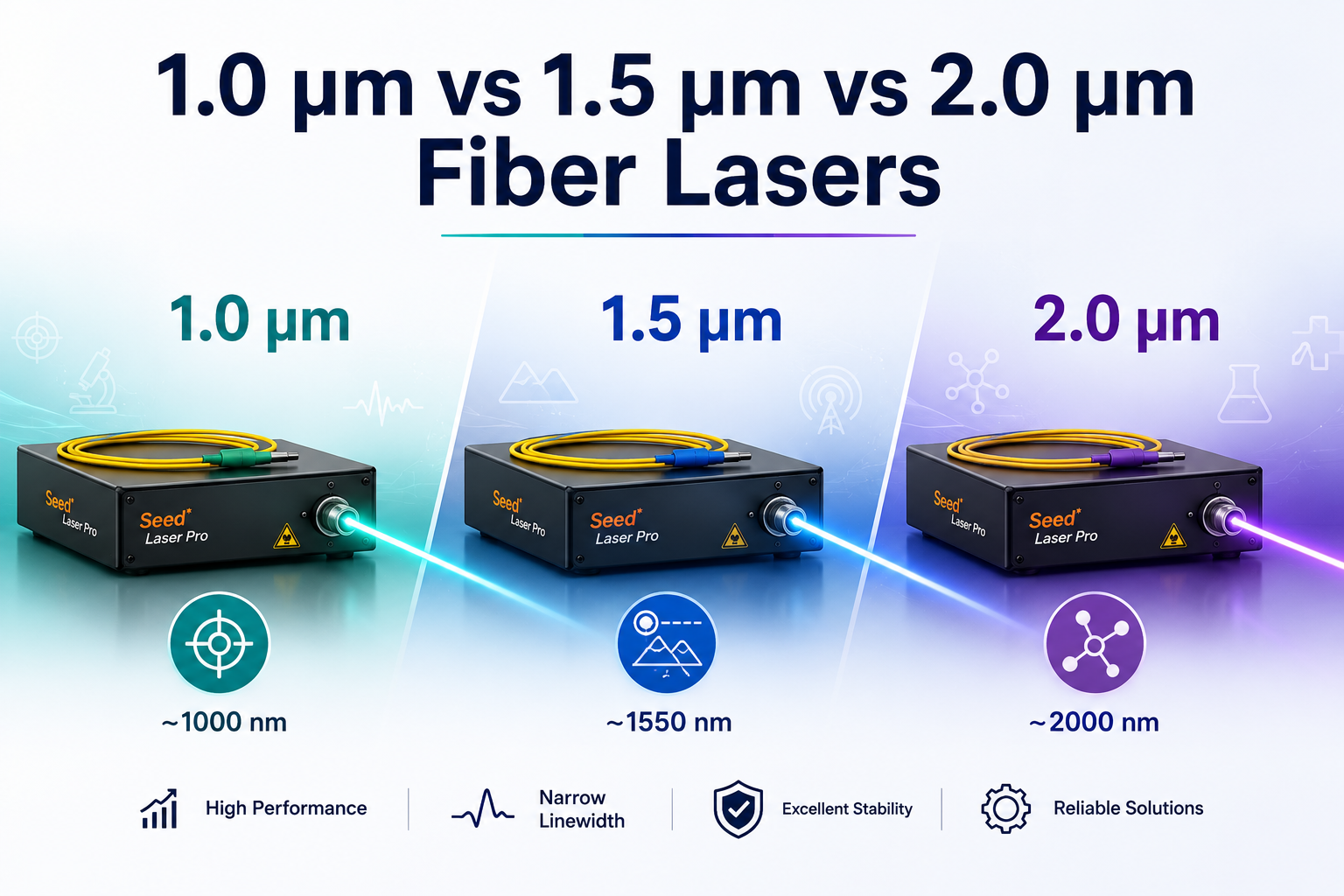
This guide explains the practical differences between 1.0 µm, 1.5 µm and 2.0 µm single-frequency fiber lasers, so you can match a wavelength band to your application rather than choosing on power or price alone. We cover dopant type, eye safety, atmospheric transmission and typical use cases for each band.
Key Takeaways
- Wavelength band, not power alone, is usually the first decision point when specifying a fiber laser for sensing or scientific work.
- 1.0 µm (ytterbium-doped) sits outside the eye-safe region and needs proper laser safety controls, while 1.5 µm and 2.0 µm fall within it.
- 1.5 µm (erbium-doped) benefits from mature telecom-grade components and a strong atmospheric transmission window.
- 2.0 µm (thulium-doped) aligns closely with CO2 and water vapour absorption features, making it a natural fit for gas sensing and DIAL LiDAR.
- Matching your laser to the absorption line of the molecule you’re targeting matters more than defaulting to a familiar band.
Choosing between a 1.0 µm, 1.5 µm and 2.0 µm fiber laser isn’t really about which one is “best”. Each band is built around a different rare-earth dopant, and that dopant decides everything from eye safety classification to which molecules the laser can usefully probe. According to laser safety standards such as IEC 60825, the retinal hazard region runs roughly from 400 nm to 1400 nm, which places 1.0 µm sources inside it while both 1.5 µm and 2.0 µm sit outside, in the eye-safe range. That single fact changes how each band gets deployed in the field. If you’re comparing options, our single frequency fiber seed lasers span all three bands, so think of this article as a practical fiber laser wavelength selection guide for narrowing down which one fits your application.
Why Do You Need a Fiber Laser Wavelength Selection Guide Before You Buy?
Specifying the wrong wavelength band is one of the more expensive mistakes in a sensing or seeding project, since swapping bands later often means swapping the amplifier, fibre and optics too.
What Sets Each Wavelength Band Apart?
- The dopant ion used in the fibre core, ytterbium, erbium or thulium, fixes the emission wavelength range.
- Eye safety classification changes significantly between 1.0 µm and the longer bands.
- Each band sits differently relative to atmospheric transmission windows and molecular absorption lines.
- Component availability varies, with 1.5 µm benefiting most from telecom-industry infrastructure.
1064 nm vs 1550 nm Fiber Laser: What’s the Real Difference?
Eye Safety and the 1.5 µm Advantage
1550 nm sits in the region where the cornea and lens absorb the light before it reaches the retina, which raises the permissible exposure limit considerably compared with 1064 nm. This is why 1.5 µm sources are more common in field-deployed sensing and open-path systems.
Where 1064 nm Still Wins
Typical 1.0 µm Applications
- High-power seed sources for fibre amplifiers and industrial systems
- Frequency-doubling setups, where the mature ytterbium technology base helps
- Reference channels for combustion diagnostics and scientific instrumentation
- Applications run in controlled environments where laser safety measures are already in place
What Is a 2 Micron Thulium Fiber Laser Best Suited For?
Atmospheric Transmission Around 2 µm
The region around 2 µm sits within a genuine atmospheric transmission window, meaning the light travels through open air with comparatively low loss over useful sensing ranges.
Why This Matters for LiDAR and Remote Sensing
This transmission window, combined with a strong carbon dioxide absorption feature near 2.05 µm, is exactly why thulium-based sources turn up so often in CO2 DIAL LiDAR and other remote atmospheric monitoring work. Our 2.0 µm high-power single-frequency lasers are built around this band for that reason.
How Do You Choose Laser Wavelength for Sensing Applications?
Sensing work almost always comes down to matching your laser to where the target molecule actually absorbs light, rather than picking a familiar band by default.
Absorption Characteristics of Key Molecules
Molecule | Notable Absorption Region | Relevant Band |
Water vapour (H2O) | Strong features near 1.4 µm, broadening towards 2 µm | 1.5 µm and 2.0 µm |
Carbon dioxide (CO2) | Distinct line near 2.05 µm | 2.0 µm |
Methane (CH4) | Features around 1.6 to 1.7 µm and near 2 µm | 1.5 µm and 2.0 µm |
Hydrogen cyanide (HCN) | Well-characterised lines near 1.5 µm | 1.5 µm |
Matching Molecule to Band
A Quick Reference
As a general rule, if the molecule you’re targeting has a strong feature inside a given band’s transmission window, that’s your starting point for wavelength selection, before you even look at power or linewidth requirements.
Wavelength Comparison at a Glance
Band | Dopant | Eye Safety | Atmospheric Window | Main Application |
1.0 µm (1064 nm) | Ytterbium (Yb) | Not eye-safe; requires laser safety controls | Good general transmission | High-power seeding, frequency doubling, scientific reference sources |
1.5 µm (1550 nm) | Erbium (Er) | Eye-safe range | Sits in the telecom C-band low-loss window | Coherent LiDAR, free-space links, precision sensing |
2.0 µm (2000 nm) | Thulium (Tm) | Eye-safe range | Strong transmission window near CO2/H2O features | Gas sensing, DIAL LiDAR, atmospheric monitoring |
Choosing Fiber Laser Wavelength Application by Application
A short decision list tends to work better than a single rule of thumb:
- Need high power for seeding or amplification in a controlled setting: consider 1.0 µm.
- Need eye-safe operation with strong component availability: consider 1.5 µm.
- Targeting CO2, methane or water vapour over open-air ranges: consider 2.0 µm.
- Building a combustion diagnostics or spectroscopy setup: match the band to the specific absorption line you need, rather than the band that’s most familiar.
Our 1.0 µm single-frequency seed lasers and 1.5 µm single-frequency seed sources both cover the more common of these scenarios, alongside the 2.0 µm range already mentioned above.
Putting Your Fiber Laser Wavelength Selection Guide Into Practice
Once you know which molecule or application you’re targeting, the choice between 1.0 µm, 1.5 µm and 2.0 µm tends to narrow itself down fairly quickly. Eye safety rules out 1.0 µm for a lot of open-path work, atmospheric absorption rules out bands that don’t match your target gas, and component availability often settles anything left over. If you’re still weighing up which band fits your setup, our team is happy to talk through the specifics before you commit to a configuration.
Frequently Asked Questions
What is the main difference between 1.0 µm, 1.5 µm and 2.0 µm fiber lasers?
The core difference is the dopant, ytterbium, erbium or thulium, which sets the emission wavelength, eye safety classification and which molecular absorption lines the laser can usefully target.
Is a 1550 nm fiber laser always safer than a 1064 nm one?
In terms of eye exposure limits, yes, 1550 nm sits within the eye-safe wavelength region while 1064 nm does not. That said, “eye-safe” refers to permissible exposure limits, not an absence of hazard, so standard laser safety practice still applies.
Why would I choose a 2.0 µm laser over 1.5 µm for gas sensing?
If your target molecule, such as CO2, has a strong absorption feature closer to 2 µm, a thulium-based source will generally give a stronger, cleaner signal than trying to probe the same molecule from a band where its absorption is weaker.
Do I need a full fiber laser wavelength selection guide, or can I just match power output?
Power matters, but it’s a secondary decision. Choosing the wrong wavelength band first often means the laser can’t reach your target absorption line at all, regardless of how much power it delivers.
Can the same fiber laser platform be reconfigured across all three bands?
Not directly. Each band relies on a different doped fibre and associated components, so moving between 1.0 µm, 1.5 µm and 2.0 µm generally means selecting a different product line rather than adjusting a single platform.