
Objective
This guide helps you understand how MOPA fiber lasers work, their differences from traditional fiber lasers, and whether they are a good choice for your manufacturing or marking needs.
Key Takeaways
- Master Oscillator Power Amplifier technology separates pulse creation from power amplification.
- A seeded fiber amplifier chain allows precise control of laser pulses.
- MOPA systems provide better pulse width and frequency control than conventional fiber lasers.
- MOPA vs single oscillator laser designs offer different levels of flexibility.
- A high-power fiber laser MOPA can improve marking quality across a wide range of materials.
Introduction
Have you ever wondered why some laser systems can create crisp black marks on aluminum, detailed QR codes on electronics, and fine engravings on delicate materials while others struggle to produce the same results?
The answer often comes down to one thing: MOPA technology.
According to photonics experts, a Master Oscillator Power Amplifier (MOPA) laser separates pulse generation from power amplification, allowing greater control over laser performance while maintaining beam quality. This design has become a preferred choice for precision industrial marking and engraving applications.
In this guide, we’ll explain how a MOPA fiber laser works in plain English, where it fits into modern manufacturing, and why many industries are moving toward this technology.
Table of Contents
- What Is a MOPA Fiber Laser System?
- Understanding the Master Oscillator Power Amplifier Design
- How the Seeded Fiber Amplifier Chain Works
- Why MOPA Lasers Offer Better Control
- MOPA vs Single Oscillator Laser
- Real-World Applications of High Power Fiber Laser MOPA Systems
- How to Choose the Right System for Your Needs
- FAQs
What Is a MOPA Fiber Laser System?
Let’s start with the basics.
A Master Oscillator Power Amplifier laser consists of two separate sections:
- A master oscillator that creates the initial laser pulse.
- A power amplifier that increases the strength of that pulse.
Instead of generating and amplifying laser power inside a single unit, the work is divided between two specialized stages. This approach gives manufacturers more control over pulse characteristics and final marking results.
What this really means is simple:
You get greater control without sacrificing power.
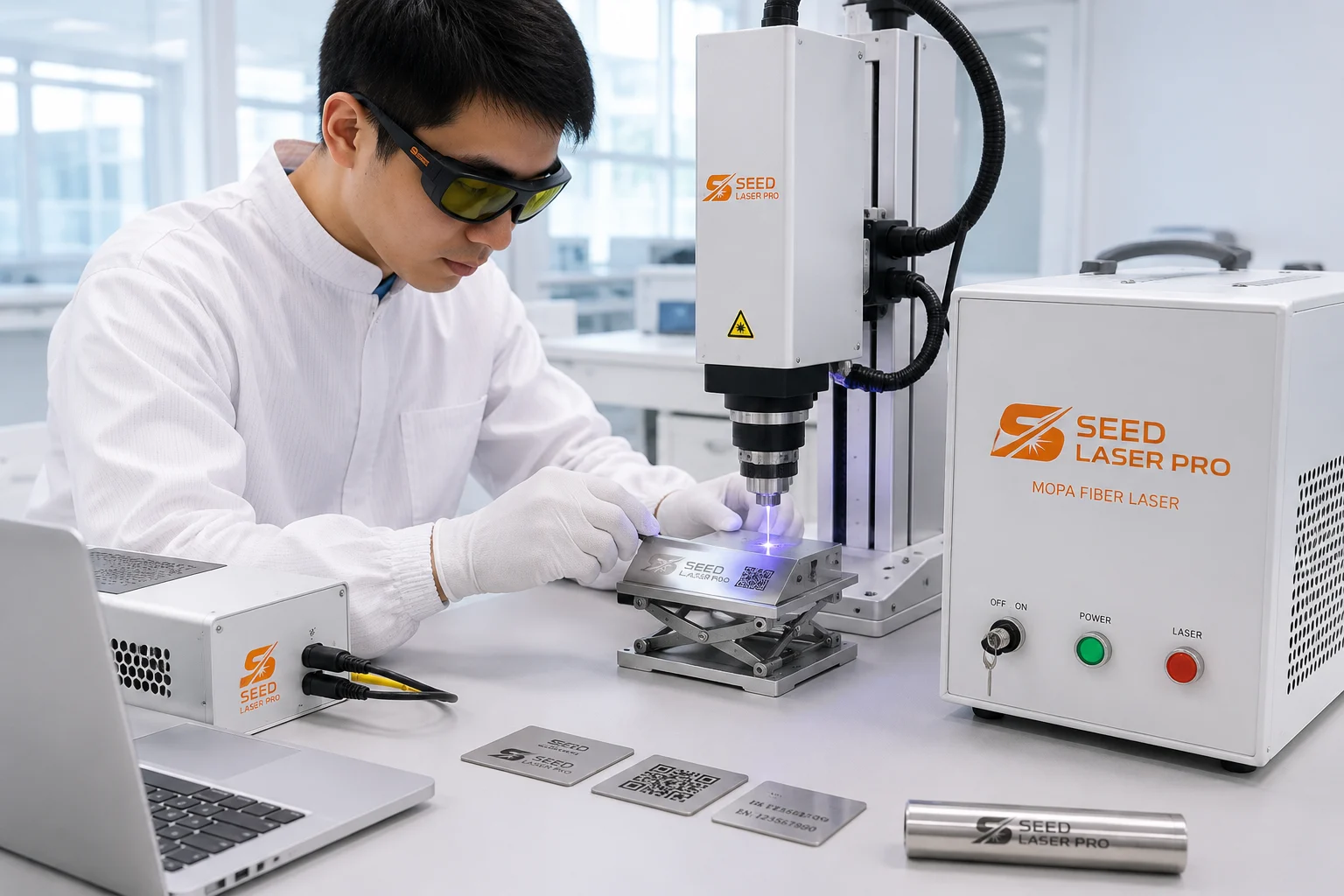
This is why MOPA systems are commonly used for precision engraving, traceability markings, electronics manufacturing, aerospace parts, medical devices, and customized metal products.
Understanding the Master Oscillator Power Amplifier Design
To understand why MOPA technology works so well, let’s look at each stage.
The Master Oscillator
The master oscillator acts as the starting point.
Its job is to create a low-power laser pulse with specific properties such as:
- Wavelength
- Pulse duration
- Frequency
- Beam quality
This stage focuses on accuracy rather than power. Experts often refer to this source as a single-frequency fiber seed laser because it creates the original signal that drives the entire system.
The Power Amplifier
After the pulse is generated, it moves into the amplifier stage.
The amplifier boosts the pulse energy while preserving its original characteristics.
Think of it like a microphone and speaker.
The microphone captures a clear voice. The speaker makes it louder without changing the message.
The same principle applies here.
How the Seeded Fiber Amplifier Chain Works
One term you may hear frequently is the seeded fiber amplifier chain.
It sounds complicated, but the process is straightforward.
Step 1: Create the Seed Pulse
A seed laser generates a stable, low-power pulse.
This pulse contains all the information needed for the final laser output.
Step 2: Amplify the Signal
The pulse enters one or more amplifier stages.
These amplifiers increase power without significantly changing pulse quality. Multiple amplification stages may be used in high-performance systems.
Step 3: Deliver the Working Beam
The amplified beam is directed toward the target material.
At this point, the laser has enough energy for:
- Marking
- Engraving
- Etching
- Surface treatment
- Traceability coding
Why MOPA Lasers Offer Better Control
One of the biggest reasons manufacturers choose MOPA systems is pulse control. Traditional fiber lasers often have limited pulse settings. MOPA systems allow operators to adjust:
| Feature | Benefit |
| Pulse Width | Better control over heat input |
| Pulse Frequency | Improved marking speed |
| Pulse Energy | More flexibility across materials |
| Beam Quality | Consistent results |
This control helps reduce heat buildup and improve marking quality on sensitive materials.
For example: An electronics manufacturer marking tiny circuit board components needs precision without damaging the surrounding material. A MOPA laser can deliver that level of control far more effectively than many traditional systems.
MOPA vs Single Oscillator Laser
This is one of the most common questions buyers ask.
Comparison Table
| Feature | MOPA Laser | Single Oscillator Laser |
| Pulse Control | Excellent | Limited |
| Frequency Adjustment | Wide Range | Narrow Range |
| Material Flexibility | High | Moderate |
| Fine Detail Marking | Excellent | Good |
| Advanced Applications | Strong | Limited |
In a MOPA vs single oscillator laser comparison, the biggest difference is flexibility. A single oscillator system performs both pulse generation and amplification inside one structure. A MOPA system separates these functions, allowing each stage to perform its task more efficiently.
Real-World Applications of High Power Fiber Laser MOPA Technology
Metal Fabrication
Manufacturers use MOPA systems for:
- Part identification
- Batch tracking
- QR code marking
- Deep engraving
Electronics Manufacturing
Circuit boards often contain delicate components.
MOPA lasers provide accurate markings with controlled heat input.
Medical Devices
Medical manufacturers need readable, permanent identification marks.
MOPA systems help create high-contrast markings while maintaining material quality.
Custom Products and Jewelry
Color marking and detailed engraving are areas where MOPA technology performs particularly well. MOPA systems are widely used for color marking on stainless steel and for precise decorative work.
Case Study Example
A production facility that marks aluminum parts switched from a conventional fiber laser to a MOPA-based system.
The result was sharper contrast, reduced heat effects, and improved barcode readability, helping streamline product traceability and quality inspections.
How to Know If a MOPA Laser Is Right for Your Business
Ask yourself these questions:
- Do you work with multiple materials?
- Do you need fine-detail engraving?
- Is heat-sensitive marking important?
- Do you require high-contrast identification marks?
- Are you planning for future production growth?
If you answered yes to several of these questions, a high-power fiber laser MOPA may be worth considering.
Many industrial users choose MOPA systems because they offer flexibility that can support changing production requirements over time.
Better Marks Start With Better Control
The biggest advantage of a MOPA fiber laser system, as explained, is not simply higher power.
It’s control.
By separating pulse generation from amplification, MOPA technology allows manufacturers to produce cleaner marks, work with more materials, and achieve results that are difficult to match with conventional laser systems.
Whether you’re marking electronics, medical devices, industrial parts, or customized products, understanding how the master oscillator power amplifier architecture works helps you make more informed equipment decisions.
Companies such as Seed Laser Pro continue to focus on advanced seed laser and amplifier technologies that help manufacturers achieve greater precision, consistency, and production efficiency.
Ready to Explore Advanced Fiber Laser Technology?
If you’re evaluating laser solutions for your production environment, take time to compare pulse control capabilities, amplifier architecture, and material compatibility rather than focusing only on power ratings. The right system can improve marking quality, reduce production issues, and support long-term manufacturing goals.
FAQs
What does MOPA stand for in laser technology?
MOPA stands for Master Oscillator Power Amplifier. It combines a seed laser with a separate amplifier to increase output power while maintaining pulse quality.
What is a seeded fiber amplifier chain?
A seeded fiber amplifier chain starts with a low-power seed laser and amplifies that signal through one or more amplifier stages while preserving beam characteristics.
How is a MOPA laser different from a standard fiber laser?
MOPA systems offer adjustable pulse width and frequency, giving users more flexibility when marking different materials.
What is a Single-Frequency Fiber Seed Laser?
A single-frequency fiber seed laser is the source that generates a stable, precise laser signal before amplification occurs within an MOPA system.
Which industries benefit most from high-power fiber laser MOPA systems?
Metal fabrication, electronics manufacturing, medical device production, aerospace, and custom engraving businesses commonly use High Power Single Frequency Laser and MOPA technologies for precision marking and processing.