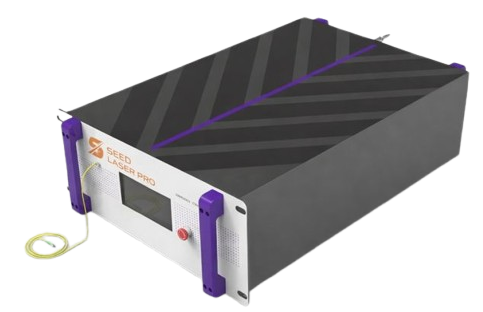
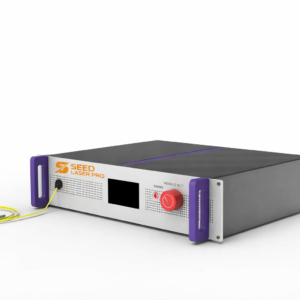
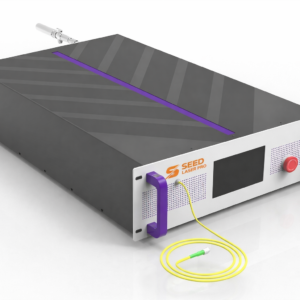
500W at 2 µm Single-Frequency: Why This Exists
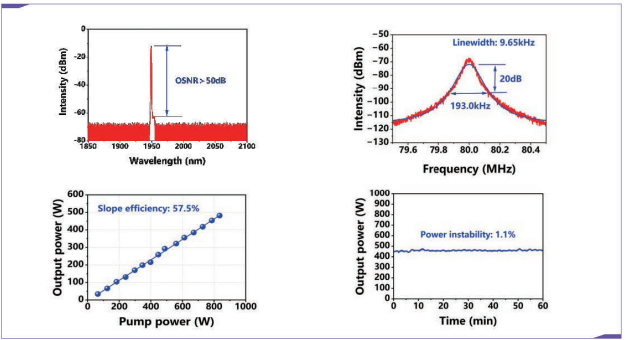
500W CW output in single-frequency operation at 2 µm is not a specification that appears elsewhere in the commercial fiber laser market. The reasons are straightforward. Getting there requires solving SBS, thermal management, and mode quality simultaneously at a wavelength where fewer engineers have deep manufacturing experience than at 1064nm or 1550nm.
Seed Laser Pro’s all-fiber Thulium MOPA architecture addresses each of these. Double-clad fiber pumping distributes thermal load across the fiber length. Large-mode-area fiber in the final amplifier stage raises the SBS threshold by increasing effective mode area. Intelligent control manages pump drive and thermal compensation in real time. The result is 500W at the output with single-longitudinal-mode CW operation maintained throughout.
For the 0.05 to 2W tier, see the 2.0 µm 0.05 to 2W configuration. For the 2 to 20W tier, see the 2.0 µm 2 to 20W configuration.
Application
Industrial Processing and Manufacturing
2 µm laser processing has distinct advantages over 1064nm in specific material categories. Polymer films, plastics, and organic materials absorb more strongly at 2 µm than at 1 µm, enabling cleaner cuts with lower heat-affected zones. Biological tissue processing and medical device manufacturing benefit from the strong water absorption at 1950nm. Eye-safe operation at 2 µm simplifies workplace safety protocols for high-power industrial deployments compared to 1064nm systems requiring more stringent enclosure requirements.
At 500W average CW power, this laser operates in the range used for high-throughput cutting, welding, and surface treatment of these material types. The QBH output connector delivers power through standard high-power fiber delivery cables compatible with industrial laser processing heads.
Long-Range LiDAR and Remote Sensing
Detection range in coherent Doppler LiDAR scales directly with transmit power. At 500W average power, detection ranges for atmospheric aerosol targets extend significantly beyond what lower-power systems achieve. Atmospheric CO2 column measurements using differential absorption LiDAR (DIAL) at 2 µm benefit from high average power to detect weak absorption signals over long atmospheric path lengths.
The single-frequency operation maintains the coherence required for coherent detection while the output power provides the signal-to-noise ratio needed for long-range atmospheric remote sensing. QCS collimator output suits direct coupling into free-space telescope transmitter architectures used in ground-based and airborne LiDAR systems.
Gas Detection and Atmospheric Sensing
CO2 has strong absorption near 2000nm. Water vapor has multiple transitions in the 1940 to 2000nm range. Atmospheric monitoring systems measuring greenhouse gas concentrations, industrial process emissions, and meteorological water vapor profiles all use 2 µm laser sources. At high power levels, these systems achieve detection over longer atmospheric paths with greater sensitivity than low-power sources allow.
Single-frequency operation at sub-30 kHz linewidth resolves individual molecular absorption lines with sufficient spectral precision for quantitative concentration measurements. Tuning within the ±wavelength range available through thermal control of the MOPA seed stage allows the output to be positioned on or adjacent to specific absorption features.
Mid-Infrared OPO Pump Source
OPO systems pumped at 2 µm and targeting output in the 3 to 5 µm molecular fingerprint region require high average pump power to achieve efficient conversion. At 100 to 500W average CW pump power entering an efficient OPO cavity, mid-IR output powers in the tens of watts range become achievable, enabling high-power molecular spectroscopy and standoff detection applications that milliwatt-level mid-IR sources cannot support.
Single-frequency pumping narrows the OPO signal and idler linewidths, enabling high-resolution molecular spectroscopy at the mid-IR output wavelengths.
Intelligent Control System
At 500W CW output, thermal stability and protection are not optional features. Seed Laser Pro’s intelligent control system provides:
- Real-time pump current regulation maintaining constant output power across the 10 to 100% adjustment range
- Thermal monitoring with automatic shutdown on over-temperature conditions
- Back-reflection protection preventing amplifier damage from high reflectivity targets
- Power ramp control preventing transient power spikes during startup and power adjustment
- RS232 or analog interface for integration into industrial control systems
These are the control functions that production deployments require. A 500W laser in an industrial or field environment needs to protect itself and the surrounding system automatically, without operator intervention.
Frequently Asked Question’s
Why is non-PM output used at 500W when lower power tiers offer PM output?
PM fiber has a smaller effective mode area than equivalent non-PM large-mode-area fiber. At 500W average CW power, the power density in PM fiber would exceed safe operating limits and increase the risk of fiber damage and nonlinear degradation. Non-PM large-mode-area fiber maintains single-mode guidance at 500W by providing the larger core diameter needed to keep power density at manageable levels. For applications requiring defined polarization at this power level, external polarization optics after the QBH output can be used.
How does this laser maintain single-frequency operation at 500W?
SBS suppression is the key challenge. The all-fiber MOPA distributes gain across multiple stages with progressively larger mode-area fiber in each stage. Each transition to larger mode-area fiber increases the SBS threshold by reducing peak power density in the fiber core. Combined with linewidth management in the seed and early amplifier stages, this architecture maintains single longitudinal mode CW operation at the output while reaching 500W.
What is the beam quality at 500W and why does it differ from lower power configurations?
M² below 1.4 at 500W compares to M² below 1.1 to 1.2 in the lower power configurations. At very high power in large-mode-area fiber, thermal gradients across the fiber core introduce a weak lensing effect that slightly degrades the ideal Gaussian beam profile. M² below 1.4 still represents near-diffraction-limited beam quality suitable for all stated applications. For extremely tight focusing requirements, the lower power tiers provide better beam quality at the cost of output power.
What industrial laser safety class does this product fall under?
This product is a Class 4 laser system under IEC 60825-1. 500W CW output at any wavelength requires full Class 4 safety precautions including beam path enclosure, interlocked access, appropriate eye and skin protection, and trained operator qualification. The 2 µm eye-safe wavelength designation applies to diffuse exposure scenarios under specific standards, not to direct beam exposure at 500W. Contact Seed Laser Pro for safety documentation relevant to your application.
Is this laser available for export to research institutions outside China?
Yes. Seed Laser Pro supplies industrial-grade and research-grade fiber laser systems to institutions and companies in North America, Europe, Japan, and South Korea. Export compliance is assessed at the inquiry stage based on application, end-user, and delivery country. Contact Seed Laser Pro with your institution, application, and delivery geography for an initial export assessment.