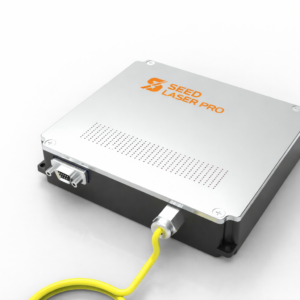
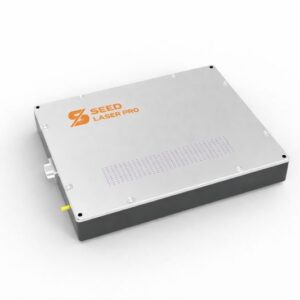
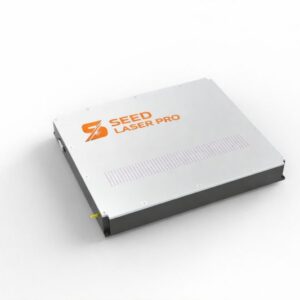
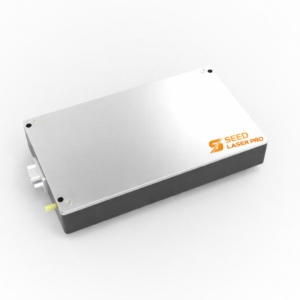
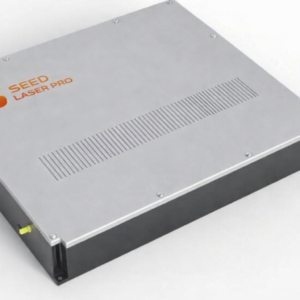
The seed laser determines the coherence quality of your entire system. A single frequency fiber seed laser emits on one longitudinal mode, delivering spectral purity, low phase noise, and long coherence length that multimode sources simply cannot match. Techwin manufactures DFB fiber lasers, PM fiber seed lasers, and ultra-narrow linewidth sources across the 1.0 µm, 1.5 µm, and 2.0 µm bands. Linewidth classes range from standard sub-10 kHz through to Hz-level performance. Both standard catalog products and fully custom seed laser modules are available.
QUICK SPECIFICATION SUMMARY
| Parameter | Range / Options |
| Wavelength | 1.0 µm (Yb) · 1.5 µm (Er) · 2.0 µm (Tm) |
| Linewidth | Sub-10 kHz · Sub-kHz · Hz-level |
| Output | PM (polarization-maintaining) and non-PM |
| Operation Mode | CW single frequency · single longitudinal mode |
| Integration | OEM module · MOPA-compatible · benchtop |
| Applications | Spectroscopy · Quantum sensing · LIDAR · Interferometry · Gravitational wave research |
What Is a Single Frequency Fiber Seed Laser?
A single frequency fiber seed laser, also called a single longitudinal mode laser or DFB fiber laser, operates on a single resonator mode and emits all optical power at one precise wavelength. Unlike multimode lasers that spread energy across a broad spectral band, a single frequency source concentrates output into one narrow coherent line. As a result, you get:
- Extremely narrow linewidth, from sub-10 kHz down to Hz-level depending on cavity design
- Ultra-low phase noise, which is critical for interferometry, spectroscopy, and quantum experiments
- Long coherence length, since a sub-kHz fiber laser achieves coherence lengths measured in hundreds of kilometers
- Stable output power with low relative intensity noise (RIN) across the operating range
In MOPA (Master Oscillator Power Amplifier) architectures, the seed laser serves as the master oscillator and sets the spectral quality ceiling. A PM fiber amplifier downstream can boost power, but it cannot recover coherence lost at the seed stage. This is precisely why selecting the right single frequency seed laser matters before any other component decision.
Available Wavelengths and Linewidth Classes
Techwin’s single frequency fiber seed laser range covers three gain bands, and each one targets a specific set of applications.
1.0 µm: Ytterbium (Yb) Band Techwin uses this band in coherent LIDAR, industrial sensing, and as seed sources for high-power Yb fiber amplifiers. It is also available in frequency-stabilized configurations for optical frequency standard applications.
1.5 µm: Erbium (Er) Band This is the most widely used band in fiber sensing, telecommunications-grade coherent systems, and interferometry. Its strong overlap with acetylene and CO2 absorption features makes it the standard choice for TDLAS combustion diagnostics. It is also available with Hz-level linewidth for gravitational wave research.
2.0 µm: Thulium (Tm) Band Techwin applies this band to molecular spectroscopy, medical sensing, and CO2 laser seeding. It covers strong absorption features of water vapor and carbon dioxide, and it is available in narrow linewidth fiber laser configurations with PM output.
Linewidth Grade Summary:
| Grade | Linewidth | Typical Applications |
| Standard | Less than 10 kHz | Fiber sensing, coherent ranging, general spectroscopy |
| High stability | Sub-kHz | TDLAS, precision interferometry, cavity-enhanced spectroscopy |
| Ultra-narrow | Hz-level | Gravitational wave detection, optical clocks, cold atom physics |
All linewidth grades support polarization-maintaining (PM) output and work with downstream fiber amplifier and frequency conversion stages.
How to Choose the Right Single Frequency Seed Laser
Choosing the right fiber seed source comes down to three primary factors. Use this as a starting point.
What linewidth do you need?
- General sensing or ranging: sub-10 kHz is sufficient
- High-resolution spectroscopy or TDLAS: sub-kHz fiber laser required
- Quantum physics, atomic clocks, or gravitational wave systems: Hz-level linewidth laser essential
What wavelength does your application require?
- Rubidium or cesium cooling experiments: 780 nm or 852 nm (via frequency conversion from 1560 nm / 1704 nm seed)
- Methane or CO spectroscopy: 1.55 µm or 2.0 µm
- High-power MOPA seeding: 1064 nm (Yb band) or 1550 nm (Er band)
- Interferometry or fiber gyroscope: 1550 nm standard
Do you need PM output?
Polarization-maintaining output is required when the downstream system, whether an amplifier, modulator, or sensing coil, is polarization-sensitive. Most precision scientific and sensing applications rely on PM fiber seed lasers. However, non-PM options are available where engineers manage polarization externally.
If you are still defining your specification, contact Techwin’s engineering team. In most cases, requirements become clearer faster through direct conversation than through catalog browsing.
Applications
Engineers and researchers select single frequency fiber seed lasers when spectral purity is a hard requirement, not a preference. Here are the core application areas.
Gravitational Wave Detection LIGO-class interferometers require a gravitational wave detection laser with Hz-level frequency stability sustained across extended measurement windows. Techwin’s ultra-narrow linewidth sources meet these specifications with phase noise performance designed specifically for kilometer-scale interferometric systems.
Cold Atom Physics and Quantum Sensing Laser cooling and magneto-optical trapping require precise resonance with atomic transitions in rubidium, cesium, strontium, or ytterbium. A cold atom physics laser must combine narrow linewidth with stable center frequency and fast modulation capability for Zeeman slowing and molasses cooling stages. Techwin’s frequency-stabilized fiber lasers cover these requirements across the relevant wavelength bands.
Combustion Diagnostics and Spectroscopy TDLAS-based combustion diagnostics laser systems resolve molecular absorption features in gases at high temperature and pressure. A narrow linewidth fiber laser with clean wavelength tunability, achievable through piezo or thermal tuning, is the standard approach for this work. Techwin’s 1.55 µm and 2.0 µm seed lasers are designed with this use case in mind.
Coherent LIDAR and Sensing Long-range coherent LIDAR systems require a CW single frequency laser with low phase noise, high coherence length, and the ability to seed high-power fiber amplifiers without linewidth broadening. Techwin’s 1.0 µm and 1.55 µm seed lasers are qualified for these demanding low phase noise laser applications.
Interferometry and Metrology From fiber optic gyroscopes to surface profiling interferometers, CW single frequency operation with long coherence length is the baseline requirement. Techwin’s single longitudinal mode lasers provide the spectral stability and output power needed for both laboratory and industrial metrology environments.
Custom Seed Laser Modules
Standard products cover the majority of applications. When they do not, Techwin’s custom seed laser module program handles the rest.
Available custom configurations include:
- Non-standard center wavelengths within Yb, Er, and Tm gain bands
- OEM-optimized compact footprints for instrument integration
- Combined seed-and-amplifier modules with single fiber output
- Specific linewidth grades, modulation bandwidth, or connector requirements
- Frequency-converted fiber laser outputs at visible and near-UV wavelengths
Techwin tests custom modules to the same performance standards as catalog products. Lead times and minimum quantities depend on configuration, so contact the Techwin team early in your design cycle for best results.
Why Techwin
Techwin has manufactured single frequency fiber seed lasers for over 20 years. Every shipped unit undergoes testing against its linewidth, phase noise, polarization extinction ratio, and output power specifications. Techwin tests every unit individually, not by sampling.
The product range covers standard and custom configurations, from robust fiber laser modules built for 24/7 industrial deployment to ultra-narrow linewidth sources designed for the most demanding research environments. Techwin supports customers through global supply, direct engineering access, and a proven track record across research institutions and photonics OEMs worldwide.