Why 1064 nm Is the Primary Seed Laser Wavelength
1064 nm sits at the peak emission cross-section of Ytterbium-doped silica fiber. Ytterbium offers the highest gain efficiency of any rare-earth dopant used in fiber lasers, which is why 1 µm is the preferred wavelength for high-power fiber laser systems. A kilowatt-class fiber laser is easier to build at 1064 nm than at any other wavelength.
That efficiency advantage cascades through the entire system architecture. Pump-to-signal conversion efficiency is higher, which means less heat to manage. Amplifier gain per unit length is higher, which means shorter gain fibers and more compact systems. Stimulated Brillouin scattering (SBS) threshold is higher at 1064 nm compared to 1550 nm for a given fiber geometry, which allows higher single-mode power delivery.
For seed lasers specifically, the 1064 nm wavelength benefits from the most mature fiber component ecosystem outside the telecom C-band. PM980 fiber, PM fiber couplers, isolators, Faraday rotators, AOMs, and electro-optic modulators are all widely available and well-characterized at 1064 nm, which simplifies system integration and reduces component cost.
Specialty Fiber Resonator: What It Changes
Most single-frequency fiber seed lasers are built on standard single-mode fiber with moderate rare-earth doping. A centimeter-scale resonator on standard fiber requires very high reflectivity Bragg gratings to achieve sufficient round-trip gain in a short cavity.
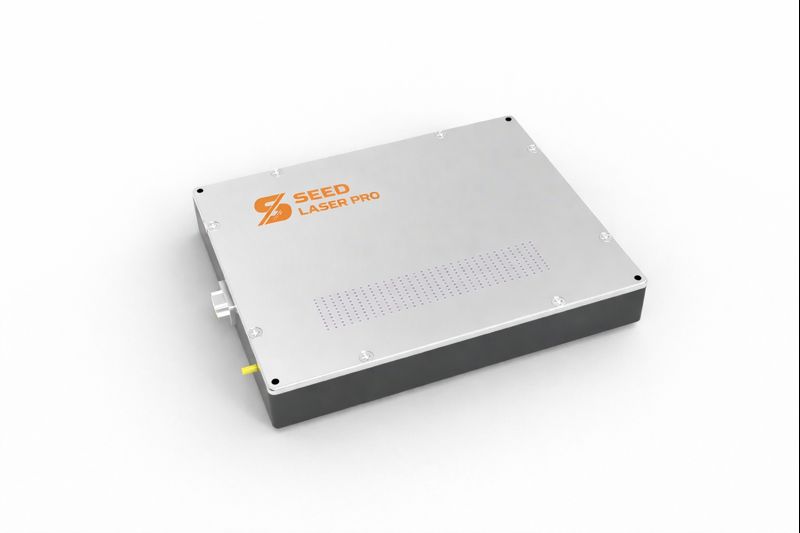
Techwin’s 1064 nm seed laser uses highly doped specialty fiber as the gain medium. Higher doping concentration means more gain per unit length, which allows a shorter cavity at the same output power level. A shorter cavity has fewer longitudinal modes within the gain bandwidth, which makes single-mode selection easier and more robust. It also raises the mode spacing, the frequency gap between adjacent longitudinal modes, making mode hops rarer and easier to suppress.
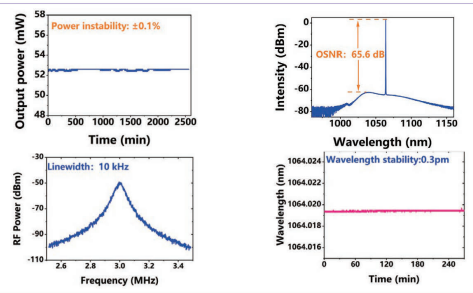
The practical result is what the specification table confirms: single longitudinal mode operation with no mode hopping, no burst noise, and a 60 dB side-mode suppression ratio that reflects genuinely clean single-mode output rather than a marginally suppressed competing mode.
Industrial Robustness vs Laboratory Performance
Premium single-frequency fiber lasers are qualified against mechanical shock, vibration, temperature cycling, powered damp heat, and high-temperature operation to confirm robustness in industrial environments. That qualification standard is what separates a laser that performs in a laboratory from one that performs in a deployed instrument.
Techwin’s industrial design for this seed laser integrates temperature-control protection and vibration-resistant construction into the resonator itself. This is not an external housing. It is built into the cavity design. The operating temperature range of -10 to 45°C and storage to -40°C reflect the actual environmental conditions of deployed field instruments, not just laboratory benches.
For buyers building LiDAR systems for automotive or airborne deployment, DAS instruments for oil and gas pipeline monitoring, or coherent sensing systems for structural health monitoring, this distinction matters. A seed laser that holds its operating specification across that temperature range and under vibration eliminates one of the most common field reliability problems in fiber sensing system design.
Using This Laser as the Seed in a 1064 nm MOPA
In a MOPA architecture, this laser defines the spectral quality of the entire system. Its sub-30 kHz linewidth, mode-hop-free operation, and low burst noise set the performance ceiling that downstream amplifier stages work within. The PM980 fiber output connects directly to Ytterbium-doped PM fiber amplifier input stages.
Techwin’s high power single frequency fiber lasers in the 1.0 µm range cover the amplifier stages from 0.2 W through 500 W output. The seed and amplifier share a common fiber output interface standard, simplifying integration.
For applications requiring lower intensity noise than this seed provides, Techwin’s broadband ultra-low-noise single-frequency fiber laser at 1064 nm offers RIN below -160 dB/Hz at 10 MHz with DBR architecture for the most demanding coherent sensing and interferometry use cases.
For linewidth verification of this seed laser in your system, the Laser Linewidth Measurement System covers the 1 µm wavelength band with DSHI-based measurement down to 2 kHz.
FAQ SECTION
What is a 1064nm single frequency seed laser?
A 1064nm single frequency seed laser is a low-power, single longitudinal mode CW laser operating in the Ytterbium gain band at 1064 nm, designed for use as the master oscillator in a MOPA fiber laser system. It sets the wavelength, linewidth, and spectral quality of the entire amplified system. This product uses a centimeter-scale highly doped specialty fiber resonator to achieve sub-30 kHz linewidth and mode-hop-free operation in an industrial-grade PM980 fiber-coupled module.
What does mode-hop-free mean and why does it matter?
Mode-hop-free operation means the laser maintains continuous, uninterrupted single-mode output without jumping between longitudinal modes as temperature or operating conditions vary within the specified range. A mode hop causes a sudden, large frequency jump, typically tens to hundreds of megahertz, that disrupts coherent detection, breaks interferometric lock, and injects a large transient into any downstream amplifier chain. For seed lasers used in coherent sensing, LiDAR, and MOPA systems, mode-hop-free operation is a basic operational requirement.
What is burst noise and why is eliminating it important?
Burst noise is the occasional large intensity spike that occurs in some single-frequency lasers during transient mode competition between adjacent longitudinal modes. It appears as an irregular, infrequent pulse on top of the normal output power. In coherent sensing systems, burst noise events register as false signal detections. In MOPA systems, they inject high-peak-power transients that can damage downstream fiber components. Techwin’s compact specialty fiber resonator design eliminates the mode competition that causes burst noise, producing clean single-mode output throughout continuous operation.
What is the wavelength tuning range and how is it used?
The thermal tuning range of up to 0.6 nm allows the laser center wavelength to be set anywhere within the 980 to 1120 nm Ytterbium gain band by adjusting the resonator temperature. This is used to set the exact operating wavelength within the gain bandwidth, to tune the seed wavelength to match the peak gain of a downstream amplifier, or to position the output at a specific spectral feature in sensing applications.
How does this seed laser compare to the ultra-low-noise 1064nm version?
Both operate at 1064 nm with single longitudinal mode CW output and PM980 fiber. This industrial seed laser targets sub-30 kHz linewidth and RIN below -130 dBc/Hz at 5 MHz, suitable for most coherent LiDAR, DAS, gravitational wave research, and coherent communication applications. The broadband ultra-low-noise version targets 1 kHz linewidth and RIN below -160 dB/Hz using a DBR architecture with multidimensional active noise suppression, for applications where the laser noise floor is the primary system limit.