| Technical Parameter | Unit | Specification | ||
|---|---|---|---|---|
| Min | Typical | Max | ||
| Wavelength Range | nm | 980-1120 | ||
| Laser Mode | / | Single Longitudinal Mode, Continuous Wave | ||
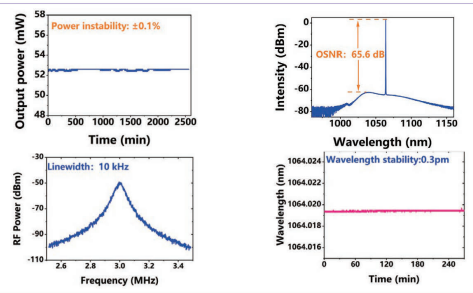
| Output Power | mW | 50 | ||
| Linewidth | kHz | 30 | ||
| Optical Signal-to-Noise Ratio | dB | 60 | ||
| Relative Intensity Noise (5M) | dBc/Hz | -130 | ||
| Output Power Stability | % | RMS <0.2 / P-P <1 | ||
| Output Power Adjustment | % | 10-100 | ||
| Wavelength Thermal Tuning Range | nm | 0.6 | ||
| Polarization Type | / | Linear Polarization | ||
| Polarization Extinction Ratio | dB | 20 | ||
| Beam Quality | M² | M² <1.05 | ||
| Operating Voltage | VDC | 12 or other | ||
| Power Consumption | W | 8 | ||
| Operating Temperature | ℃ | -10 | 45 | |
| Storage Temperature | ℃ | -40 | 70 | |
| Output Fiber Type | / | PM980 | ||
| Output Fiber Length | m | 0.6, customizable | ||
| Output Fiber Connector | / | FC/APC, other options available | ||
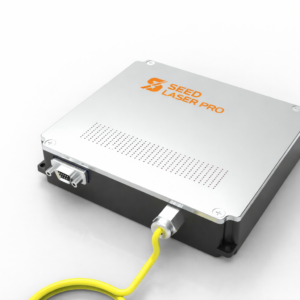
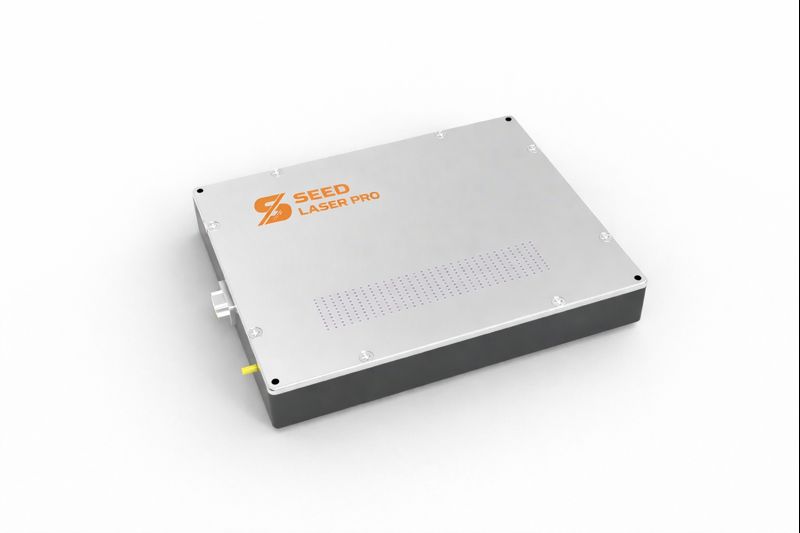
| Dimensions | mm | 175 (L) × 140 (W) × 25 (H) | ||
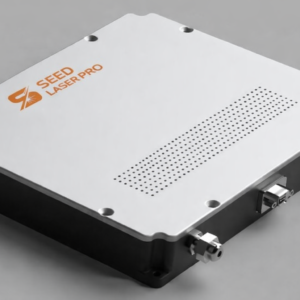
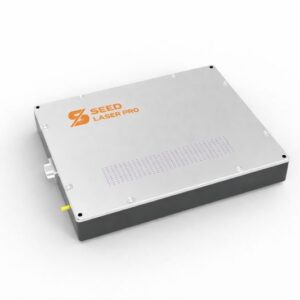
The 1.5 μm hundred-hertz ultra-narrow linewidth fiber laser is a laser with completely independent intellectual property rights and performance reaching an internationally advanced level. It adopts a special resonant cavity structure design and combines noise suppression and linewidth-narrowing technologies to achieve ultra-narrow linewidth laser output as low as the hundred-hertz level.
Product Features
Ultra-Narrow Linewidth
Low Intensity Noise
High Environmental Adaptability
Typical Applications
High-Precision Fiber Sensing
Quantum Computing
Quantum Precision Measurement